
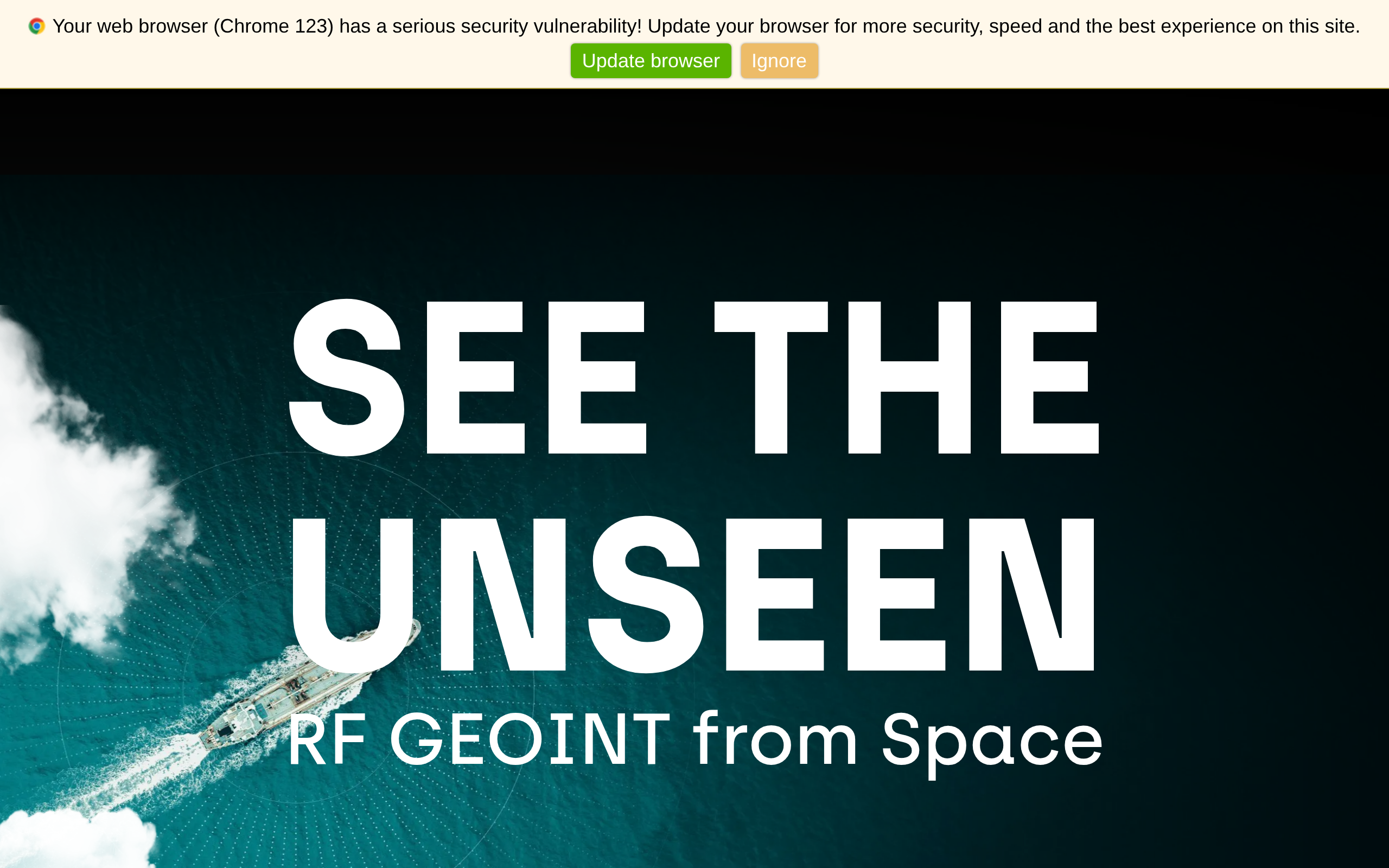
 Unseenlabs is a French operator running RF geolocation for maritime awareness.
Yes, legitimate: privately held with €112.5M in total funding.
This review covers detection capability, pricing and the fit for maritime work.
Table of Contents
Key Takeaways
- Unseenlabs is the specialist for buyers who need space-based RF detection of dark vessels independent of AIS
- Its standout edge is a pure-play passive RF geolocation constellation: 300,000 km² per pass, 24/7, ITAR-free
- The key caveat: Unseenlabs is RF-only with no optical or SAR imagery and pricing requires direct engagement
About Unseenlabs
RF geolocation is the one modality where I would not judge a provider on resolution at all. What decides it is revisit over the water you care about, and my reading of this fleet is that coverage cadence, not sensitivity, is the number to negotiate.
Unseenlabs operates the BRO (Blue Ring Observation) constellation, a growing fleet of LEO RF monosatellites designed specifically to intercept electromagnetic signals from shipborne devices and geolocate vessels that have disabled or are spoofing their AIS transponders. The key facts below are drawn from Unseenlabs’ own published pages as of June 2026.
| Name | Unseenlabs |
|---|---|
| Website | unseenlabs.com |
| Legal name | UNSEENLABS |
| Address | 15 rue Claude Chappe, 35510 Cesson-Sévigné, Bretagne, France |
| Founded | 2015 |
| Ownership | Private (SAS), total funding €112.5M across three rounds |
| Leadership | Clément Galic (CEO and Co-founder); Jonathan Galic (Director of Publication, SIGINT expert, Co-founder); Benjamin Galic (Business attorney, Co-founder) |
| Employees | 130+ globally |
| Products & data | Space-based RF geolocation (BRO constellation); area-of-interest monitoring; intelligence reports; data visualisation portal; urgent request service; technical training |
| Pricing | Quote-based; no public rates; contact or demo booking required |
| Languages | English, French |
Unseenlabs describes BRO as a “monosatellite” constellation: each unit is an independent RF-detection payload capable of intercepting signals across roughly 300,000 km² in a single collection pass. As of May 2026, the company has launched 21 satellites (BRO-1 through BRO-21), with BRO-21 reaching orbit on 3 May 2026. The site states a cadence of three to six new satellites per year, making this a rapidly expanding constellation.
Is Unseenlabs legit?
In my analysis, Unseenlabs is a credible and operationally active company. Founded in 2015 by three brothers with a SIGINT and legal background, it has grown from a single prototype satellite in 2019 to 21 launched satellites in seven years, with a verifiable launch record on its own site and €112.5M in confirmed funding backing the program.
Ownership and funding
Unseenlabs is a French société par actions simplifiée (SAS), registered in Rennes (RCS 811 856 376) and based in Cesson-Sévigné, Brittany. The company has completed three funding rounds: €7M in 2018, €20M in 2021, and a record €85M in February 2024, with the total of €112.5M stated directly on the company’s own site.
The investor base spans commercial venture capital (360 Capital, OMNES Capital, S2G Ventures) and French public-sector backers including Bpifrance, Fonds Innovation Défense (FID), and Bpifrance Definvest, a composition that reflects meaningful engagement from France’s defense innovation ecosystem. Supernova Invest and ISALT via the Strategic Transition Fund led the 2024 round alongside returning investors.
Track record and credentials
The BRO constellation launched its first satellite in August 2019 via Rocket Lab Electron, and the company has since executed 16 distinct launch campaigns using SpaceX Falcon 9 rideshare (Transporter series), Rocket Lab Electron, and Arianespace Vega. Unseenlabs has launched 21 BRO satellites as of May 2026; as with any constellation of this age, some early-generation units have reached end of life, while the company sustains coverage through three to six new satellites per year.
Unseenlabs holds ISO 9001 certification and is a UN Global Compact signatory. The company has an ESA Business Incubation Centre (ESA BIC Nord-France) relationship, reflected in a public partner logo on its company page. A Singapore office opened in February 2025, signalling expansion into the Asia-Pacific maritime market where SEACAT-aligned government customers operate.
Compliance and data rights
Unseenlabs publishes an explicit ITAR-free statement for its RF data products, making the constellation commercially accessible beyond the US government supply chain and available to maritime security stakeholders, commercial insurers, and NGOs without the licensing overhead that ITAR-controlled imagery systems impose.
The company markets primarily to government and civil security buyers but also to commercial operators including insurers, shipowners, and NGOs focused on ocean conservation. Data is delivered as standard GIS-compatible files, described as lightweight (under 1 MB per collection file), requiring no proprietary processing software on the buyer’s side.
Data and capabilities
Unseenlabs is a pure-play RF geolocation operator. It does not produce optical imagery or SAR data: the entire constellation is built around passive interception of electromagnetic signals emitted by shipborne navigation and communication devices, processed into geolocation outputs rather than visual scenes.
RF detection and geolocation
Each BRO monosatellite performs multiband RF data collection in a single pass, intercepting signals from shipborne devices across a coverage area of approximately 300,000 km² per collection. The site states kilometer-level geolocation accuracy, and outputs include geolocation coordinates, timestamps, and RF technical parameters for each detected emitter.
The core operational value is dark-vessel detection: ships that disable their AIS transponder, manipulate position data, or operate entirely without AIS remain detectable by RF emissions from their navigation and communication equipment. This capability operates 24/7, in all weather, day and night, since passive RF interception has no dependency on solar illumination or cloud conditions.
Specific RF frequency bands intercepted are not disclosed on the site. The technology is described as multiband with no further band specification published. Revisit frequency is described as coverage of the same area “multiple times a day,” though a specific sub-hour figure is not confirmed in published materials.
Constellation and launch cadence
BRO-1 launched in August 2019 and BRO-21 reached orbit on 3 May 2026, representing consistent expansion over seven years. The constellation uses a non-sequential numbering convention in some batches: for example, BRO-17 and BRO-20 launched together on Transporter-15 in November 2025, while BRO-18 and BRO-19 flew on separate earlier and later missions, so the launch sequencing is best read from the published date record rather than the satellite number alone.
The company states a target of three to six new satellites per year. Launch vehicles have included SpaceX Falcon 9 rideshare (the predominant choice), Rocket Lab Electron, and Arianespace Vega, a diverse launch base that reduces single-vehicle dependency for a constellation of this scale.
Products and delivery
The core product is area-of-interest RF data collection: the buyer specifies a geographic area and the number of daily revisits, and Unseenlabs delivers standard RF data files via what the company describes as an API-compatible data pipeline. Optional services layered on top include custom intelligence reports for deeper analytical work, technical training, a data visualisation portal, and an urgent-request service for time-critical tasking.
The data files are described as GIS-compatible and lightweight, designed to integrate with standard maritime domain awareness platforms rather than requiring a proprietary analytical environment. A distribution partnership with Ursa Space and a Japan-market agreement with Marubeni Corporation are both disclosed on Unseenlabs’ site as active commercial relationships.
Pricing
Unseenlabs does not publish pricing. The company’s solutions page describes a model where customers specify their area of interest and required revisit frequency, with quotes provided through a direct contact or demo booking process. No per-area, per-satellite-pass, or subscription rates are listed publicly.
| Product | Model | Published rate | Notes |
|---|---|---|---|
| RF data collection (area-of-interest) | Quote-based | Not published | Buyer specifies area + daily revisit count. Unseenlabs prices accordingly |
| Intelligence reports | Quote-based | Not published | Custom analytical layer on top of raw RF data |
| Data visualisation portal | Quote-based | Not published | Custom solution option, not a standard self-serve web app |
| Technical training | Quote-based | Not published | Available as an add-on service |
| Urgent request service | Quote-based | Not published | Time-critical tasking at accelerated priority |
There is no self-serve ordering route and no published free tier or trial. Buyers approaching Unseenlabs should expect an enterprise procurement process involving demo booking, requirements scoping, and a formal quotation cycle before data access is established. The contact form and demo booking option at unseenlabs.com/en/contact/ are the two documented entry points.
Given the customer base spans coast guards, civil government agencies, maritime insurers, and commercial fleet operators, the quote-based model is consistent with B2B contract and invoice billing rather than credit-card self-serve. Buyers with strict budget-approval timelines should factor in the engagement lead time.
Who it’s for
Unseenlabs’ RF geolocation capability addresses a narrow but operationally critical gap: detecting vessels that are invisible to AIS-based systems. The strongest buyer fits cluster around workflows where vessel behavior, not visual imagery, is the primary intelligence requirement.
Government and maritime security
Coast guards, naval authorities, and civil maritime agencies responsible for EEZ sovereignty monitoring and IUU fishing enforcement are the most direct fit. The constellation covers the same area multiple times per day without being affected by cloud cover, darkness, or AIS manipulation, making it well-suited to persistent patrol of large exclusive economic zones where conventional aerial surveillance is cost-prohibitive at scale.
The SEACAT exercise community, which includes Singapore, Indonesia, Philippines, Thailand, Brunei, Vietnam, Malaysia, India, Sri Lanka, Maldives, Australia, New Zealand, France, the United Kingdom, and the United States, is referenced on Unseenlabs’ government page as an aligned stakeholder community, pointing to a focus on Indo-Pacific and allied-nation maritime security customers.
Maritime insurance and commercial intelligence
For hull and cargo insurers, the ability to track vessel movements independent of declared AIS positions supports risk assessment for high-value transits, sanctions compliance screening, and detection of ships engaging in ship-to-ship transfers in open ocean, where RF behavioral data complements optical imagery for insurers who need movement records without relying on the vessel’s own reporting.
Commercial trade intelligence teams tracking port congestion, commodity flows, and fleet positioning can use RF detection to fill gaps where vessels are AIS-dark or in regions with poor terrestrial AIS coverage, a persistent limitation in open-ocean and high-seas trade corridor monitoring.
NGOs and environmental monitoring
Ocean conservation organizations focused on illegal fishing, ocean dumping, and maritime pollution have access to ITAR-free data, which means Unseenlabs’ products are available without the government-procurement overhead typically associated with defense-origin EO data. This makes RF dark-vessel monitoring accessible for fisheries NGOs operating in regions where IUU fishing is a primary concern.
Where it’s less competitive
Unseenlabs is not the right choice for buyers whose primary need is visual imagery, vessel identification from optical or SAR scenes, or any workflow requiring pixel-level inspection of a target. Because RF geolocation outputs are coordinate and timestamp data, not images, buyers who need to confirm vessel type, read hull markings, or assess cargo configuration will require a separate optical or SAR provider alongside Unseenlabs.
The absence of published pricing and a self-serve access route also makes Unseenlabs less competitive for small teams, academic researchers, or NGOs with limited procurement bandwidth who need fast data access without a sales cycle.
Strengths and limitations
Unseenlabs’ differentiation is built on a genuinely distinctive capability: the only commercial pure-play space-based RF geolocation constellation focused on maritime intelligence. The strengths concentrate in detection independence, operational geometry, and data accessibility:
- Pure-play passive RF geolocation: detects vessels regardless of AIS status, operating 24/7 in all weather, with no dependency on solar illumination or vessel cooperation
- 21 BRO monosatellites launched as of May 2026, each covering approximately 300,000 km² per pass, with multiple daily revisits over areas of interest and three to six new satellites added per year
- ITAR-free data products commercially accessible to non-government buyers including insurers, NGOs, and commercial fleet operators without US export-control overhead
- Lightweight GIS-compatible output files (under 1 MB per collection) that integrate with standard maritime domain awareness platforms, reducing the technical barrier to deployment
- French ISO 9001-certified operator with €112.5M in confirmed funding, defense-ecosystem investors, and a clean seven-year launch record across SpaceX, Rocket Lab, and Arianespace vehicles
The limitations are equally important to weigh against your specific intelligence requirements before committing to an engagement:
- RF-only: no optical imagery, SAR, or AIS data product. Buyers needing vessel identification, cargo assessment, or visual scene analysis require a separate provider
- Geolocation accuracy is stated as kilometer-level, which is sufficient for maritime tracking and dark-vessel detection but not for precise positioning or port-level traffic mapping
- No published pricing, no self-serve access, and no free trial. Every engagement requires a direct sales cycle, which increases evaluation friction and time-to-data for new buyers
- Specific RF frequency bands intercepted are not publicly disclosed, limiting independent technical assessment of detection coverage against specific device types
- The constellation count is growing rapidly (three to six satellites per year) so revisit and coverage specifications published today may be outdated within months. Primary sources are the most reliable current reference
The structural tension for buyers is between the uniqueness of the RF dark-vessel capability and the opacity of the commercial model. For maritime domain awareness teams where AIS-independent detection is the core requirement, no comparable pure-play commercial constellation exists at this scale. For teams evaluating on self-serve access or published pricing, Unseenlabs requires a longer evaluation runway than most alternatives.
Unseenlabs alternatives
If RF-only geolocation does not fully cover your maritime intelligence requirement, or if you want to compare Unseenlabs against operators with overlapping but distinct detection approaches, three providers offer meaningfully different capability profiles in the RF and maritime intelligence space. The table below draws on verified specifications from primary sources for each provider.
| Provider | Detection method | Constellation | Coverage / revisit | Key differentiator |
|---|---|---|---|---|
| Unseenlabs | Passive RF geolocation (pure-play) | 21 BRO monosatellites (LEO) | ~300,000 km²/pass, multiple times per day | Pure-play maritime RF dark-vessel detection, ITAR-free, kilometer-accuracy geolocation |
| HawkEye 360 | RF geolocation (cluster formation) | Multi-satellite clusters (LEO) | Global RF detection with cluster-based geolocation | Formation-flying cluster architecture enabling precise RF source geolocation with broad spectrum coverage |
| Spire Global | RF / AIS maritime data (multi-sensor) | 100+ satellite LEMUR constellation (LEO) | Global AIS and RF-based vessel monitoring at constellation scale | Large multi-sensor constellation spanning AIS, RF, and weather data, broad maritime domain awareness rather than precise emitter geolocation |
| Horizon Technologies | COMINT / VHF-UHF maritime signals | Small satellite payloads (LEO) | Targeted maritime communications interception | Focuses on maritime COMINT (voice/data communications interception) alongside vessel tracking |
HawkEye 360 operates RF-geolocation satellite clusters using formation flying, which enables geometric triangulation of RF emitters and broad spectral coverage across the constellation. Spire Global runs a large multi-sensor constellation delivering AIS and RF-based vessel monitoring at scale, though its focus is broad maritime domain awareness rather than precise emitter geolocation. Horizon Technologies targets a different signal layer (maritime communications interception rather than AIS-band RF), complementary for buyers needing COMINT alongside vessel geolocation.
Unseenlabs’ differentiation within this group remains its monosatellite architecture, its pure-maritime focus, its 21-satellite launch scale with active annual expansion, and its explicit ITAR-free commercial accessibility, which the other three do not all match on every dimension.
Unseenlabs features in our ranking of the best RF intelligence providers.
Verdict
Legitimacy is not the question with Unseenlabs: it is a privately held French SAS with seven years of active operations, a fully documented 21-satellite launch record, €112.5M in confirmed funding from credible investors including France’s defense innovation funds, ISO 9001 certification, and an operational data product in continuous commercial deployment. For buyers, the more useful question is whether RF-only geolocation fits your maritime intelligence workflow.
For buyers whose core requirement is detecting vessels that have disabled or spoofed their AIS, persistent EEZ surveillance that is independent of vessel behavior, or IUU fishing and dark-ship detection at ocean scale, Unseenlabs is the most focused pure-play commercial solution in this segment. The ITAR-free status opens it to non-government buyers who would be blocked or slowed by US export-control requirements on other defense-adjacent data sources.
The caveats are structural. There is no optical or SAR layer, so buyers needing visual scene data or vessel identification will require a separate imaging provider alongside Unseenlabs. Kilometer-level geolocation accuracy is fit for maritime tracking but not for precise positioning applications. The quote-only model and absence of self-serve access mean evaluation requires a direct sales engagement, which is a real friction point compared to operators with published pricing and trial access.
For maritime domain awareness teams, coast guards, insurers, and ocean conservation organizations where AIS-independent vessel detection is the primary driver, Unseenlabs is a well-matched specialist choice with a credible track record. The alternatives table above is the practical starting point if the RF-only scope leaves gaps your program cannot absorb.
Frequently asked questions
Below are answers to the questions buyers most commonly ask about Unseenlabs. Each answer points to the section where the full detail lives.
How does Unseenlabs work?
Unseenlabs operates a LEO constellation of RF monosatellites that passively intercept signals from shipborne navigation and communication devices in a single satellite pass. Each pass covers approximately 300,000 km², producing geolocation coordinates, timestamps, and RF parameters as lightweight GIS-compatible files. The system uses no AIS transponder data, so dark vessels are detectable regardless of whether they have disabled or spoofed their AIS. Full technical detail is in the “Data and capabilities” section.
What does Unseenlabs do?
Unseenlabs detects and geolocates vessels at sea using space-based RF signal interception, including ships that are invisible to conventional AIS-based maritime tracking. Its products serve maritime domain awareness, EEZ surveillance, IUU fishing enforcement, maritime insurance risk assessment, and trade and security intelligence use cases. The full capability picture is in the “Data and capabilities” section.
Is Unseenlabs a legit company?
Yes. Unseenlabs is a French SAS founded in 2015, with its first satellite launched in August 2019 and 21 active BRO satellites in orbit as of May 2026. It holds ISO 9001 certification, is a UN Global Compact signatory, and has raised €112.5M in confirmed funding across three rounds, including from French defense innovation funds. See “Is Unseenlabs legit?“
How much does Unseenlabs cost?
Unseenlabs does not publish pricing. All products are quote-based: buyers specify their area of interest and required revisit frequency, and the company responds with a formal proposal. Contact or demo booking via unseenlabs.com is the documented entry point for new buyers. Pricing details are in the “Pricing” section.
Does Unseenlabs have a free tier?
No free tier or trial is published on the site. Access requires a direct commercial engagement through the company’s contact or demo booking process. As of the time of this review, there is no self-serve or credit-card access route available. See the “Pricing” section.
Who owns Unseenlabs?
Unseenlabs is a privately held French SAS with no disclosed majority controlling shareholder. The company was founded by three brothers: Clément Galic (CEO), Jonathan Galic (SIGINT expert and Director of Publication), and Benjamin Galic (business attorney). Investors include Bpifrance, Fonds Innovation Défense, 360 Capital, OMNES Capital, Supernova Invest, and others, with total disclosed funding of €112.5M. Ownership detail is in “Is Unseenlabs legit?“
How does Unseenlabs make money?
Unseenlabs’ revenue model is B2B data licensing: buyers pay for RF data collection services scoped by area of interest and revisit frequency, with optional add-ons including intelligence reports, technical training, and a data visualisation portal, and all contracts are quote-based and priced through direct engagement rather than self-serve purchasing. The pricing structure is in the “Pricing” section.
When was Unseenlabs founded?
Unseenlabs was founded in 2015 by the Galic brothers in France. The company launched its first BRO satellite in August 2019 via Rocket Lab Electron, and completed its third funding round of €85M in February 2024. Background is in the “About Unseenlabs” section.
Where is Unseenlabs based?
Unseenlabs is headquartered at 15 rue Claude Chappe, 35510 Cesson-Sévigné, Bretagne, France, in the Rennes metropolitan area of Brittany. The company also opened a Singapore office in February 2025, expanding its Asia-Pacific commercial presence. Location details are in the “About Unseenlabs” section.
Who are Unseenlabs’ customers?
Unseenlabs’ site does not name individual government or commercial customers by name. The company’s government page references alignment with the SEACAT exercise community, which spans Singapore, Indonesia, Philippines, Thailand, Brunei, Vietnam, Malaysia, India, Sri Lanka, Maldives, Australia, New Zealand, France, the United Kingdom, and the United States, and distribution partnerships with Ursa Space and Marubeni Corporation are publicly disclosed. Customer context is in “Is Unseenlabs legit?“
What are the best alternatives to Unseenlabs?
The closest matches in the RF maritime intelligence space are HawkEye 360 (RF geolocation via cluster formation flying), Spire Global (a large multi-sensor constellation for AIS and RF-based vessel monitoring), and Horizon Technologies, which focuses on maritime communications interception alongside vessel tracking. A full comparison is in the “Unseenlabs alternatives” section.
What use cases is Unseenlabs best suited for?
Unseenlabs is strongest for dark-vessel detection, EEZ and maritime sovereignty surveillance, IUU fishing enforcement, maritime insurance risk assessment, and any use case where AIS-independent vessel detection is the primary requirement. It is less competitive for buyers who need optical imagery, sub-kilometer positioning accuracy, or self-serve data access without a procurement cycle. Details are in the “Who it’s for” section.

My passions are Earth Observation and Satellites, and my profession is Data Analysis. I combine both within ObservationData.com to show you the use cases of Earth Observation, to help you find the right provider, and to share your experiences.
