
 Tilebox is an Austrian space data infrastructure platform for developers.
Yes, real: a confirmed $1.7 million Pre-Seed round and publicly verifiable founders.
This review covers the two modules, published pricing and the early-stage caveats.
Table of Contents
Key Takeaways
- Tilebox is a developer-first data platform suited for teams building EO pipelines from open and commercial satellite data
- Its standout edge: a unified SDK spanning data access, parallel workflow orchestration, and CRON automation without vendor lock-in
- The key caveat is that Tilebox is Pre-Seed and early-stage, with only one publicly named customer as of June 2026
About Tilebox
Tilebox provides two tightly integrated modules: a Datasets layer for programmatic access to open and commercial satellite data, and a Workflows engine for parallel, distributed EO task execution. The combination targets developers and data engineering teams who want to avoid building and maintaining their own data-access and compute infrastructure. The key facts below are drawn from Tilebox’s published pages and privacy policy as of June 2026.
| Name | Tilebox |
|---|---|
| Website | tilebox.com |
| Legal name | Tilebox, Inc. |
| Address | 1111B S Governors Ave Suite 6076, Dover, Delaware 19904, USA |
| Founded | 2022 |
| Ownership | Private (Pre-Seed, $1.7M raised as of August 2023) |
| Leadership | Stefan Amberger (Co-founder); Laura Costa (Co-founder) |
| Products & data | Datasets module (open + commercial satellite data via API); Workflows module (parallel task execution, CRON automations); Python SDK; Go SDK; CLI tools; Tilebox MCP Server; web console |
| Pricing | Labs free tier; Production from $199/mo (annual) or $249/mo; Enterprise on request |
| Languages | English |
Tilebox’s open data catalog, documented on docs.tilebox.com, integrates the full Copernicus Sentinel series (Sentinel-1 SAR, Sentinel-2 multispectral, Sentinel-3, Sentinel-5P atmospheric, Sentinel-6), Landsat missions 1 through 9 via USGS, and ERS SAR through NASA’s Alaska Satellite Facility. Commercial upstream integrations include Umbra X-band SAR, Satellogic EarthView optical at 1 m, and Wyvern Dragonette hyperspectral.
Airmo, a greenhouse-gas monitoring company, is a named early customer confirmed in 2023 press. Tilebox also provides the data access and processing layer for the ADLER satellite missions, contributing alongside Spire Global, the Austrian Space Forum, and Findus Venture to a space-debris detection program.
Is Tilebox legit?
In my analysis, Tilebox is a real and operational company, but the legitimacy question deserves honest framing. It is a very early-stage startup, not an established platform with years of enterprise customer evidence. For a developer evaluating production infrastructure, that distinction matters more than the binary “is it a scam” question.
Ownership and funding
Tilebox, Inc. is a Delaware-registered corporation with operational headquarters in Vienna, Austria, the typical structure for a European startup that incorporates in the US for investor access. The company’s Pre-Seed round of $1.7 million closed in August 2023, led by Cocoa Ventures, Possible Ventures, and Remote First Capital.
Findus Ventures and Luis Sanz, the CEO of CARTO, also participated. The involvement of Sanz as an individual investor from the geospatial industry is a credibility signal specific to the sector: this is not generalist consumer-app capital.
The co-founders, Stefan Amberger and Laura Costa, are publicly associated with the company in press coverage. No subsequent funding rounds have been publicly announced as of June 2026; teams evaluating Tilebox for production pipelines should factor in that the company’s runway and growth trajectory are not independently verifiable.
Track record and customers
Airmo, a greenhouse-gas monitoring company, is the one clearly named customer from 2023 press coverage. Tilebox’s own homepage has a “Trusted by” section but lists no named logos as of June 2026, so public evidence of production use is limited to early press and the ADLER mission work.
The ADLER-1 satellite mission collaboration with Spire Global is a more substantial proof point: Tilebox contributed to an actual space mission, not just a pilot study, giving it a credible operational reference in a technically demanding context.
The platform’s GitHub presence and public documentation at docs.tilebox.com are technically substantive, which is a meaningful signal for a developer-facing product. Open-source tooling and public documentation can be independently inspected in ways that closed-platform marketing claims cannot.
Agentic and developer positioning
As of 2026 Tilebox has reframed its product around an “agentic framework for geospatial data,” introducing a Tilebox MCP Server that grounds AI agents and LLMs in live geospatial data schemas. This positions the company in the emerging AI-plus-EO infrastructure space, which carries real commercial opportunity but also the risk of pivoting early-stage resources across too many architectural directions at once.
Buyers building production pipelines should evaluate the core Datasets and Workflows modules on their current maturity, not on the roadmap positioning.
Data and capabilities
Tilebox does not operate satellites and does not resell imagery directly. Its value is in the infrastructure layer: a unified API and SDK that abstracts away the differences between upstream data providers, and a workflow engine that handles the distributed compute side. The two modules are designed to work together but can be adopted independently depending on the buyer’s existing stack.
Datasets module
The Datasets module provides programmatic access to open and commercial satellite data through upstream integrations. The open data catalog covers the Copernicus Sentinel series via the Copernicus Data Space: Sentinel-1 C-band SAR at down to 5 m resolution with up to 400 km swath, Sentinel-2 multispectral at 10/20/60 m across 13 spectral bands including Red Edge and NIR, and Sentinel-3 OLCI/SLSTR/SYN at approximately 300 m for atmospheric and ocean surface temperature data.
Also included are Sentinel-5P TROPOMI for daily global atmospheric constituent observations covering ozone, NO2, SO2, CO, methane, and formaldehyde, and Sentinel-6 radar altimetry.
The USGS Landsat archive spans the program from 1972 onward, across Landsat 1 to 9 (excluding Landsat 6, which failed at launch), at 15 to 120 m resolution. ERS SAR, the European C-band archive at roughly 25 to 30 m resolution, is accessible via NASA’s Alaska Satellite Facility.
Commercial upstream integrations extend the catalog to Umbra X-band SAR at up to 16 cm resolution, Satellogic EarthView four-band optical at 1 m GSD, and Wyvern Dragonette hyperspectral imagery. The Tilebox Datasets module handles the authentication and data access contract with each upstream provider, so a team building a multi-sensor pipeline does not need to negotiate separate agreements for each data source through the platform’s supported integrations.
The web console at console.tilebox.com provides a dataset explorer and catalog management interface for teams that prefer a UI alongside the API. The platform supports historical archive access back to the Landsat 1 era, reaching imagery from 1972 onward.
Workflows module
The Workflows module is a parallel task execution engine for EO processing pipelines. It handles distributed compute across on-premise clusters, cloud environments, and, on the product roadmap, on-orbit satellite computers. Tasks run as workers defined in the Python or Go SDK; the orchestration layer manages scheduling, parallel execution, retry logic, and observability including trace generation and visualization without requiring teams to build that infrastructure from scratch.
Production and Enterprise tiers add workflow automations, unlimited parallel runners, CRON scheduling, and 90-day job retention. The Labs free tier includes 24 task-hours per month, which is sufficient for development and testing but not production pipeline volumes. Task-hours beyond the included allocation are billed on a volume-tiered add-on model detailed in the Pricing section below.
SDKs, API, and developer tooling
The platform exposes a REST API documented at docs.tilebox.com, with first-party SDKs for Python (tilebox-python) and Go (tilebox-go). CLI tools support machine-readable command execution for scripted environments. The Tilebox MCP Server is a newer addition that grounds AI agents and LLMs in live geospatial data schemas, targeting teams building automated or agent-driven EO workflows alongside traditional pipeline architectures. All tooling is documented publicly, and the GitHub repository at github.com/tilebox is open for inspection.
Pricing
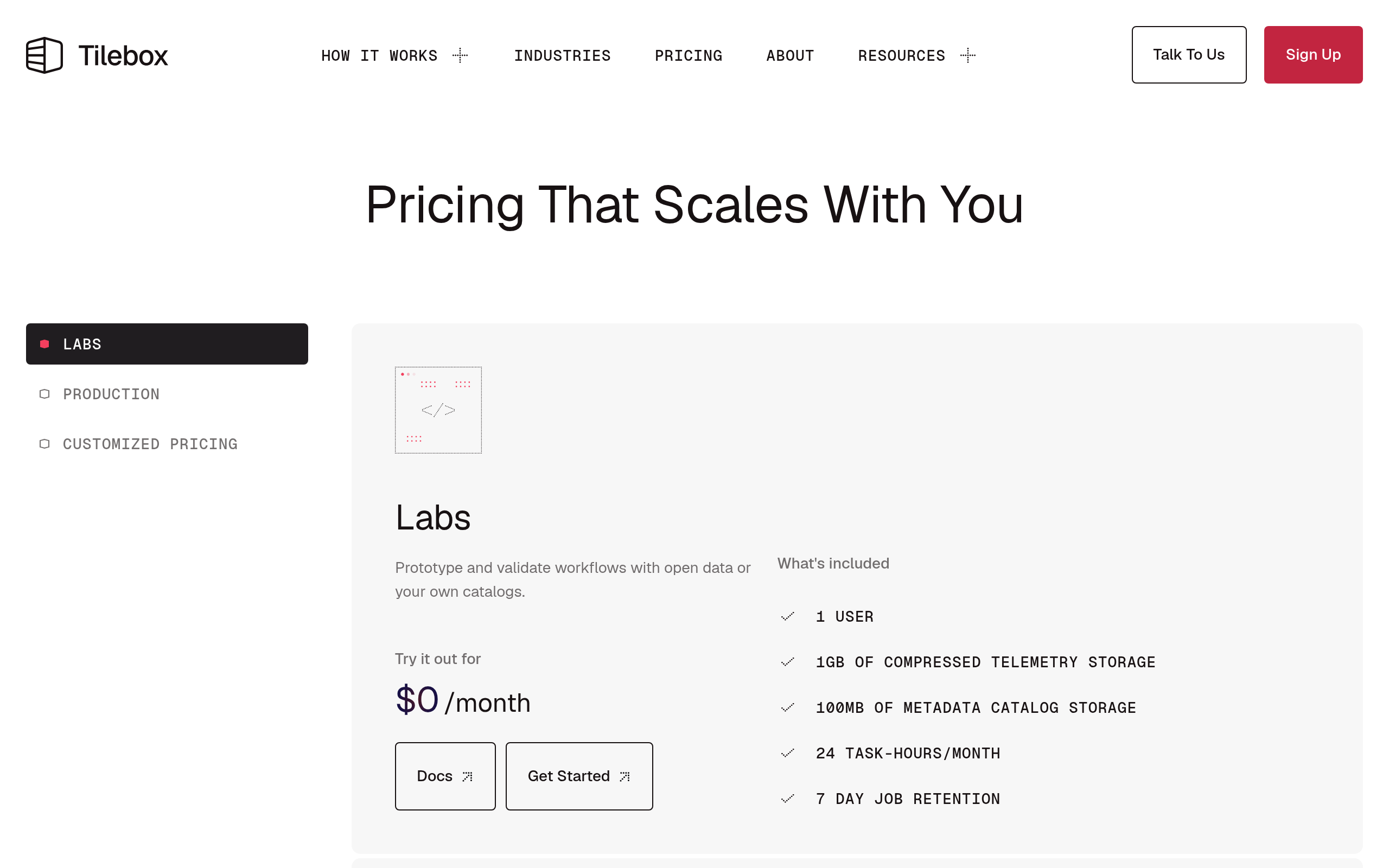
Tilebox publishes a freemium SaaS model with transparent plan tiers on its pricing page. The table below maps the documented rates as of June 2026. Data access costs for commercial upstream datasets, such as Umbra or Satellogic, depend on the upstream provider’s pricing and are not published on Tilebox’s pricing page: buyers evaluating commercial data access should factor in upstream costs separately.
| Plan | Price | Billing | Notes |
|---|---|---|---|
| Labs (Free) | $0/mo | Free | 1 user, 1 GB compressed telemetry storage, 100 MB metadata catalog, 24 task-hours/month, 7-day job retention |
| Production (annual) | $199/mo | Billed annually | Unlimited users, 90-day job retention, workflow automations, unlimited parallel runners and CRON automations |
| Production (monthly) | $249/mo | Month-to-month | Same features as annual Production. No annual commitment required |
| Enterprise | Custom | On request | Customized plans to fit mission needs. Contact via tilebox.com/contact |
Add-on task-hours are available on a volume-tiered basis: the rate steps down from $0.30 per task-hour for the first 500 hours, to $0.25 for 500 to 1,000, $0.20 for 1,000 to 5,000, $0.15 for 5,000 to 10,000, and $0.10 for volumes above 10,000 task-hours. This means the compute cost for large production pipelines scales downward significantly as volume grows, which is a design choice that favors teams running high-throughput processing rather than occasional single-scene jobs.
Payment methods are not published on the pricing or checkout pages. Engineering consultation for environment-specific implementation is listed as an offering but carries no published rate. Teams with specific infrastructure requirements should contact Tilebox directly via the contact form or schedule a discovery call before committing to a plan tier.
Who it’s for
Tilebox is designed for a specific profile of technical user. If you are a data scientist looking for a point-and-click imagery viewer or a procurement team buying pre-packaged analytics products, this platform is not the right starting point. The architecture rewards developers who want to build their own EO pipelines and data products, not consume finished ones.
The clearest fit is for EO and geospatial developers building multi-source satellite data pipelines: teams who need to combine Copernicus open data with commercial SAR or hyperspectral layers in a single processing workflow. Tilebox abstracts the data access layer so the developer focuses on the algorithm or data product, not the infrastructure plumbing.
Satellite operators and mission teams building data product generation pipelines are a second explicit target. The Workflows module handles the parallel processing pattern that mission data pipelines require, and the ADLER-1 collaboration with Spire Global is evidence that Tilebox is used in this context. Engineering consultation is offered alongside the platform for teams implementing mission-specific data processing environments.
Data engineering teams at analytics companies, particularly those building automated EO monitoring or change detection workflows, are a third fit. The CRON automations, parallel runners, and observability tooling in the Production tier are designed precisely for scheduled, recurring geospatial processing jobs. Airmo’s greenhouse-gas monitoring pipeline is the named customer example that represents this recurring-pipeline use case directly.
Where Tilebox is less competitive: if your team needs a self-serve imagery archive browser, ready-made analytics products, or a large named enterprise customer base as proof of production reliability, the current stage of the company means you are making an early-adopter bet. Tilebox is not the right choice if your organization requires enterprise SLAs backed by years of production evidence, or a marketplace with pre-built integrations across dozens of providers.
Strengths and limitations
Tilebox’s architectural choices create a clear set of structural advantages for developer-centric EO work. The strengths concentrate in flexibility, open data breadth, and developer ergonomics:
- Unified Python and Go SDKs covering data access, parallel workflow orchestration, observability, and CRON automation within one platform, reducing the number of tools a developer needs to integrate
- Free Labs tier with immediate API access to the full Copernicus Sentinel series and Landsat 1-9 archive, reaching back to 1972, without any infrastructure setup requirement
- Transparent, published pricing with a genuine free tier and volume-scaling task-hour rates that favor high-throughput pipeline teams over point-in-time imagery buyers
- Commercial upstream integrations for Umbra SAR, Satellogic optical, and Wyvern hyperspectral data within the same SDK abstraction layer as open data sources
- Agentic framework positioning with a Tilebox MCP Server, giving teams building AI-assisted EO workflows a native grounding layer for live geospatial data schemas
The limitations deserve direct treatment, particularly the ones tied to the company’s current stage. In my analysis, these are genuine buyer-risk factors, not minor caveats:
- Pre-Seed stage with $1.7M raised and only one publicly named customer as of June 2026: teams building production-critical infrastructure on Tilebox are taking an early-adopter risk that a more established platform does not carry
- No named CEO on the official site, no published SLA documentation, and no cloud marketplace listings (AWS, Google Cloud, Azure Marketplace), which limits how Tilebox fits into enterprise procurement workflows
- Payment methods not published; commercial upstream data access costs (Umbra, Satellogic, Wyvern) are not disclosed and require separate upstream contracts, making total cost of ownership harder to estimate upfront
- On-orbit compute integration remains a roadmap item, not a current product: teams evaluating Tilebox for edge compute scenarios are evaluating intent, not shipped capability
- Total catalog size and the number of commercial data integrations are not stated as figures on the site, making it difficult to compare catalog breadth against competing platforms on a like-for-like basis
The core tension for a buyer is genuine: Tilebox’s architectural design is coherent and the developer ergonomics are well-considered, but the company is at a stage where production adoption carries platform risk that a team needs to consciously accept.
For teams building greenfield EO pipelines who can tolerate early-stage platform risk, the infrastructure design and free open-data access make it worth a serious evaluation. For teams migrating critical production workloads from an established platform, the maturity gap is a real constraint.
Tilebox alternatives
The platforms closest to Tilebox occupy the same developer-facing, data-access-plus-processing space, though each with a different emphasis. The table draws on verified specifications from primary sources for each provider.
| Provider | Type | Data access | Pricing model | Key differentiator |
|---|---|---|---|---|
| Tilebox | Software tool + data aggregator | Copernicus, Landsat, ERS, Umbra, Satellogic, Wyvern via SDK | Freemium, Production from $199/mo, task-hour add-ons | Unified SDK for data access and parallel workflow orchestration. Includes agentic MCP layer |
| Sentinel Hub | Data aggregator + software tool | Copernicus, Landsat, MODIS, commercial. Bring Your Own Data supported | Tiered, from $28/mo (Exploration), 30-day free trial | Cloud-native on-the-fly processing of petabytes of satellite archive. Powers Copernicus Data Space Ecosystem |
| UP42 | Data aggregator + analytics | Broad multi-source catalog including tasking, SAR, thermal, hyperspectral, aerial | Credit-based, free access to Sentinel-2 and Landsat-8, no subscription required | Broadest catalog by source-operator count. Single procurement account for multi-modal commercial data |
Sentinel Hub, now part of Planet, is the infrastructure that powers the Copernicus Data Space Ecosystem and processes petabytes of archive data on-the-fly via a REST API. It is the more production-proven platform for Copernicus-heavy workflows, with a published 99% monthly uptime SLA and support for WMS/WCS/STAC/openEO standards that Tilebox does not yet match in terms of documented enterprise compliance markers.
UP42, backed by Airbus, takes a marketplace approach with a broad multi-source catalog accessible via credits, no subscription required, and coverage that extends to aerial, drone, and lidar data alongside satellite sources. For teams whose primary concern is catalog breadth and commercial data procurement without a recurring subscription, UP42’s credit model and multi-modal sourcing are a more direct fit than Tilebox’s current offering.
Tilebox’s differentiation against both is the workflow orchestration layer: neither Sentinel Hub nor UP42 provides an integrated parallel task execution engine and CRON automation framework within the same platform. For teams who need data access and compute orchestration together, Tilebox’s integrated design addresses a gap that the alternatives leave to the developer to fill.
Verdict
Tilebox is a real company building genuine infrastructure for EO developers, and its core architecture is technically coherent. The question is not legitimacy but fit, and that fit depends heavily on your team’s risk tolerance for early-stage platforms.
For greenfield EO pipeline development, particularly for teams combining open Copernicus and Landsat data with commercial SAR or hyperspectral layers in a single automated workflow, Tilebox’s free Labs tier and unified SDK make it worth a hands-on evaluation. The transparent pricing and volume-scaling task-hour rates suit teams running high processing volumes.
The Datasets and Workflows modules together address an integration problem that most developers currently solve with custom glue code. The absence of a per-imagery credit model is a deliberate design choice that favors pipeline teams over one-off imagery buyers.
The caveats are real and should not be soft-pedaled. Tilebox is Pre-Seed, has just one publicly named customer, no published SLA documentation, and no cloud marketplace presence. Teams migrating production workloads or building infrastructure with enterprise procurement requirements will find the maturity gap is a practical constraint, not just a theoretical one. Upstream commercial data pricing is also not disclosed on Tilebox’s site, which makes full cost modeling harder than it should be.
If your requirement is proven Copernicus data access with documented uptime SLAs, Sentinel Hub is the more established choice. If catalog breadth and commercial data procurement with no subscription commitment are the priority, UP42’s credit model is more flexible.
For teams willing to build on early-stage infrastructure in exchange for integrated workflow orchestration alongside data access, Tilebox is the more differentiated option. The alternatives table above is the practical starting point for matching your requirement to the right platform.
Frequently asked questions
Below are answers to the questions developers and buyers most commonly ask about Tilebox. Each answer points to the section where the full detail lives.
How does Tilebox work?
Tilebox provides two modules accessible via a REST API and Python or Go SDK. The Datasets module connects to upstream satellite data providers (Copernicus, USGS, Umbra, Satellogic, Wyvern) and retrieves data through a unified interface. The Workflows module handles parallel task execution and scheduling for EO processing pipelines across on-premise or cloud environments. No satellite hardware is required. Full detail is in “Data and capabilities.”
Is Tilebox a legit company?
Yes. Tilebox, Inc. is a Delaware-registered corporation co-founded in 2022 by Stefan Amberger and Laura Costa, with a confirmed $1.7 million Pre-Seed round from named institutional investors. It is an early-stage company with a small public customer base, not an established enterprise platform. See “Is Tilebox legit?“
How much does Tilebox cost?
The Labs tier is free with 24 task-hours per month. The Production plan runs $199 per month billed annually, or $249 per month on a monthly basis. Enterprise pricing is custom. Add-on task-hours start at $0.30 per task-hour, stepping down to $0.10 at volumes above 10,000 hours. Full pricing is in the “Pricing” section.
Does Tilebox have a free tier?
Yes. The Labs tier is permanently free and includes API access to open satellite data collections, 24 task-hours per month, and 7-day job retention. It is a genuine free tier rather than a time-limited trial, though its 1-user and storage limits make it suitable for development and evaluation rather than production pipelines. Details are in “Pricing.”
Who owns Tilebox?
Tilebox, Inc. is privately held, incorporated in Delaware with operational origins in Vienna, Austria. The company was co-founded by Stefan Amberger and Laura Costa. Institutional investors from the Pre-Seed round include Cocoa Ventures, Possible Ventures, Remote First Capital, and Findus Ventures, with individual investor Luis Sanz (CEO of CARTO). Ownership context is in “Is Tilebox legit?“
How does Tilebox make money?
Tilebox’s primary revenue model is SaaS subscription fees from the Production and Enterprise tiers, plus usage-based add-on task-hour charges for compute above the plan allocation. Enterprise customers with custom mission requirements engage via direct contact for tailored plans. See “Pricing” for the rate structure.
When was Tilebox founded?
Tilebox was founded in 2022 by Stefan Amberger and Laura Costa, with operational origins in Vienna, Austria. The company closed its $1.7 million Pre-Seed round in August 2023. Background is in “About Tilebox.”
Where is Tilebox based?
Tilebox’s operational roots are in Vienna, Austria, where it was founded. The legal registered entity, Tilebox, Inc., is incorporated in Delaware, USA, a common structure for European startups with US investors. The registered address is 1111B S Governors Ave Suite 6076, Dover, Delaware, which is a Delaware incorporation address rather than a physical operations office. Details are in “About Tilebox.”
Who are Tilebox’s customers?
The clearest publicly confirmed customer from 2023 press coverage is Airmo, which uses Tilebox for greenhouse-gas monitoring pipelines. Tilebox also provides the data platform for the ADLER satellite missions alongside Spire Global and the Austrian Space Forum. The current customer base is not published on the site. Context is in “Is Tilebox legit?“
What are the best alternatives to Tilebox?
For Copernicus data access with proven enterprise uptime and standards compliance, Sentinel Hub is the more established choice. For broadest catalog coverage and credit-based commercial data procurement without a subscription, UP42 is the more flexible option. Tilebox’s differentiation is its integrated workflow orchestration alongside data access in one SDK. A full comparison is in “Tilebox alternatives.”

My passions are Earth Observation and Satellites, and my profession is Data Analysis. I combine both within ObservationData.com to show you the use cases of Earth Observation, to help you find the right provider, and to share your experiences.
