
 Granular.ai is a US geospatial AI company offering a full-stack MLOps platform for imagery.
Yes, real: NGA Accelerator and Techstars backing, with verifiable program participation.
This review covers what the platform delivers, pricing in practice and the fit for your team.
Table of Contents
Key Takeaways
- Best fit for teams that need to build and deploy custom geospatial AI models without their own ML infrastructure
- The standout feature is an end-to-end MLOps pipeline covering data ingestion, annotation, training, and deployment in one platform
- The key caveat: pricing is not published, so budget clarity requires a direct sales conversation
About Granular.ai
Granular.ai operates from Somerville, Massachusetts, and serves two distinct buyer types through a single platform: R&D teams building custom geospatial vision models, and operational end-users consuming finished analytics products for insurance, disaster response, and property workflows. The key facts below reflect granular.ai’s own published pages as of June 2026.
| Name | Granular AI |
|---|---|
| Website | granular.ai |
| Address | 240 Elm Street, Somerville, MA 02478, USA |
| Founded | 2019 |
| Ownership | Private (seed-stage, Techstars Boston 2020, NGA Accelerator 2023) |
| Leadership | Siddharth Gupta (Co-founder and CEO); Sagar Verma (Co-founder and CTO) |
| Products & data | GeoEngine (geospatial MLOps platform); GeoSearch (natural language querying); Geo LVM (large vision and language model); Inspect.Properties (property inspection); FireMap (wildfire mapping); HADR AI (disaster response); QuakeMap; FloodedLand; SpillTrack |
| Pricing | Quote-based for all tiers; no published rates; contact via [email protected] or the contact form |
| Languages | English |
Granular.ai’s government backing provides a concrete proof point for a company of its size: the NGA Accelerator (run by Capital Innovators) selected Granular.ai for its inaugural 2023 cohort, a program specifically designed to identify geospatial AI companies with practical defense and intelligence applications. Grants from AFRL (Air Force Research Laboratory) and SDL, alongside Google Cloud TPU Research Program support, round out a pattern of institutional validation that is meaningful for a seed-stage startup.
The open-source “fabric” urban change model on GitHub, with 63 stars and a domain-verified organization adds a layer of technical credibility that is independently verifiable.
Is Granular.ai legit?
In my analysis, Granular.ai is a legitimate operating company, not a vaporware project. The more relevant question for a buyer is whether it has the scale and stability appropriate for your program timeline and risk tolerance, and on that question the picture is more nuanced.
Ownership and funding
Granular.ai is privately held, with no disclosed parent company. The company does not publish a total funding figure, but its disclosed program history includes the Techstars Boston 2020 cohort and the NGA Accelerator’s publicly stated $100,000 grant. The company has not completed a formal institutional VC funding round as of mid-2026, which is consistent with an early-stage company building on government program revenue rather than investor capital.
Investors on record include Bell Capital, Hyperspace Challenge, and AI Venture Labs alongside the two accelerator programs. The company discloses its legal address, phone number, and email publicly, and its GitHub organization is domain-verified for granular.ai, all markers that a real organization is behind the platform.
Track record and customers
Academic partnerships with the University Paris-Saclay, Sorbonne University, IIIT Delhi, IIT Delhi, and IIT Gandhinagar establish a research lineage that is independently checkable. The NGA and AFRL program selections confirm that US defense and intelligence agencies have evaluated and funded Granular.ai’s work, which is a significant legitimacy signal for a five-person-scale team.
Granular.ai does not publish a named customer count on its site. For Inspect.Properties specifically, the company targets insurance carriers, construction firms, and adjusters, and the product’s positioning as a self-serve analytics tool implies commercial traction beyond pilot deployments, but confirmed customer numbers are not disclosed.
Compliance and data rights
Granular.ai does not operate satellites and does not publish a formal data licensing agreement on its site. The platform ingests imagery from 21 satellite data sources, with Sentinel-2 (an ESA mission) the only one named publicly (used in FireMap). For enterprise deployments, buyers should request a clear statement of data provenance and sub-licensing terms from each source before committing to a workflow that depends on Granular.ai’s data layer.
Data and capabilities
Granular.ai’s product portfolio splits into two tracks that share an underlying AI infrastructure but serve very different buyers. Understanding which track aligns with your need is the most important question before evaluating the platform.
Developer platform: GeoEngine, GeoSearch, Geo LVM
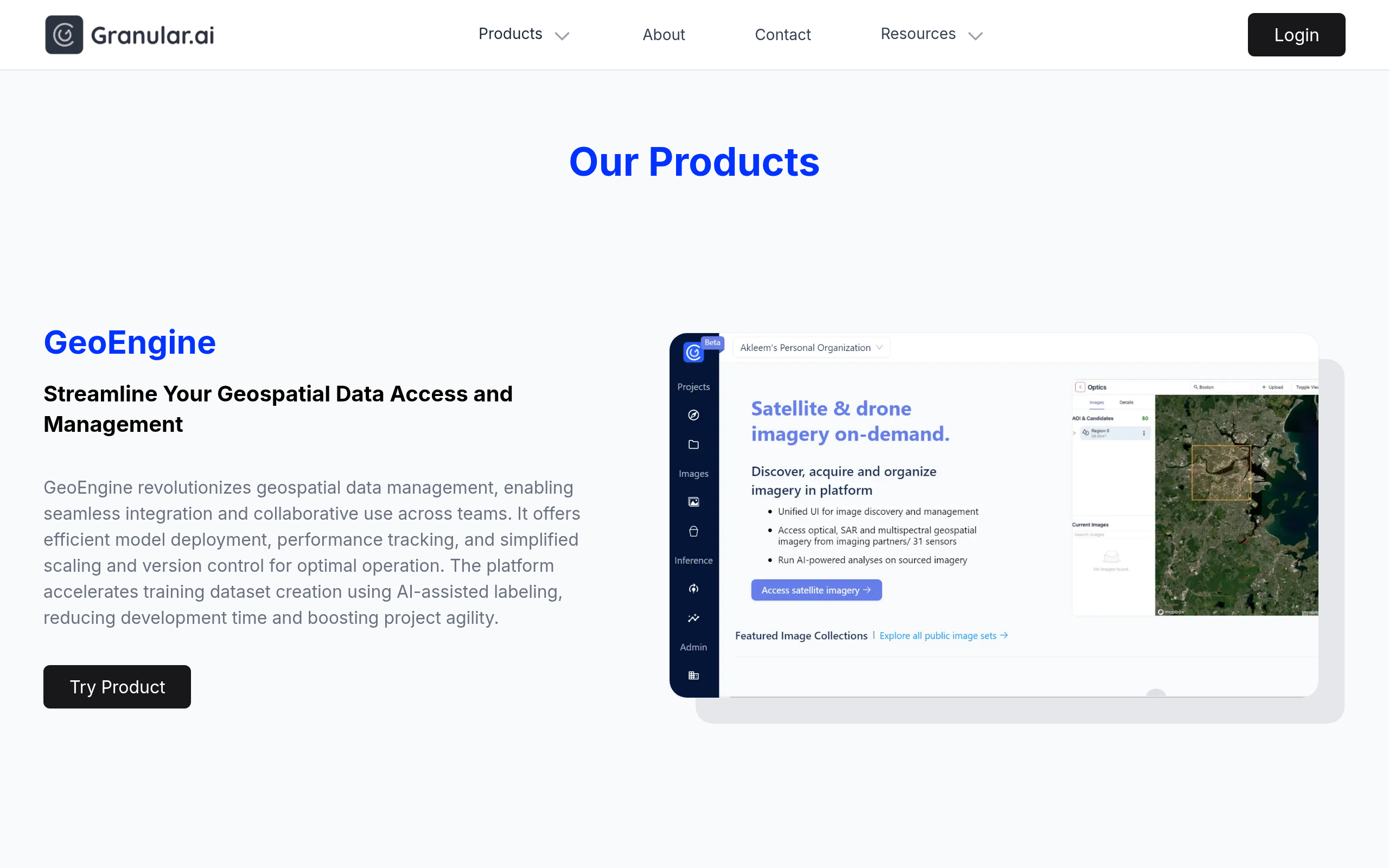
GeoEngine is the core MLOps offering, described by the company as the first end-to-end geospatial machine learning platform. It covers the full model lifecycle from data sourcing and AI-assisted annotation through model training, deployment, and performance tracking, pulling from 21 satellite sources. Teams working on custom geospatial vision models can ingest optical, SAR, and drone imagery, train on Granular.ai’s infrastructure, and deploy finished models as APIs without building separate pipeline components.
GeoSearch adds a natural language query interface for geospatial assets, lowering the barrier for non-specialist analysts to extract insights from change detection and object detection outputs without writing custom queries. Geo LVM is the underlying multi-modal large language and vision model that powers this interface, combining language and vision capabilities for satellite imagery interpretation across diverse scene types.
The platform also accepts user-uploaded drone and aerial imagery. DL Judge provides model compression tools, Synthetix generates synthetic geospatial training data for coverage gaps, and Europa handles dataset development, rounding out a pipeline that few geospatial AI products cover end-to-end.
Applied analytics products
The second track delivers finished geospatial outputs to operational users who do not need to build models themselves. Inspect.Properties automates residential and commercial property inspection and roof measurement for the insurance, construction, and real-estate sectors. The product targets hail and wind storm damage assessment for insurance claims, where automated satellite-derived inspection competes directly with traditional aerial flyover workflows.
The HADR AI cluster covers disaster response analytics: FireMap maps wildfire burn areas using Sentinel-2, QuakeMap assesses earthquake damage, FloodedLand maps flood inundation extent, and SpillTrack detects and tracks oil spills. These products sit alongside each other under a common geospatial AI layer, meaning that a government agency or NGO buying disaster response capabilities gets multi-hazard coverage from a single vendor rather than separate tool integrations.
Pricing
Granular.ai publishes no pricing on its website. All tiers, whether for the GeoEngine developer platform or the applied analytics products, are quote-based and require a direct conversation. The contact channels are [email protected], a standard contact form at granular.ai/contact, and a phone number (617-230-2952).
| Product track | Model | Entry point | Notes |
|---|---|---|---|
| GeoEngine / Geo LVM developer platform | Quote-based | Contact required | Enterprise and research/academic access both implied by institutional partner list, no self-serve tier confirmed |
| Inspect.Properties | Quote-based | Contact required | Property inspection and roof measurement for insurance and construction workflows |
| HADR AI / disaster analytics | Quote-based | Contact required | Government and NGO programs, supported by NGA and AFRL grants |
| Free tier | None confirmed | N/A | engine.granular.ai has a login portal, but whether a trial or free tier exists is not published |
The absence of published pricing is a friction point for teams doing initial budgeting. It is consistent with an early-stage company that customizes contracts per buyer, but it means evaluation requires committing to a sales conversation before cost is known. Research and academic buyers have a separate implied path given the university partnership list, though the terms of that path are also not disclosed.
Who it’s for
Granular.ai’s dual-track architecture creates two fairly distinct buyer profiles. The platform is well-matched for both, but the evaluation path and contract expectation differ significantly between them.
The developer platform (GeoEngine, GeoSearch, Geo LVM) fits R&D teams, government AI programs, and university research groups that need to train and deploy custom geospatial vision models without provisioning their own data pipeline, annotation tooling, and model-serving infrastructure.
The NGA and AFRL backing confirms that US defense and intelligence programs are the core institutional buyer for the developer track. Teams at universities with geospatial AI programs, particularly in India and France given the named partnerships, have an established path to academic access.
The applied analytics products (Inspect.Properties, FireMap, HADR AI, FloodedLand) fit operational buyers who need geospatial intelligence outputs rather than a development environment. Insurance carriers and third-party administrators processing hail and wind storm claims are the clearest commercial fit for Inspect.Properties. Emergency management agencies and disaster response organizations are the natural buyers for the HADR AI suite, particularly given the NGA accelerator framing around national security and rapid geospatial response to natural hazard events.
Where Granular.ai is a weaker fit: teams looking for a self-serve imagery marketplace or a turnkey monitoring subscription with transparent pricing will not find that here. The platform requires an integration effort and a direct engagement model, which is not well-suited to proof-of-concept buyers with limited budget authority.
Buyers who need formal SLAs, published uptime guarantees, or enterprise procurement terms typical of larger software vendors should factor in the company’s early-stage status when assessing vendor risk.
Strengths and limitations
Granular.ai’s structural strengths flow from its focus on the AI model development layer, which most imagery providers treat as the buyer’s problem. The strengths concentrate in platform depth and applied product breadth for its size:
- End-to-end geospatial MLOps pipeline covering data ingestion from 21 satellite sources, annotation, training, API deployment, and model performance tracking in one platform
- Multi-modal AI combining large language and vision models (Geo LVM) with a natural language query interface, reducing the technical barrier for non-specialist analysts
- Ready-built applied analytics products (Inspect.Properties, FireMap, QuakeMap, FloodedLand, SpillTrack) for buyers who need outputs rather than a development environment
- Validated by NGA Accelerator, AFRL, and Google Cloud TPU grants, providing independent institutional credibility for a seed-stage company
- Open-source components (GitHub: granularai) and verifiable academic partnerships give R&D buyers a technical foundation to evaluate before committing
The limitations are worth mapping carefully against your specific requirements before engaging:
- No published pricing for any tier, meaning all contracts require a direct sales conversation before budget scoping is possible
- Early-stage company (approximately 17 employees as of 2026) with seed-level funding, which places vendor risk higher than for established analytics providers at Series B and beyond
- The 21 satellite data sources are unnamed on the platform’s public pages, making it difficult to verify data provenance or licensing rights without direct engagement
- No published API documentation, SLA terms, or uptime commitments on the site; enterprise procurement teams should request these during contract negotiation
- Customer references on the company’s own site are limited; no named customer count is published on granular.ai for any product
In my analysis, the core tension for a buyer evaluating Granular.ai is between its genuine platform depth and its early-stage operational profile. For R&D programs and government agencies that can absorb some vendor risk, the MLOps completeness is a real differentiator compared to assembling the same stack from separate components.
For enterprise procurement teams requiring auditable vendor stability, the lack of published terms and the funding scale are factors to address explicitly in the sales process before committing to a deployment.
Granular.ai alternatives
If Granular.ai’s combination of geospatial MLOps development tools and applied analytics does not match your requirement profile, three analytics and platform providers offer meaningfully different positionings. The table below draws on verified entries from primary sources.
| Provider | Type | Core strength | Best fit |
|---|---|---|---|
| Granular.ai | Analytics + MLOps platform | End-to-end geospatial model development and applied disaster/property analytics | R&D teams and government programs building custom geospatial AI |
| EOS Data Analytics | Satellite operator + analytics platform | Self-serve imagery access, crop monitoring tools, and a published tiered pricing model | Agriculture, forestry, and land-use buyers who want transparent self-serve access |
| Kayrros | Analytics + data aggregator | Energy, methane, and carbon analytics derived from multi-source satellite data | Energy sector and ESG programs focused on emissions monitoring and commodity tracking |
| Orbital Insight | Analytics provider | Geospatial analytics for supply chain, retail, and economic intelligence | Commercial intelligence and financial analytics use cases using geospatial signals |
EOS Data Analytics operates its own satellite constellation alongside a cloud analytics platform and publishes self-serve pricing, which makes it a practical alternative for buyers who want imagery access and analytics from a single vendor with transparent costs. Kayrros concentrates on energy and emissions analytics derived from satellite data, serving a narrower but deeper vertical with less overlap on the MLOps development use case.
Orbital Insight focuses on commercial and economic intelligence derived from geospatial data, targeting supply chain and financial sector buyers rather than the R&D and disaster response programs where Granular.ai is strongest.
Verdict
Granular.ai is a real and operating company with verifiable institutional backing. The legitimacy question is settled; the fit question depends on what kind of buyer you are.
For R&D teams, government AI programs, and defense agencies that need a complete geospatial MLOps environment rather than a piecemeal stack, Granular.ai’s GeoEngine platform is one of the few offerings that addresses the full model lifecycle, from imagery ingestion through deployment, in a single system. The NGA and AFRL backing is a meaningful signal that the platform holds up under government-grade scrutiny. Academic teams at partner institutions have a clear entry path.
For operational buyers in insurance and disaster response, the applied analytics products deliver a ready-built multi-hazard geospatial layer without requiring AI expertise. Inspect.Properties in particular occupies a well-defined niche in automated property damage assessment that competes with traditional aerial survey workflows on cost and turnaround.
The key caveats are vendor scale and pricing opacity. With approximately 17 employees and seed-level funding, Granular.ai carries the execution risk of early-stage companies, and the absence of any published pricing or SLA terms means enterprise procurement teams will need to invest time in the sales process before cost clarity is possible.
If you are evaluating this platform for a mission-critical production deployment, factor vendor stability into your risk register alongside the platform’s technical strengths. For programs where the MLOps development use case is the priority and vendor scale is less of a constraint, Granular.ai is worth a serious look. The alternatives table above is the right starting point if you need a more established vendor or a self-serve pricing model.
Frequently asked questions
Below are answers to the questions buyers most commonly ask about Granular.ai. Each answer points to the section where the full detail lives.
How does Granular.ai work?
Granular.ai provides two product tracks from a shared AI infrastructure. The GeoEngine developer platform covers geospatial ML model development end-to-end: data ingestion from 21 satellite sources, AI-assisted annotation, model training, and API deployment. The applied analytics track delivers finished outputs for property inspection, wildfire mapping, and disaster response to operational users who do not build models themselves. Full detail is in “Data and capabilities.”
Is Granular.ai a legit company?
Yes. Granular.ai is an active company founded in 2019, headquartered at 240 Elm Street, Somerville, Massachusetts, and backed by the NGA Accelerator and Techstars Boston programs. Its GitHub organization is domain-verified and hosts open-source geospatial AI tools. Full legitimacy detail is in “Is Granular.ai legit?“
Who owns Granular.ai?
Granular.ai is privately held with no parent company. The co-founders, Siddharth Gupta (CEO) and Sagar Verma (CTO), founded the company in 2019. Investors include Techstars, Capital Innovators (NGA Accelerator), Bell Capital, Hyperspace Challenge, and AI Venture Labs. Ownership background is in “Is Granular.ai legit?“
How much does Granular.ai cost?
Granular.ai does not publish pricing for any product, and all tiers are quote-based, requiring direct contact via [email protected] or the contact form at granular.ai/contact. A login portal exists at engine.granular.ai, but no free or trial tier is confirmed on the public site. Pricing detail is in “Pricing.”
Does Granular.ai have a free tier?
No free tier is published or confirmed on the site. The GeoEngine platform has a login portal at engine.granular.ai, and research or academic access may be available through the university partnership program, but no self-serve trial or free tier is documented on granular.ai’s public pages. See “Pricing” for what is known.
Who are Granular.ai’s customers?
Named academic partners include the University Paris-Saclay, Sorbonne University, IIIT Delhi, IIT Delhi, and IIT Gandhinagar. Government program participants include the NGA Accelerator and AFRL. Granular.ai does not publish a named customer count, so the Inspect.Properties commercial traction is not independently verifiable from company sources. Context is in “Is Granular.ai legit?“
How does Granular.ai make money?
Granular.ai operates on two revenue streams: government and institutional program contracts (NGA, AFRL grants and program fees) and enterprise contracts for the applied analytics products, particularly Inspect.Properties for the insurance and construction sectors. Pricing on both tracks is negotiated directly with no self-serve or subscription model published. See “Pricing” for what is disclosed.
When was Granular.ai founded?
Granular.ai was founded in 2019 by Siddharth Gupta and Sagar Verma. The company joined the Techstars Boston 2020 cohort and later the inaugural NGA Accelerator cohort in 2023. Background is in “About Granular.ai.”
Where is Granular.ai based?
Granular.ai is headquartered at 240 Elm Street, Somerville, Massachusetts 02478, USA. The company operates primarily in the US market and serves academic partners in France and India through its university research program. Location detail is in “About Granular.ai.”
What are the best alternatives to Granular.ai?
The best match depends on your use case: EOS Data Analytics for self-serve imagery and analytics with published pricing, Kayrros for energy and emissions-focused geospatial intelligence, and Orbital Insight for commercial and supply chain analytics derived from geospatial signals. A comparison is in “Granular.ai alternatives.”

My passions are Earth Observation and Satellites, and my profession is Data Analysis. I combine both within ObservationData.com to show you the use cases of Earth Observation, to help you find the right provider, and to share your experiences.
