
 Capella Space is a US X-band SAR operator that built the first US commercial SAR constellation.
Real and established: NRO, NASA and Space Force contracts, now owned by NYSE-listed IonQ.
This review covers sensors, imaging modes, pricing and where SAR earns its premium.
Table of Contents
Key Takeaways
- Capella Space is a US SAR operator best suited to buyers who need all-weather radar imagery at sub-meter resolution
- Its standout feature is 0.25 m Spotlight Ultra azimuth resolution with 2–15 daily revisit opportunities globally
- After we weighed all the strengths and limitations, the key caveat is that Capella itself publishes no price list
About Capella Space
Capella Space Corp. was founded in 2016 by Payam Banazadeh while at Stanford University. The original motivation, which still shows up in company materials, was the 2014 disappearance of Malaysia Airlines MH370 and the gap it exposed in persistent, all-weather Earth monitoring. Sequoia (Capella-2) began operations in 2020, making it the first commercial US SAR satellite in operational orbit, and the company has since expanded to 20 named missions across three hardware generations.
As of July 2025, Capella operates as a subsidiary of IonQ Inc. (NYSE: IONQ), a quantum technology company. The combined entity is marketed as “Powered by IonQ,” with the longer-term strategy pointing toward quantum-enabled Earth observation capabilities. The acquisition brought Capella under a publicly traded parent for the first time.
Its three US locations (Louisville, CO primary, Chantilly, VA for federal operations, and San Francisco for commercial) reflect a dual-track business across commercial and national security customers.
| Name | Capella Space |
|---|---|
| Website | capellaspace.com |
| Legal name | Capella Space Corp. |
| Address | 397 S Taylor Avenue, Louisville, CO 80027, USA |
| Founded | 2016 |
| Ownership | Subsidiary of IonQ Inc. (NYSE: IONQ), acquired July 2025 |
| Leadership | Frank Backes (CEO); Payam Banazadeh (Founder, Board Director); Jessica Hunter (General Counsel and Board Secretary) |
| Products & data | X-band SAR imagery (Spotlight Ultra, Spotlight, Spotlight Wide, Stripmap, Parallel Stripmap); InSAR monitoring service; Capella Console (web UI); REST API; Space Systems (custom satellite builds) |
| Pricing | Quote-based (no published rates); open data archive free via AWS S3 |
| Languages | English |
The key facts above capture the company’s current legal and operational structure. The sections below go deeper on what matters for a procurement decision: the government contract record, the sensor matrix and imaging modes, and the pricing reality.
Is Capella Space legit?
Yes, without qualification. Capella Space Corp. is a US-incorporated company with a decade of verifiable operational history, government contracts at the highest classification levels, and a publicly traded parent company since mid-2025. The question is not whether it is legitimate. It is whether its SAR-only, quote-based model fits your procurement context.
Ownership and funding
Prior to its acquisition, Capella raised over $250 million in venture capital across multiple rounds: a $97 million Series C in April 2022 led by NightDragon and a $60 million growth equity round in January 2023 from the US Innovative Technology Fund. In July 2025, IonQ Inc. completed its acquisition, bringing the company under a NYSE-listed parent for the first time.
Capella now operates as a subsidiary branded “Powered by IonQ,” with IonQ’s quantum-technology roadmap driving the combined entity’s long-term direction. The acquisition closed at $311 million in IonQ stock, and Frank Backes continues as CEO of Capella Space under the combined structure. IonQ CEO Niccolo de Masi leads the parent company.
Track record and customers
In my analysis of Capella’s contract disclosures, the federal customer list spans civilian science, national security, and intelligence agencies. Named contracts include a Commercial Radar License from the National Reconnaissance Office and a multi-year blanket purchase agreement from NASA’s Commercial Smallsat Data Acquisition program. A HALO Europa contract with the US Space Development Agency followed in 2026.
Earlier agreements cover the US Space Force Space Systems Command, the Department of Defense, and the National Geospatial-Intelligence Agency. That breadth across agencies, assembled over less than a decade, is one of the clearest indicators of legitimate operational standing.
On the commercial side, named partners include FloodBase (parametric flood insurance), LiveEO (infrastructure monitoring), and Sarmap (SAR processing). Capella’s SAR data also appears on the UP42 geospatial marketplace, which extends its reach to buyers who prefer catalog-style access over direct operator contracts.
Compliance and data rights
Capella processes all imagery through an AWS GovCloud data pipeline, with on-board encrypted downlink and alignment to US NIST 800-171 requirements. As a US company with a defense-heavy customer base, Capella does not market any ITAR-free offering, and export-controlled use cases should be addressed directly in the procurement conversation.
Commercial data access runs through direct contracts, while an open data archive on AWS S3 is available free of charge for research and community use. Buyers with government or export-controlled use cases should address US export regulations early in the procurement conversation.
Data and capabilities
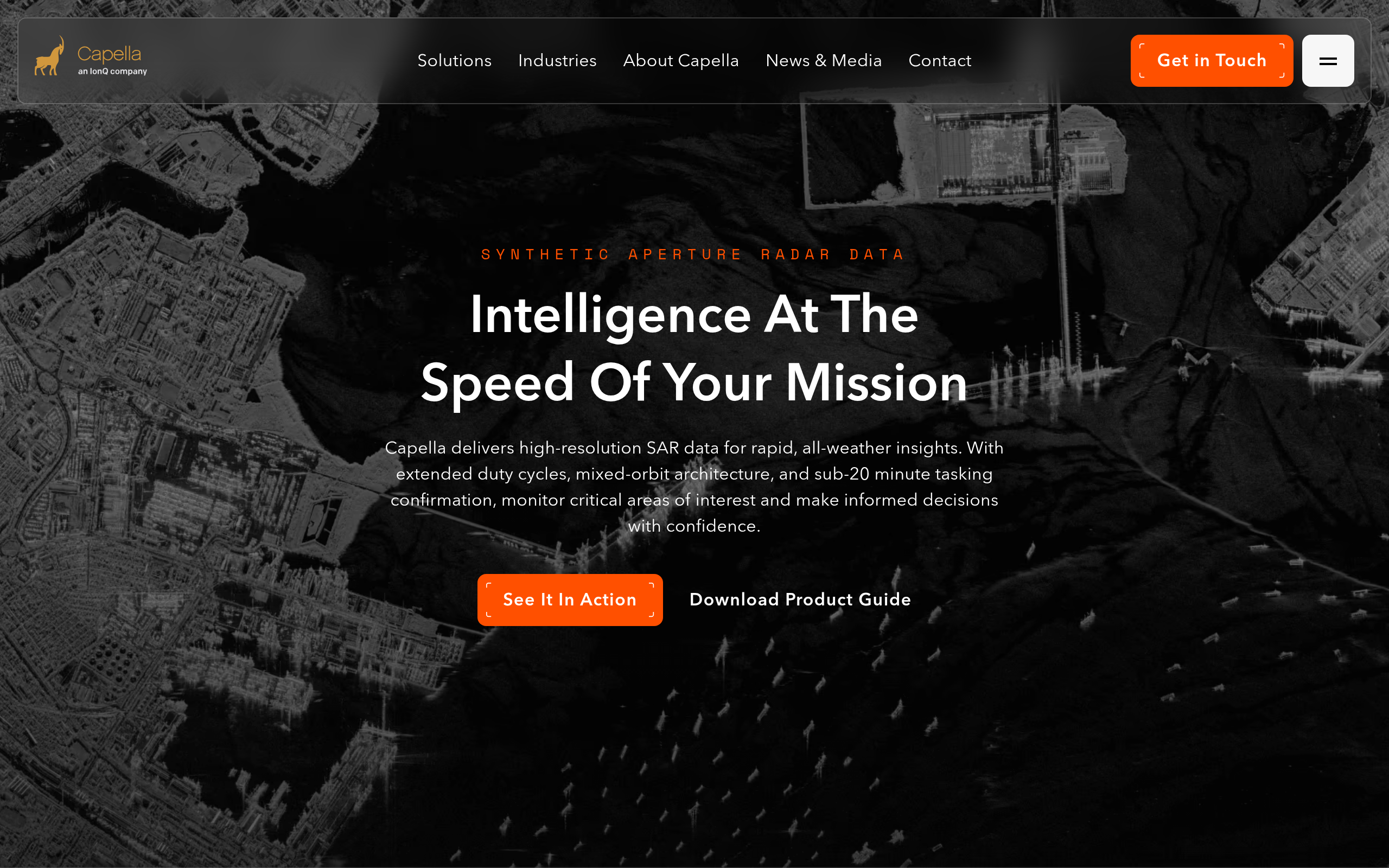
Capella is a SAR-only operator, which means every product in its catalog comes from its own X-band radar constellation rather than a mixed or aggregated sensor stack. That focus shows in the depth of its mode matrix and the precision of its specifications.
Sensors and imaging modes
The current production hardware is the Acadia class (third generation, launched from August 2023 onward), operating in the 9.3–9.9 GHz X-band range with up to 600 MHz imaging bandwidth. Capella offers five imaging modes across its Acadia constellation, each offering a distinct tradeoff between resolution and scene coverage.
| Mode | Azimuth resolution | Slant-range resolution | Scene size |
|---|---|---|---|
| Spotlight Ultra | 0.25 m | 0.25 m | 5 x 5 km |
| Spotlight | 0.5 m | 0.25 m | 5 x 5 km |
| Spotlight Wide | 1.0 m | 0.5 m | 10 x 20 km |
| Stripmap | 1.2 m | 0.75 m | 5–10 km x 20–100 km |
| Parallel Stripmap | 1.2 m | 0.75 m | 20 km x 20–100 km |
Spotlight Ultra, at 0.25 m azimuth and 0.25 m slant-range, is the mode most relevant to high-value target monitoring, vessel identification, and precision change detection. Each Acadia satellite has a 10-minute duty cycle per orbit pass, a meaningful capacity advantage: Capella claims up to five times more on-orbit collection per pass compared to other commercial SAR systems.
Single-polarization (HH or VV) is the supported configuration, the look angle range runs from 15 to 50 degrees, and dwell time of up to 60 seconds per pass on Spotlight Ultra enables extended collection on time-critical targets.
The product suite covers the full complexity spectrum. For users who want raw phase data, complex SLC (Single Look Complex) is available. Above that, GEO (Capella’s ellipsoid-corrected product) delivers geocoded amplitude, and GEC (the terrain-corrected variant) applies DEM-based correction. SICD and SIDD are NGA-standard formats, while CPHD and CSI (Colorized Sub-aperture Imaging) round out the catalog. All products are STAC-compliant and delivered via AWS S3.
Comparing Capella’s Spotlight Ultra against ICEYE’s Dwell Precise or Umbra’s commercial Spotlight, what stands out is the consistent 0.25 m figure across both azimuth and slant-range axes. At the 0.25 m level Capella competes with the leading commercial catalogs, though newer hardware generations from ICEYE and Umbra have demonstrated sub-0.25 m resolution in limited contexts.
Constellation and revisit
Capella has named 20 missions (Capella-1 through Capella-20) across three hardware generations. The architecture combines sun-synchronous orbit (SSO, approximately 97 degrees inclination) with mid-inclination orbit (MIO, 45 degrees), a deliberate design choice that expands daily revisit opportunities at mid-latitudes and tropical regions beyond what a pure SSO constellation can achieve. The result is 2 to 15 revisit opportunities per day globally, depending on latitude and configuration.
Active satellite count as of mid-2026 is not published on capellaspace.com. The site shows 20 mission patches without separating active from retired, so treat aggregate revisit figures as the operative specification rather than a per-satellite breakdown.
Platform and InSAR
Tasking runs through Capella Console, a self-serve web interface, or the REST API. The scheduler runs every 20 minutes with sub-20-minute tasking confirmation, which buyers who need rapid-response collection will find operationally relevant. Five collection tiers cover the urgency spectrum: Urgent, Priority, Standard, Flexible, and Routine (for repeat tasking). One practical note: the Flexible tier carries no “No Bumping” protection, meaning orders at that tier can be deleted without notification under operational pressure.
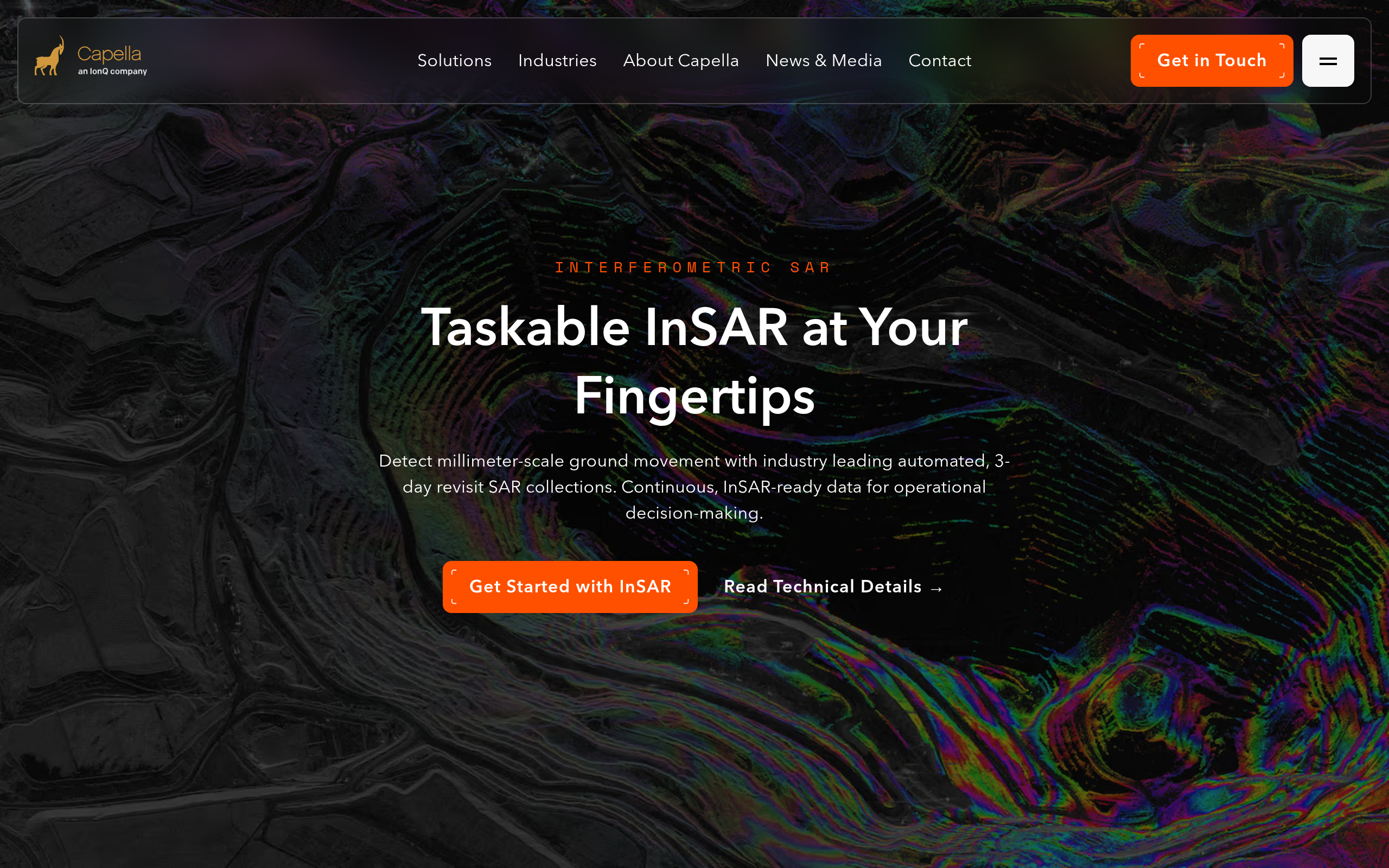
In May 2026, Capella launched a commercial taskable InSAR service using a 3-day repeat cadence for millimeter-scale surface deformation monitoring. The service derives 3D displacement measurements by comparing SAR phase across acquisitions at matching orbital geometry, combining SSO and MIO passes.
What I’d flag for a buyer here is that this capability is genuinely new in the commercial InSAR market at a 3-day cadence. It opens ground deformation monitoring to buyers who previously had to rely on Sentinel-1 temporal resolution or build multi-source workflows.
Pricing
Capella publishes no price numbers anywhere on capellaspace.com. All commercial access is quote-based, typically structured as a direct contract covering defined tasking volumes, delivery specifications, and usage rights. Government customers generally procure through existing program vehicles (NRO CRL, NASA CSDA blanket purchase agreement, or DoD acquisition mechanisms).
| Product | Model | Notes |
|---|---|---|
| SAR imagery and tasking | Quote-based contract | Covers collection tier, delivery SLA, and volume terms |
| Open data archive | Free | Selected archive scenes on AWS S3 for research use |
| InSAR monitoring service | Quote-based | 3-day repeat cadence; commercial launch May 2026 |
| Space Systems | Contract | End-to-end custom mission design, build, launch, and operation |
The free open data archive on AWS S3 is worth knowing about if you are evaluating data format, processing pipeline, or product quality before entering a commercial conversation. It is a research-oriented offering and not a substitute for tasked commercial imagery, but it allows technical teams to validate integration with their workflows before procurement commitments.
Capella publishes no rate card of its own, but a price floor is not out of reach. The UP42 marketplace resells its imagery at published credit rates: catalog scenes from 29,000 credits, tasking from 86,300 credits per scene, both orderable self-serve.
For a budget proposal those numbers are usually enough. A direct contract still starts with a sales conversation. Peer operators such as ICEYE are similarly quote-based for high-resolution tasking, so this is not unusual in the SAR market, but the evaluation timeline needs to budget for it.
Who it’s for
Capella’s SAR-only, US-manufactured model attracts a specific buyer profile. The clearest fit is US government and defense procurement: the combination of AWS GovCloud processing, NIST 800-171 compliance, and an established NRO/DoD contract record makes Capella a natural choice for national security applications where supply-chain and data-sovereignty requirements rule out non-US operators.
On the commercial side, Capella suits buyers whose monitoring requirements simply cannot tolerate optical imagery’s cloud-cover problem. Maritime domain awareness (vessel detection, dark ship tracking, port monitoring), disaster response and flood mapping, and infrastructure change detection in persistently cloudy regions all benefit from a radar system that delivers regardless of weather. The all-weather, day-or-night characteristic of SAR is the core value proposition for these use cases.
The InSAR service, launched commercially in May 2026, opens a distinct use case for engineering and environmental buyers: millimeter-scale surface deformation monitoring for subsidence in urban areas, settlement under infrastructure, geohazard early warning, and mining-related ground movement. At a 3-day repeat cadence over a taskable area, this is a meaningful step beyond what free Sentinel-1 InSAR workflows deliver in temporal resolution.
Where it is less competitive
Capella is not the right entry point if your primary need is wide-area optical coverage, multispectral indices for agriculture, or a large volume commitment at a negotiated rate. Buying direct is quote-only, and export-compliance considerations add friction for international buyers outside the US Five Eyes and allied-nation context.
For buyers who want to combine optical, SAR, and hyperspectral data through a single access point, an aggregator platform is a better starting position than a single-modality SAR operator.
Strengths and limitations
Based on the full data picture, here is how Capella’s strengths and limitations stack up for a commercial or government buyer evaluating its SAR capability.
- 0.25 m Spotlight Ultra azimuth resolution, among the highest available in commercial SAR
- Mixed SSO and 45-degree mid-inclination orbits deliver 2–15 daily revisit opportunities globally
- Sub-20-minute tasking confirmation with fully automated TCPED pipeline
- US-manufactured, AWS GovCloud pipeline, NIST 800-171 aligned for demanding US government supply-chain requirements
- Taskable commercial InSAR at 3-day repeat cadence, launched May 2026
- Publicly listed parent (IonQ, NYSE: IONQ) with transparent corporate structure
- SAR-only catalog with no optical, multispectral, or hyperspectral data
- Capella publishes no rate card itself: direct contracts are quote-based, though UP42 resells catalog and tasking at published credit rates
- US-only defense posture adds export-compliance complexity for some international buyers
- Post-acquisition roadmap still evolving under IonQ parent, with quantum integration timeline unclear for imagery customers
- Active satellite count not published on the provider’s own site
The two limitations worth weighting most heavily are pricing opacity and US export posture. Both require you to commit time before a number lands on paper or eligibility is confirmed.
Capella Space alternatives
The commercial SAR market has grown considerably since Capella launched the first US constellation. Your choice among these alternatives depends on geography, procurement jurisdiction, resolution priority and export compliance, and whether you want SAR-only or a multi-sensor stack.
| Provider | Best resolution | Constellation size | Key differentiator | Ownership / HQ |
|---|---|---|---|---|
| Capella Space | 0.25 m (Spotlight Ultra) | 20 missions (SSO + MIO) | US-only supply chain; AWS GovCloud; InSAR service | IonQ subsidiary, US |
| ICEYE | 0.25 m standard (Dwell Precise); Gen4 up to 0.16 m | 70+ launched since 2018 | Largest SAR constellation; Flood/Wildfire analytics products; EUR 10B+ valuation (Series F, June 2026) | Private, Finland |
| Umbra | 0.25 m commercial standard (Spotlight); 1200 MHz bandwidth | 11+ satellites (SSO) | Highest-bandwidth commercial SAR; cross-track Scan mode; published pricing | Private, US |
| Airbus Defence and Space | 0.25 m SAR (Staring SpotLight); 0.30 m optical (Pléiades Neo) | Multi-sensor (optical + SAR) | Multi-sensor catalog (optical and SAR); 40 years of EO heritage; European operator with no US export restrictions | Airbus SE subsidiary, France |
| Synspective | 0.25 m (Staring Spotlight) | 9 satellites (StriX) | Japanese operator; analytics solutions (LDM, flood, deformation); TSE-listed | Public, Japan |
ICEYE is the natural first comparison for volume and analytics: it has launched more than three times as many satellites, offers derived flood and wildfire analytics products, and carries no US export constraints for international buyers. Umbra offers the same 0.25 m resolution and is also US-based, but publishes pricing and adds a cross-track Scan mode that Capella’s geometry does not replicate.
Airbus is the main alternative for buyers who need optical and SAR from a single vendor without US export-compliance overhead, particularly in European or NATO procurement contexts. Synspective rounds out the comparison as the leading Japanese SAR operator, relevant to Asia-Pacific buyers or those evaluating TSE-listed companies.
See how Capella Space compares with seven rival SAR operators in our guide to the best SAR data providers.
Verdict
Capella Space is a legitimate, technically strong SAR operator. The question for any buyer is fit, not credibility. It holds a defensible position at the intersection of US supply-chain requirements, sub-meter radar resolution, and operational SAR depth from being the first American commercial constellation.
For US government and defense buyers, Capella’s combination of an NRO/DoD/NASA contract record, AWS GovCloud processing, NIST 800-171 alignment, and a publicly listed parent gives it a procurement standing that most commercial SAR operators cannot match. The IonQ acquisition adds a quantum-technology roadmap to the story, though what that means concretely for imagery customers is still taking shape.
On the commercial side, the case is strongest for buyers who need all-weather persistent monitoring: maritime, disaster response, infrastructure deformation. The new taskable InSAR service at 3-day repeat cadence is a real addition for ground deformation applications.
The limitation to watch is that Capella publishes no rate card of its own. If you need published numbers before a procurement conversation, the UP42 listing is where to find them, not capellaspace.com.
Our recommendation: Capella warrants a serious evaluation for US-based government and commercial SAR buyers. International buyers in non-allied-nation contexts should run ICEYE or Airbus in parallel to assess export-compliance before narrowing down.
Frequently asked questions
Here are answers to the most common questions about Capella Space and what it offers.
How does Capella Space work?
Capella operates a constellation of X-band SAR satellites that collect radar imagery by transmitting microwave pulses and recording the reflected signal. Buyers task collections through Capella Console (a web UI) or the REST API. The scheduler runs every 20 minutes, with tasking confirmation taking under 20 minutes. Processed imagery is delivered via AWS S3 in STAC-compliant format. Find more detail in the section “Data and capabilities”.
Is Capella Space a legitimate company?
Yes. Capella Space Corp. has operated the first commercial US SAR constellation since 2020, holds contracts with the NRO, NASA, and the US Department of Defense, and has operated as a subsidiary of NYSE-listed IonQ Inc. since July 2025. Read the full answer under “Is Capella Space legit?”.
How much does Capella Space cost?
Capella publishes no pricing on its own site, and a direct contract is quote-based, depending on collection tier, volume, delivery SLA, and usage rights. Its imagery is also sold self-serve on the UP42 marketplace at published credit rates: catalog from 29,000 credits per scene, tasking from 86,300. A free open data archive of selected SAR scenes is available on AWS S3. See the full breakdown in the section “Pricing”.
Does Capella Space have a free tier?
There is no free commercial tasking tier. Capella does maintain an open data archive on AWS S3 with selected SAR scenes available at no cost for research and development purposes. Commercial tasking requires a direct contract. More details are in the “Pricing” section.
Who owns Capella Space?
Capella Space Corp. is a subsidiary of IonQ Inc. (NYSE: IONQ), a quantum technology company, with the acquisition completed in July 2025. The company was founded in 2016 by Payam Banazadeh, who remains a Board Director. The ownership background is covered in the section “Is Capella Space legit?”.
When was Capella Space founded?
Capella Space was founded in 2016 by Payam Banazadeh while at Stanford University, with commercial satellite operations beginning in 2020 with the launch of Sequoia (Capella-2), the first operational US commercial SAR satellite. See the section “About Capella Space” for the full timeline.
Where is Capella Space based?
The legal and primary facility address is 397 S Taylor Avenue, Louisville, Colorado 80027, USA. Capella also operates a federal office in Chantilly, Virginia. More background on locations and operations is in “About Capella Space”.
Who are Capella Space’s customers?
Named government customers include the National Reconnaissance Office, NASA (CSDA program), the US Space Force, the US Space Development Agency, the Department of Defense, and the National Geospatial-Intelligence Agency, with commercial customers including FloodBase and LiveEO and SAR data also distributed via the UP42 marketplace. Customer disclosures are summarized in the “Is Capella Space legit?” section.
What are the best Capella Space alternatives?
The main peer SAR operators are ICEYE (largest constellation, Finland), Umbra (US, transparent pricing, 1200 MHz bandwidth), Airbus Defence and Space (multi-sensor optical and SAR, no US export restrictions), and Synspective (Japan, analytics-integrated). Your choice among them depends on resolution priority, geography, and export-compliance requirements. The full comparison is in the section “Capella Space alternatives”.

My passions are Earth Observation and Satellites, and my profession is Data Analysis. I combine both within ObservationData.com to show you the use cases of Earth Observation, to help you find the right provider, and to share your experiences.
