
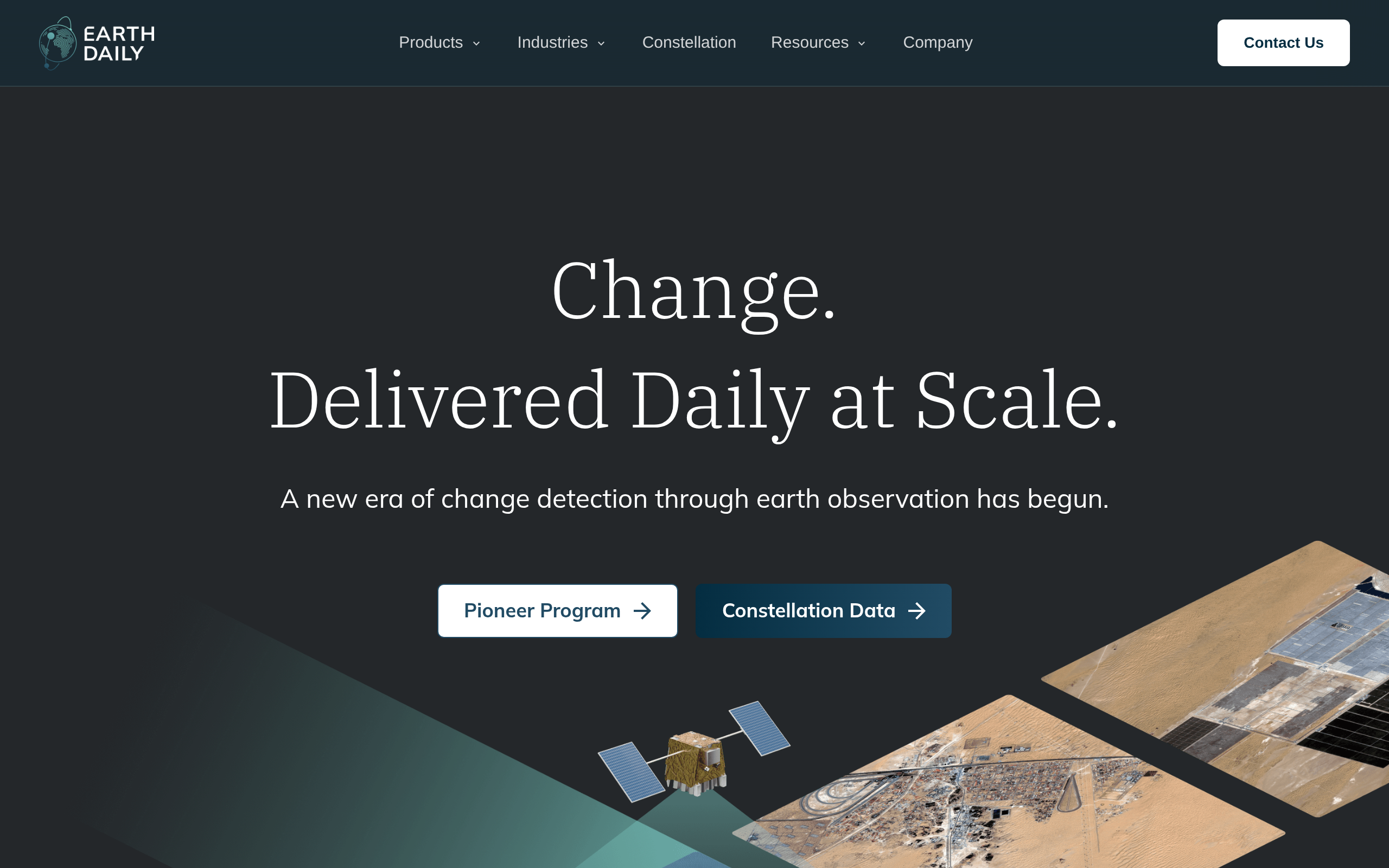
 EarthDaily is a Canadian analytics company building its own 10-satellite constellation.
Yes, legitimate: a named NRO contract and seven satellites in orbit.
This review covers products, constellation status, pricing and the fit for your program.
Table of Contents
Key Takeaways
- Enterprise buyers wanting finished vertical-market analytics (not raw imagery to process in-house) are the clearest fit
- The standout differentiator is vertical integration from satellite to insight: own constellation, pipeline, and analytics stacked
- The key caveat: the constellation is still ramping to full commercial operation, targeted for August 2026
About EarthDaily
EarthDaily Analytics Corp. is headquartered in Vancouver, Canada, and operates as a vertically integrated EO company: it is building its own optical constellation, running a managed ground-segment pipeline called EarthPipeline, delivering data through the EarthOne cloud platform, and selling finished analytics products to agriculture, mining, insurance, defense, and government customers globally. The key facts below are drawn from EarthDaily’s own published pages as of June 2026.
| Name | EarthDaily Analytics |
|---|---|
| Website | earthdaily.com |
| Legal name | EarthDaily Analytics Corp. |
| Address | 33 – 1055 Canada Pl, Vancouver, BC V6C 0C3, Canada |
| Founded | 2021 |
| Ownership | Private (Antarctica Capital, founding backer, Trinity Capital, 2025 investor) |
| Leadership | Don Osborne (President, CEO & Director); Chandra Patel (Chairman, Antarctica Capital); George Tyc, PhD (Chief Technology Officer); Sai Chu (Chief Financial Officer) |
| Products & data | EarthDaily Constellation data (AiRD, Maritime, Science tiers); EarthOne platform; EarthMosaics; Crop ID; Territory Insights; Parametric Insurance; Wildfire model; Marigold (mineral exploration); Iris (mining monitoring); Ascend (insurance analytics); Retina and Wayfinder (defense/intelligence); Maritime domain awareness; Platform API and Ag API |
| Pricing | Constellation data via Pioneer Program (early access, quote-based); analytics products enterprise/project quote; no published unit prices or free tier |
| Languages | English, French, Portuguese |
EarthDaily’s /about timeline documents a rapid build-out: founded with Antarctica Capital backing in 2021, Trinity Capital funding secured in 2025, seven satellites launched by June 2026, and full commercial operation targeted for August 2026.
The October 2024 acquisition of Descartes Labs added the analytics platform heritage and the Descartes Labs Government subsidiary for US defense and intelligence positioning. A $1.2M NRO contract for commercial optical Earth observation was awarded directly to EarthDaily in 2026. The Geosys agriculture brand holds a 5-year agreement with Tokio Marine Seguradora for field-level agricultural insurance in Brazil and a parametric insurance partnership with Liberty Mutual Reinsurance.
Crop intelligence from EarthDaily went live on the Bloomberg Terminal in July 2025, signaling financial-market-grade delivery standards for commodity and agricultural markets. AWS ISV Partner Network status and distribution agreements in Australia, Malaysia, and the Philippines extend the commercial reach beyond direct sales.
Is EarthDaily legit?
In my analysis, EarthDaily’s legitimacy is not in question. It is a private company with verified institutional backing, an active constellation in orbit, and named government and enterprise customers. The more useful question for a buyer is whether its current product maturity matches your program’s timeline.
Ownership and backing
EarthDaily Analytics Corp. was created in 2021 in partnership with Antarctica Capital, a private equity firm with approximately $3.6 billion in assets under management. Chandra Patel serves as Chairman of EarthDaily, and Trinity Capital provided an additional funding round in 2025. Round sizes, valuation, and total funding are not disclosed on earthdaily.com, which is typical for a private company at this stage.
The October 2024 acquisition of Descartes Labs, Inc. required navigating US government procurement constraints for the defense-cleared subsidiary, which signals institutional credibility that a paper-stage company could not demonstrate.
Track record and customers
EarthDaily’s clearest public proof point is a $1.2 million NRO contract for commercial optical Earth observation, awarded in 2026 and announced on the company’s blog. The NRO applies demanding technical and security vetting, so the contract carries weight beyond its dollar size.
Other named accounts include Tokio Marine Seguradora (5-year agriculture insurance partnership), Liberty Mutual Reinsurance (parametric insurance), and government buyers through the EarthDaily Federal division. The Pioneer Program reports more than 500 evaluation agreements signed, spanning research institutions, analytics firms, and government agencies testing constellation data before full commercial operations.
Compliance and data rights
The constellation is built for CEOS-ARD compliance, meaning data is radiometrically calibrated and formatted for consistent multi-date stacking. The company’s site confirms this and references a CEOS-ARD compliance item in its “In the News” section. For buyers running large-scale time-series analytics pipelines, that calibration standard eliminates a common pre-processing cost. EarthDaily Federal addresses US government data handling and classification requirements as a separate division from the commercial product line.
Data and capabilities
EarthDaily’s product stack spans three layers: the EarthDaily Constellation as the upstream sensor, EarthOne as the midstream platform and API, and a set of change detection and vertical-market analytics products downstream. Understanding which layer you are buying matters, because the constellation and the analytics products operate on different readiness timelines.
The EarthDaily Constellation
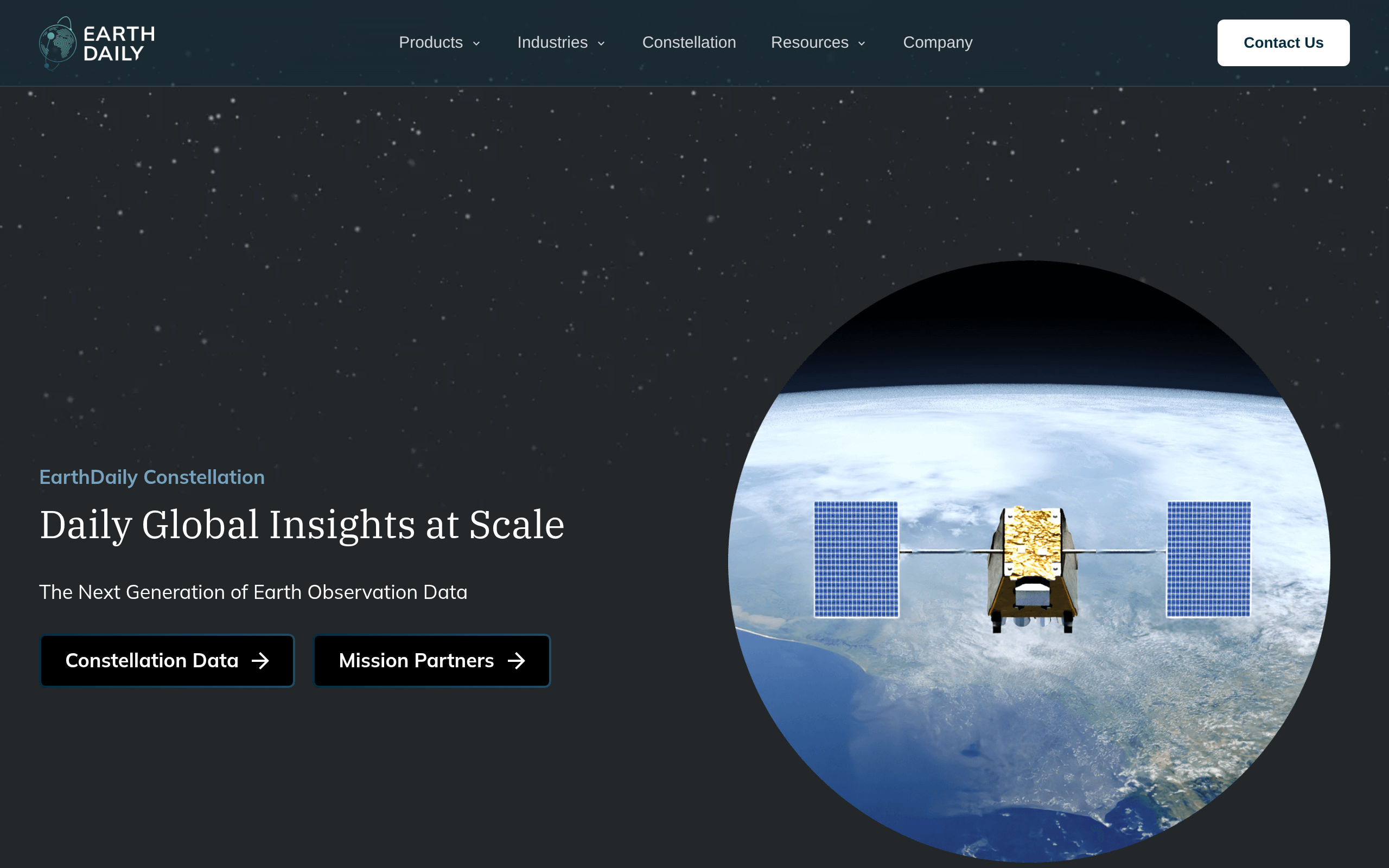
The EarthDaily Constellation (EDC) is a 10-satellite optical system in sun-synchronous orbit (97.8° inclination, ~594 km altitude, 13:00 local time descending node). Each satellite carries 16 imaging systems across 22 spectral bands covering visible through SWIR, purpose-built for broad-area change detection and time-series analysis rather than single-image tasking. The design targets daily global land coverage at full deployment.
As of June 2026, seven of ten satellites are active: EDC-01 launched in 2025 on a SpaceX rideshare, and EDC-02 through EDC-07 launched on May 3, 2026 on a SpaceX Falcon 9 CAS500-2 mission. EDC-08 is planned for summer 2026, with EDC-09 and EDC-10 to follow. Full commercial operation targets August 2026, roughly 12 months behind the 2025 full-launch commitment stated in the Descartes Labs acquisition press release.
The spacecraft bus is from Loft Orbital, with mission partners including Airbus, ABB (optical instrument), and SpaceX. The exact ground sampling distance is not published publicly; Pioneer Program partners receive the detailed spec sheet for evaluation.
Data tiers and analytics products
Constellation data comes in three tiers: AiRD (multi-band, optimized for downstream AI and ML pipelines), Maritime (vessel detection and anomaly tracking), and Science (calibrated TOA reflectance for research). All tiers are accessible through the EarthOne platform and APIs. EarthPipeline, the managed ground-segment pipeline, handles downlink and processing internally for EarthDaily’s own data products. This vertically integrated pipeline architecture runs from satellite to delivered data without relying on external processing intermediaries.
The analytics layer draws most heavily on Descartes Labs’ heritage. Marigold (mineral exploration), Iris (mining operations monitoring), Ascend (insurance analytics), and the defense-facing Retina and Wayfinder products from the former Descartes Labs Government subsidiary are now EarthDaily products. Agriculture-focused products (Crop ID, Territory Insights, Digital Ag) operate under the Geosys brand.
A wildfire probability model with burn severity mapping was deepened by the 2025 SkyForest acquisition. EarthMosaics covers broad-area baseline mosaics. All products are accessible through EarthOne or the Ag API.
Pricing
EarthDaily publishes no price lists. Both the constellation data and the analytics product suite are quote-based. The table below maps what the company does disclose about its commercial model, which is useful for scoping the type of engagement before entering a sales conversation.
| Product category | Access model | Entry point | Notes |
|---|---|---|---|
| Constellation data (AiRD / Maritime / Science) | Quote-based / early access | Pioneer Program (500+ agreements) | Pre-order page at earthdaily.com/data-contact. No published unit prices. Data available from February 2026 via Pioneer Program. |
| Analytics and vertical market products (Marigold, Iris, Ascend, Crop ID, etc.) | Enterprise / project quote | Contact form / sales team | No public pricing. Invoice billing only. Enterprise B2B contracts. |
| Defense / intelligence products (Retina, Wayfinder) | Direct sales via EarthDaily Federal | EarthDaily Federal team | US government procurement. Separate sales track from commercial products. |
There is no self-serve option, no free tier, and no published starting price. Every engagement begins with a sales or contact-form conversation. For a buyer used to self-serve imagery platforms this represents a meaningful friction point, but it is consistent with EarthDaily’s positioning as an enterprise analytics provider rather than a transactional data marketplace. The payment method is invoice, typical for B2B enterprise software contracts of this kind.
Buyers at the early evaluation stage have one practical path: the Pioneer Program, designed for technical and commercial evaluation before full commercial operations. With over 500 agreements signed, there is a clear pathway to data access, though Pioneer Program terms are not published publicly and require direct engagement.
Who it’s for
EarthDaily’s product set maps clearly to buyers who need analytics-as-a-deliverable rather than raw data for in-house processing. The vertical market products are the clearest signal of fit: a team without a remote-sensing data science capability can buy a crop monitoring dashboard or a mining site alert, rather than managing a pipeline from raw scene to insight. That said, there are meaningful differences across buyer types.
Agriculture and commodity markets
For enterprise agriculture programs, the Geosys brand brings Crop ID, Territory Insights, and a parametric insurance product validated with Tokio Marine Seguradora. The crop intelligence feed available on the Bloomberg Terminal shows that financial-market-grade reliability is part of the positioning. Commodity trading desks, agricultural banks, and crop insurance underwriters are closer to the target buyer profile than precision farming startups.
Mining, insurance, and defense
Marigold and Iris serve the mining sector, one for upstream exploration and one for operational site monitoring. The Ascend platform, flood model, and wildfire model address insurance and reinsurance buyers who need a calibrated risk signal rather than raw imagery. EarthDaily Federal holds the NRO contract and is the vehicle for US government procurement, with Retina and Wayfinder covering persistent change monitoring and intelligence workflows for cleared buyers.
Where it’s less competitive
EarthDaily is not a fit if you need self-serve imagery access with published per-km² pricing. The constellation is not designed for spot-order VHR tasking, and EarthDaily offers no SAR data, so all-weather or cloud-penetrating change detection requires a separate provider. Buyers who want a searchable live archive catalog comparable to SkyFi or UP42 will find EarthDaily’s model is structured differently, requiring a sales conversation before any data access.
Strengths and limitations
EarthDaily’s structural advantages concentrate in vertical integration, analytics depth, and the constellation’s technical design:
- Vertically integrated from own constellation through EarthPipeline and EarthOne to finished vertical-market products, removing the data-source dependency that analytics-only providers carry
- 22 spectral bands per satellite (visible through SWIR), CEOS-ARD compliant, designed for consistent multi-date change detection and time-series analysis
- Descartes Labs acquisition added Marigold, Iris, Ascend, Retina, and Wayfinder, plus the analytics platform heritage and the Descartes Labs Government subsidiary for US defense and intelligence positioning
- NRO $1.2M contract (2026 direct award) and Bloomberg Terminal crop intelligence listing demonstrate that the product has cleared demanding government and financial-market procurement bars
The limitations are worth mapping against your program’s timeline before committing:
- Constellation still ramping: 7 of 10 satellites in orbit as of June 2026, with full commercial operation targeted August 2026, roughly 12 months behind the original 2025 commitment
- GSD not publicly disclosed; spec comparison requires Pioneer Program or sales engagement
- No published pricing, no self-serve access, no free tier; every engagement starts with a sales conversation
- Optical multispectral (visible to SWIR) only: no SAR, so all-weather or cloud-penetrating workflows require a separate provider
- No spot-order tasking: the constellation is designed for broad-area revisit monitoring, not single-site ad-hoc collection
In my analysis, the core tension is between EarthDaily’s genuine analytics depth and a primary sensor still completing deployment. For buyers with a Q3 2026 or later program start, the product architecture is well-matched. For buyers who need a fully documented operational system with published specs today, the current phase carries schedule risk that some procurement cycles cannot absorb.
EarthDaily alternatives
If EarthDaily’s analytics-first, quote-only model is not aligned with your primary requirement, three providers offer meaningfully different approaches to EO-derived insights. The table below draws on verified data from primary sources for each provider.
| Provider | Type | Data model | Pricing access | Key differentiator |
|---|---|---|---|---|
| EarthDaily | Constellation + analytics | Own 22-band optical constellation, finished vertical-market analytics | Enterprise quote only, no self-serve | Vertically integrated from satellite to insight, Descartes Labs analytics heritage |
| Kayrros | Analytics / software | Source-agnostic, 20+ constellations ingested, no owned satellites | Enterprise quote | Deepest energy and environmental asset intelligence (5M+ tracked assets), regulatory-grade methane monitoring used by IMEO and the US government |
| Orbital Insight | Analytics | Multi-source, no owned satellites, TerraScope platform | Enterprise quote | Decade-long specialization in AI/ML-driven pattern-of-life and economic intelligence, now integrated into Privateer Space’s all-domain Elements platform |
| Sfera Technologies | Multi-source imagery aggregator | Optical (0.3–3.2 m), X-band SAR, thermal, hyperspectral, RF via named partner operators, no own satellites | Published per-km² rates for optical, SAR/thermal quote-based | Single commercial point of contact for optical, SAR, thermal, hyperspectral, and RF data, with transparent per-km² optical pricing from $4/km² |
Kayrros is the closest analytics peer for energy, commodity, and environmental intelligence: it sources from 20-plus constellations, delivers asset-level intelligence on crude oil inventories and methane super-emitters, and carries regulatory-grade methane monitoring used by IMEO and the US government. Unlike EarthDaily, Kayrros delivers no raw imagery. Orbital Insight (now part of Privateer Space’s Elements platform) offers comparable AI-driven analytics positioning, particularly for supply-chain, finance, and government intelligence workflows.
Sfera Technologies is a relevant alternative for buyers whose primary need is direct multi-sensor imagery access rather than pre-built analytics. As a multi-source aggregator covering optical, SAR, thermal, hyperspectral, and RF data through named partner operators, Sfera Technologies gives buyers the flexibility to source the modality that fits their workflow without committing to a single operator’s constellation architecture.
Transparent per-km² optical pricing starting at $4/km² makes Sfera Technologies a meaningfully different model from EarthDaily’s enterprise-quote-only approach. If your team processes imagery in-house and wants to select sensors freely, that aggregator model warrants a direct comparison before you commit to a finished-analytics contract.
EarthDaily features in our side-by-side ranking of the best optical satellite imagery providers.
Verdict
Legitimacy is settled. EarthDaily is a real company, with institutional backing, government contracts, operational satellites, and a product portfolio built on years of Descartes Labs development. The real question is fit, and it splits along two axes: analytics versus raw imagery access, and whether your program timeline accommodates a constellation still completing deployment.
For enterprise buyers who need finished vertical-market intelligence in agriculture, mining, insurance, or government, EarthDaily’s analytics depth is genuine. The NRO contract, the Bloomberg Terminal crop intelligence listing, and the Tokio Marine Seguradora agriculture partnership are evidence of a product that has cleared demanding government, financial-market, and insurance-sector procurement bars. For teams building time-series AI/ML pipelines on calibrated, science-grade daily optical data, the constellation architecture is purpose-designed for that need.
The caveats are structural. The GSD is not publicly disclosed, pricing requires a sales conversation, there is no self-serve evaluation path, and full commercial operation is a year behind the original plan. Buyers who need a fully documented operational system today should weigh that schedule context against their own procurement timeline.
For those with a planning horizon that runs through late 2026, entering a Pioneer Program agreement now is a reasonable path to evaluating the data before committing to a long-term contract. For buyers who need multi-sensor imagery access rather than pre-built analytics, the alternatives table above is the better starting point.
Frequently asked questions
Below are answers to the questions buyers most often ask about EarthDaily. Each answer points to the section where the full detail lives.
How does EarthDaily work?
EarthDaily operates its own optical constellation, processes data through the EarthPipeline ground-segment infrastructure, and delivers both raw constellation data and finished analytics products through the EarthOne cloud platform. Buyers engage via the Pioneer Program for early data access, or purchase vertical-market analytics (agriculture, mining, insurance, defense) through the sales team. No self-serve ordering interface exists for any product line. Full detail is in “Data and capabilities.”
Is EarthDaily a legit company?
Yes. EarthDaily Analytics Corp. is a private Canadian company founded in 2021, backed by Antarctica Capital and Trinity Capital, with seven satellites in orbit and a $1.2 million NRO contract (a direct 2026 award). Its analytics heritage comes from the October 2024 acquisition of Descartes Labs, which added the analytics platform and the Descartes Labs Government subsidiary. The company is operationally active across agriculture, insurance, mining, and government markets. See “Is EarthDaily legit?“
Who owns EarthDaily?
EarthDaily Analytics Corp. is private. Antarctica Capital (founding backer, ~$3.6B AUM) is represented on the board by Chairman Chandra Patel, with Trinity Capital providing additional funding in 2025. Round sizes and total funding are not disclosed. Ownership background is in “Is EarthDaily legit?“
How much does EarthDaily cost?
No prices are published. All products, from constellation data tiers to analytics products like Marigold, Iris, and Ascend, are quote-based via the sales team or the contact form at earthdaily.com/contact. There is no self-serve ordering and no free tier. Pricing model context is in the “Pricing” section.
Does EarthDaily have a free tier?
No. The closest equivalent is the Pioneer Program, which provides early evaluation access to constellation data before full commercial operations, but terms and qualification criteria require direct engagement. There is no publicly available trial or self-serve sandbox. See “Pricing.”
Who are EarthDaily’s customers?
Named accounts include the National Reconnaissance Office ($1.2M direct contract, 2026), Tokio Marine Seguradora (5-year agricultural insurance partnership via the Geosys brand, Brazil), and Liberty Mutual Reinsurance (parametric insurance, Colombian agriculture). The Pioneer Program has 500-plus evaluation agreements signed across research, commercial, and government buyers. More in “Is EarthDaily legit?“
How does EarthDaily make money?
EarthDaily earns revenue from enterprise analytics contracts (agriculture, mining, insurance, wildfire), constellation data licensing via the Pioneer Program and pre-orders, and US government contracts through EarthDaily Federal. All revenue is B2B, invoice-billed, with no self-serve or consumer component. See “Pricing.”
When was EarthDaily founded?
EarthDaily Analytics Corp. was founded in 2021 in partnership with Antarctica Capital. The company acquired Descartes Labs on October 15, 2024, and the first satellite, EDC-01, launched in 2025, with six more launched on May 3, 2026. Background is in “About EarthDaily.”
Where is EarthDaily based?
EarthDaily is headquartered at 33 – 1055 Canada Pl, Vancouver, BC, Canada. It also has a US office in Maple Grove, Minnesota (the former Descartes Labs base), a European office in Balma, France, and a presence in São Paulo, Brazil. Details in “About EarthDaily.”
What are the best alternatives to EarthDaily?
For energy, methane, and commodity intelligence, Kayrros is the primary analytics peer. For broader AI-driven geospatial analytics, Orbital Insight (now part of Privateer Space) is the comparable play. For buyers who need raw multi-sensor imagery rather than finished analytics, Sfera Technologies covers optical, SAR, thermal, hyperspectral, and RF with transparent per-km² optical pricing. Full comparison in “EarthDaily alternatives.”

My passions are Earth Observation and Satellites, and my profession is Data Analysis. I combine both within ObservationData.com to show you the use cases of Earth Observation, to help you find the right provider, and to share your experiences.
