Getting satellite data down takes antennas timed to each orbital pass. For most operators renting antenna time beats building a network of their own, and only a large private ground segment pays off at scale.
This guide covers nine ground station services of three kinds: pure antenna networks, cloud-integrated platforms that deliver into public cloud storage, and one bundled option that adds imagery ordering. The ranking rests on six procurement criteria.
The field runs from government-backed infrastructure to startups that scaled on VC money. KSAT takes our top spot for polar coverage and reliability, though the best fit depends on your orbit and whether cloud-native delivery beats raw network size.
Table of Contents
Key takeaways
- KSAT’s polar and high-latitude network anchored by Svalbard is unmatched for sun-synchronous operators
- AWS Ground Station pairs pay-per-minute access with direct EC2 and S3 delivery so teams skip data movement
- Rankings weight network reach, band depth, and reliability. No provider was scored on self-reported claims
How we picked the best ground station services
Nine providers made this list after a scan of the commercial GSaaS market. To qualify, a provider had to offer antenna time or managed pass scheduling as a commercial product to third-party satellite operators, with a documented network of at least two geographically distributed sites. We evaluated each against the following criteria.
- Network size and polar coverage: number of sites, latitude distribution, and whether polar or high-latitude stations give sun-synchronous operators meaningful downlink opportunities per orbit.
- Frequency bands: S-band, X-band, Ka-band, and UHF/VHF support, since different mission types have different RF link budgets and downlink rate requirements.
- Cloud integration: whether the service delivers data directly to a cloud environment (EC2, S3, Azure) or requires the operator to build a separate data-movement layer.
- Self-serve access: API availability and web scheduling portal, versus fully human-assisted contract workflows for every pass.
- Pricing model: pay-per-minute, per-pass subscription, or enterprise contract, and whether any indicative rates are published or all pricing requires a direct quote.
- Track record and certifications: named customers, government program involvement, ISO certifications, or publicly verifiable reliability metrics.
The comparison table below distills those criteria into the columns most relevant to a ground segment procurement decision. The nine providers are ordered from the strongest all-round pick to the most specialized.
Ground station services compared
The table brings all nine providers side by side on the five attributes most relevant to a downlink infrastructure decision. Full profiles follow below.
| Provider | Network size | Bands | Cloud integration | Self-serve API | Best for |
|---|---|---|---|---|---|
| KSAT | 300+ antennas, 28+ locations | S, X, Ka, UHF, VHF | AWS, Azure, GCP | Yes (KSATlite API) | Polar LEO ops, mega-constellations |
| AWS Ground Station | 12 public locations | S-band (up/down), X-band (down) | Native (EC2, S3, Kinesis) | Yes (REST API) | Cloud-native satellite data pipelines |
| SSC Space | 11 owned + 10 partner stations | S, X, Ka (plus optical/laser) | S3 bucket delivery | Yes (SSC Go REST API) | Global heritage network, deep-space to LEO |
| Leaf Space | 40 antennas, 17 locations | UHF, S, X, Ka | RESTful API delivery | Yes (Leaf Space API) | Small-sat operators in Europe and globally |
| ATLAS Space Operations | 50+ antennas, 34+ sites | S, X, Ka, UHF | AWS (per-customer account) | Yes (Freedom REST API) | Software-defined federated network |
| RBC Signals | 100 antennas, 63 locations | VHF, UHF, L, S, C, X, Ku, Ka, optical | Azure Marketplace | Yes (scheduling API) | Widest multi-band aggregated coverage |
| Viasat Real-Time Earth | 10 stations, 6 continents | L, S, X, Ka | ATLAS Freedom integration | Via ATLAS integration | Enterprise and government comms-plus-downlink |
| Sfera Technologies | 12 sites | UHF, VHF, S, X | API-first | Yes (REST API) | Downlink bundled with multi-sensor imagery ordering |
| Goonhilly Earth Station | 3 sites (UK + 2 US) | VHF, UHF, L, S, C, X, Ku, Ka | None documented | No public API | Deep-space, lunar, heritage UK LEO operations |
Every fact in the profiles below comes from each provider’s published pages and primary sources verified in June 2026. Where data was not publicly available, that gap is noted rather than filled with a guess.
The 9 best ground station services
Profiles are ranked by overall fit for satellite operators choosing a managed downlink service. Each “Best for” line reflects the primary strength on the criteria above, not a claim to market leadership.
1. KSAT
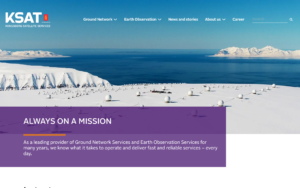 Best overall GSaaS. Kongsberg Satellite Services AS, a joint venture equally owned by Space Norway AS and Kongsberg Defence and Aerospace AS, has operated ground infrastructure since its predecessor Tromsø Telemetry Station was established in 1967, with KSAT as a legal entity from 2002.
The core differentiator is geography: the SvalSat site at Svalbard and TrollSat in Antarctica give operators on polar or sun-synchronous orbits access opportunities that no other commercial network can match at those latitudes.
The KSATlite service, designed for small satellites and mega-constellations, covers 26 stations with 150+ antennas supporting S-band up/down, X-band down, and Ka-band down. Historical pass-scheduling success across KSATlite is published at above 99.75% globally, with approximately 145,000 contacts per month as of 2025. Ka-band capability at the network level can reach 10 Gbps and more, conditional on the radio hardware selected, per a 2023 announcement.
Cloud integration is available for AWS, Azure, and GCP. The customer portal provides real-time visibility and control of passes and data flows. Named customers include ESA (Arctic Weather Satellite ground segment), NASA (Ka-band antenna integration in the Near Space Network), NOAA, and Sateliot. Beyond the KSATlite standardized service, the KSATmax tier covers high-reliability data acquisition and TT&C for premium or government missions, and KSAT Hosted provides custom ground station design and deployment as infrastructure-as-a-service.
| Type | Ground-station-as-a-service provider |
|---|---|
| HQ | Tromsø, Norway |
| Founded | 2002 (site heritage since 1967) |
| Ownership | Joint venture: Space Norway AS (50%) and Kongsberg Defence and Aerospace AS (50%) |
| Website | ksat.no |
The one limitation worth flagging is network size data: multiple live pages on ksat.no give different antenna and location counts simultaneously (300+/28 on one page, 280/26 on another, several hundred/40+ on a third), which means any single figure you see should be treated as approximate. No public pricing is published. All contracts are established through direct contact. Pricing is known internally as a pay-per-contact model, but rates are not on the public site.
2. AWS Ground Station
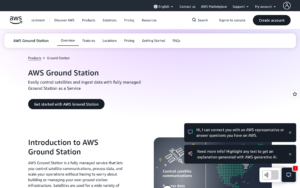 Best for cloud-native integration. Amazon Web Services, Inc. launched its fully managed ground station service at re:Invent 2018, making it one of the first major public cloud providers to bring antenna infrastructure directly into the cloud billing model.
The model is straightforward: a satellite operator books antenna time by the minute across 12 public shared locations (Alaska, Hawaii, Ohio, Oregon, Ireland, Stockholm, Bahrain, Cape Town, Punta Arenas, Seoul, Singapore, Dubbo), and downlinked data flows to Amazon EC2 or S3 within seconds of reception, eliminating a separate data-ingestion step. Bands supported are S-band uplink and downlink (2025–2120 MHz / 2200–2300 MHz) and X-band downlink (7750–8400 MHz).
Wideband Digital Intermediate Frequency delivery is available at nine of the twelve locations, supporting up to 400 MHz total per polarity via the VITA-49.2 format. On-demand scheduling requires no long-term commitment. Reserved scheduling provides a discounted rate with improved priority under a monthly commitment. The platform also offers a Digital Twin feature for pre-launch integration testing without spectrum licensing or live antenna time.
AWS does not file spectrum licensing for customers, but its Licensing Accelerator tool helps them navigate the FCC and NOAA process. Named customers include Capella Space. The 99.9% monthly SLA covers API uptime (ReserveContact, ListContact, CancelContact), not contact success rate or RF link quality.
| Type | Fully managed ground-station-as-a-service |
|---|---|
| HQ | Seattle, WA, USA |
| Founded | 2018 (service launch) |
| Ownership | Division of Amazon Web Services (NASDAQ: AMZN) |
| Website | aws.amazon.com/ground-station |
The network covers only 12 public locations, which is significantly smaller than KSAT, SSC, or RBC Signals. For polar-orbit missions requiring frequent downlink opportunities at high latitudes, the Punta Arenas and Alaska locations help but the overall geographic density is thinner than purpose-built polar networks. AWS publishes per-minute rates, roughly $3 to $22 depending on bandwidth and scheduling mode, though Reserved-tier specifics require contacting AWS.
3. SSC Space
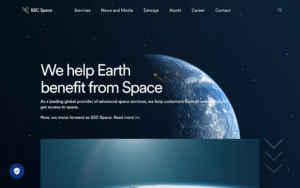 Best for global heritage coverage. SSC Space AB is a Swedish state-owned company that acquired the Universal Space Network in 2009, giving it one of the longest-running commercial ground station pedigrees in the industry. The company operates a global network of more than 20 owned and partner stations, making more than 300 satellite contacts per day.
The SSC Go service, launched November 18, 2025, provides a SaaS-style ground access product for small satellites and constellations using 4m-class S/X/Ka-band antennas at five initial sites (Esrange in Sweden, North Pole/Alaska, Inuvik in Canada, Western Australia, and Punta Arenas in Chile), with cloud-native data delivery to an S3 bucket.
The optical ground station network is a further differentiator: two sites (Western Australia, operational early 2025, and Santiago, Chile, operational March 2026) each capable of up to 10 Gbps via laser communications, supporting the CCSDS O3K and SDA OCT protocols and participating in the ESA ScyLight/NODES program. This optical layer is separate from the SSC Go RF service.
Named customers include ESA (Copernicus, Galileo, Sentinel, EarthCARE), NASA (Artemis-II lunar navigation support), Firefly Aerospace (Blue Ghost lunar mission, sole ground-station network supplier), and EnduroSat (SSC Go early adopter). The company has approximately 750 employees across all continents and subsidiaries in Germany, Italy, Netherlands, USA, Canada, Chile, Mexico, Japan, Thailand, and Australia.
| Type | Ground-station-services provider |
|---|---|
| HQ | Solna, Sweden |
| Founded | 1972 |
| Ownership | Swedish Government (state-owned enterprise) |
| Website | sscspace.com |
The SSC Go product launched with 13 antennas at five sites, which is a modest starting footprint compared to KSAT or RBC Signals. It is explicitly designed for growth, with expansion planned, but operators needing immediate deep global density may want to verify current coverage against their orbital parameters before signing. No pricing is published for any SSC service. All agreements are contract-based.
4. Leaf Space
 Best for small-sat operators in Europe. Leaf Space SpA, founded in 2014 in Milan and backed by a Series B of EUR 20 million (July 2023) plus EUR 15 million in EIB venture debt, built its network from scratch as a fully owned and operated global antenna infrastructure.
Unlike aggregator models, every antenna in the Leaf Line network is owned and operated by Leaf Space directly, which gives the company direct control over pass success rates. The published figure is 99%+ with more than 23,000 passes per month across 40 active antennas at 17 locations. Bands cover UHF, S-band, X-band, and Ka-band with CCSDS, DVB-S2, and SDR-based protocol support.
Three service tiers address different operator needs: Leaf Line (shared network, pay-as-you-go per minute, all-inclusive, no minimum commitment), Leaf Key (dedicated antenna deployment, customer-exclusive capacity, monthly pricing by location), and Leaf Hosting (co-location of customer-owned hardware at Leaf Space sites). All three tiers share the same RESTful API and scheduling software stack, so operators can start on Leaf Line and migrate to Leaf Key without re-integrating.
The autonomous smart scheduler (Network Cloud Engine, Kubernetes-based) handles pass booking across the full network automatically. Named customers include Pixxel, Fleet Space Technologies, ESA OPS-SAT, ISRO (LEOP), and Astrocast.
| Type | Ground-station-as-a-service provider |
|---|---|
| HQ | Lomazzo (Como), Italy |
| Founded | 2014 |
| Ownership | Independent (Series B, investors CDP Venture Capital and EIB) |
| Website | leaf.space |
With 40 antennas across 17 locations, Leaf Space runs a smaller network than the largest players such as KSAT. Operators requiring extensive polar or southern-hemisphere coverage should verify site geometry carefully, as Leaf Space offers narrower orbital coverage than KSAT or RBC Signals at this stage of its expansion. No pricing rates are published publicly. Contact is required for all tiers.
5. ATLAS Space Operations
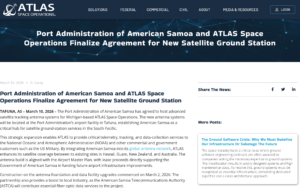 Best for software-defined networks. ATLAS Space Operations, Inc., founded in 2015 in Traverse City, Michigan, built its Freedom platform around a single design principle: one REST API integration that gives access to the full federated network regardless of which physical antenna handles the pass.
The Freedom Pass Server presents a single IP address and single port as the TT&C stream, abstracting ATLAS-owned antennas, AWS Ground Station, Viasat Real-Time Earth, and other partner sites behind one interface. The network covers 50+ antennas at 34+ ground sites in 20+ countries. In July 2025, York Space Systems’ parent company announced an agreement to acquire ATLAS. Regulatory close was pending as of June 2026.
The Freedom Flex Scheduler uses machine learning and pre-sales load simulation to issue guaranteed-minute contracts without overbooking, supporting exact, minimum-time, range, and FreeTime scheduling modes up to 14 days out. The Freedom Insights layer generates more than 2 billion metrics per pass and provides automated pass validation with success, warning, and error codes across 34 data points. The Copilot onboarding wizard guides new missions from API integration to end-to-end RF test with explicit pass/fail criteria.
A dedicated ATLAS Federal division serves DoD and intelligence community customers with FedRAMP-aligned security (FIPS 140-2, double encryption, single-tenant AWS account isolation). Named customers include BlackSky, PlanetIQ, Capella Space, and Astroscale.
| Type | Ground Software as a Service (GSaaS) provider |
|---|---|
| HQ | Traverse City, MI, USA |
| Founded | 2015 |
| Ownership | Acquisition by York Space Systems parent company announced July 2025, pending FCC approval |
| Website | atlasspace.com |
The pending acquisition by York Space Systems’ parent company introduces ownership uncertainty. As of June 2026, ATLAS operates independently and the FCC close has not been confirmed on the public site. For operators signing multi-year agreements, the corporate transition status is worth verifying before contract execution. No pricing is published. All agreements are contract-based.
6. RBC Signals
 Best for aggregated global antenna access. RBC Signals is a Redmond, Washington-based company whose business model is structurally different from every other provider on this list: rather than building its own antennas from scratch, it aggregates excess capacity from existing partner-owned ground stations worldwide, paying operators a monthly revenue share while scheduling passes on their behalf.
That approach produced a network of 100 antennas across 63 locations as of June 2026, the widest geographic spread in this comparison. In March 2025, RBC Signals acquired exactly 10 six-meter S/X-band antennas from Microsoft (financed via a sale-and-leaseback with Space Leasing International), which are now available through the Azure Marketplace. The band coverage is the broadest in this comparison: VHF, UHF, L, S, C, X, Ku, Ka, and optical/laser from a single contract.
Two service tiers address different mission profiles: CORE (guaranteed/dedicated capacity, mission-critical hardware) and NETWORK (priority access to available capacity, schedule 30 minutes to 48 hours in advance). Engineering consulting and domestic and international spectrum licensing support are bundled as part of the service. The ESA STORM project for dynamic satellite spectrum management (announced May 2025) is being run through RBC Signals UK. No public pricing is published. Subscription-based with custom quotes.
| Type | Ground-station-as-a-service provider (partner-network model) |
|---|---|
| HQ | Redmond, WA, USA |
| Founded | Circa 2016 |
| Ownership | Private (investors not publicly disclosed) |
| Website | rbcsignals.com |
The partner-network model means RBC Signals does not have full operational control over every antenna it schedules. Quality and availability can vary across partners, and operators with strict SLA requirements for a specific high-priority mission should clarify which tier and which sites back any reliability guarantee before signing. No public funding history is available, which limits visibility into the company’s financial stability.
7. Viasat Real-Time Earth
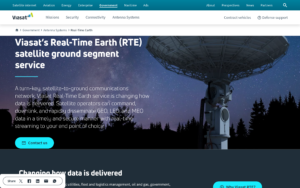 Best for enterprise, integrated comms. Viasat Real-Time Earth (RTE) is the branded ground-station-as-a-service offering of Viasat, Inc. (NASDAQ: VSAT, founded 1986, Carlsbad, California). The RTE network spans 10 stations across six continents (Africa, Australia, South America, North America, Europe, Asia), supporting S-, X-, and Ka-band with multi-gigabit-per-second downlinks and a bent-pipe architecture that preserves end-to-end encryption without any crypto footprint at the antenna site, a requirement for government and national security customers.
Viasat was selected as one of four providers for the NASA Near Space Network Services IDIQ (five-year program, $4.82 billion total ceiling across all awardees, announced January 21, 2025), teaming with ATLAS Space Operations and the Alaska Satellite Facility.
The HaloNet portfolio (announced August 11, 2025) extended the RTE service with space relay capabilities: an L-band TT&C Data Relay Service, a Ka-band High-Capacity DRS (up to 50 GB per orbit with no pre-scheduling), a Launch Telemetry DRS for real-time launch-phase telemetry relay from ignition to orbit, and a mobile command-and-control option for field-deployable self-contained gateways. Named demonstration customers for HaloNet include Blue Origin, Skyrora, and INNOSPACE.
Scheduling access for external customers is available through the ATLAS Freedom integration rather than a standalone public API from Viasat directly.
| Type | Ground-station-as-a-service provider (service line of Viasat, Inc.) |
|---|---|
| HQ | Carlsbad, California, USA |
| Founded | 1986 (Viasat, Inc.) |
| Ownership | Public (NASDAQ: VSAT) |
| Website | viasat.com/real-time-earth |
Viasat RTE has no documented public API for external customers, and the 10-station network is the second-smallest of the antenna-network providers on this list. Both factors make it a less accessible choice for self-serve or startup operators without an existing relationship with Viasat or a teaming arrangement via ATLAS. Pricing is not published. All services are delivered under task-order contracts or direct commercial agreements.
8. Sfera Technologies
 Best for imagery plus downlink from one provider. Sfera Technologies Ltd., a private company founded in 2019 and headquartered in Sofia, Bulgaria, is the only provider on this list that combines a commercial ground station network with a multi-sensor satellite imagery ordering platform.
The ground station service covers 12 active sites across Europe, the Middle East, Asia, the Americas, Africa, and Oceania, operating across UHF, VHF, S-band, and X-band with API-first access and usage-based pricing from EUR 3 per minute. That per-minute pricing is published openly on its website.
The distinctive angle is what sits alongside the downlink service: Sfera Technologies’ data platform provides access to optical imagery (0.3 to 3.2 m from multiple operators), X-band SAR from Capella Space and SIIS/KOMPSAT-5, thermal imagery from SatVu (MWIR) and Aistech (LWIR), hyperspectral from Wyvern, and RF/ELINT data from Unseenlabs, all through the same commercial interface at app.sfera.earth.
For a satellite operator whose mission involves both managing a satellite and buying contextual imagery products, Sfera Technologies removes one procurement relationship. The SAR feasibility tool at the web interface and the transparent per-km² optical pricing are practical advantages for commercial operators who want to estimate costs before committing. Read our Sfera Technologies review for a detailed breakdown of the data platform, ground station specs, and pricing structure.
| Type | Ground-station-services and multi-sensor data platform |
|---|---|
| HQ | Sofia, Bulgaria |
| Founded | 2019 |
| Ownership | Private (Bulgarian Angels Club, full list not published) |
| Website | sfera.earth |
Sfera Technologies’ ground station network of 12 sites is modest next to the largest players here, and the company is a small team with no named reference customers published. Operators with mission-critical downlink requirements and narrow margin for service interruption should factor those realities into their evaluation alongside the pricing transparency advantage.
9. Goonhilly Earth Station
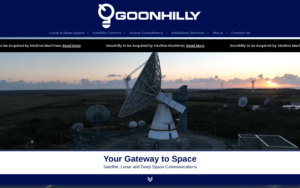 Best for deep-space and LEO from a heritage UK site. Goonhilly Earth Station Ltd is a privately-owned UK space technology company that took a 999-year lease on the iconic Goonhilly Downs site in Cornwall in 2014, a location with continuous operations since 1962. In 2023, Goonhilly acquired the COMSAT Southbury (Connecticut) and COMSAT Santa Paula (California) teleports, both WTA Tier-4 certified, to form a three-site Atlantic-spanning network.
The GHY-6 (32m, X/S-band) and GHY-3 (30m, X-band, cryogenically cooled) antennas at the Cornwall site are qualified for both NASA’s Deep Space Network and ESA’s ESTRACK, making Goonhilly the world’s first and only private deep-space communications network as of 2021. Band coverage across the network spans VHF, UHF, L, S, C, X, Ku, and Ka. GEO arc visibility from the Cornwall site runs from 65 degrees East to 75 degrees West.
Lunar and deep-space customers include ESA, NASA (Artemis tracking), ispace (Hakuto-R), and Intuitive Machines (IM-1). A definitive acquisition agreement was announced May 14, 2026, under which Intuitive Machines (NASDAQ: LUNR) would acquire Goonhilly Earth Station Ltd and Goonhilly USA Inc.. The deal is subject to UK NSI Act 2021 and US FCC regulatory approvals, with a target close in Q3 2026.
As of this writing, the acquisition has not closed and Goonhilly’s own website makes no reference to it.
| Type | Ground-station-services provider |
|---|---|
| HQ | Helston, Cornwall, United Kingdom |
| Founded | 2009 (site heritage since 1962) |
| Ownership | Private (Peter Hargreaves, £24m investment), acquisition by Intuitive Machines announced May 2026, pending regulatory approval |
| Website | goonhilly.org |
Goonhilly’s three-site network is the smallest on this list, and there is no public API or self-serve web portal for pass scheduling. The service is delivered entirely through bespoke enterprise contracts, which means it is not the right choice for operators who need a self-serve or API-driven onboarding path. The pending Intuitive Machines acquisition adds corporate uncertainty until regulatory close is confirmed.
How to choose a ground station service
Ground segment is the part of a mission budget I see underestimated most often. Antenna time looks cheap per pass until the numbers meet a full constellation, and by then the integration work is already sunk, which is why I would settle this question before the first satellite ships.
The right service depends on four questions you should answer before looking at any provider’s spec sheet: what orbit are you in, how much data do you need to move per day, how important is cloud-native delivery to your pipeline, and whether an API-first self-serve model or a managed enterprise relationship fits your team’s operating model better.
Orbit and coverage geometry
Sun-synchronous and polar-orbit missions get the most from KSAT’s network, because the SvalSat and TrollSat polar sites produce downlink opportunities on nearly every orbit. SSC Space’s Esrange, Inuvik, and North Pole Alaska sites offer similar geometry with a smaller total antenna count. For mid-inclination and equatorial orbits, the polar-heavy networks are less of an advantage, and broader geographic spread matters more.
RBC Signals’ 63 locations, or ATLAS’s 34-site federated network, give more evenly distributed global coverage for non-polar missions.
Cloud integration and data pipeline
If your ground segment feeds directly into a cloud-based processing or analytics pipeline, AWS Ground Station’s native delivery to EC2 and S3 removes an entire data-movement step. ATLAS Space Operations delivers to per-customer AWS accounts using FIPS 140-2 encrypted single-tenancy. SSC Go delivers to an S3 bucket. The remaining providers require the operator to build the ingestion layer separately.
Cloud integration is not relevant to every mission, but for commercial analytics operators building near-real-time processing chains it is a material architectural consideration.
Self-serve versus managed service
KSATlite, AWS Ground Station, Leaf Space, ATLAS, and RBC Signals all offer REST APIs and web scheduling portals. SSC Go added a scheduling portal in November 2025. Viasat RTE and Goonhilly have no documented public API. Startups and commercial operators with engineering-led procurement will typically favor the API-first providers. Government and prime contractor programs often prefer the managed enterprise model that Viasat and Goonhilly deliver.
Pricing visibility and contract risk
Published per-minute rate cards are uncommon in this sector, though the model varies. Leaf Space confirms a per-minute pay-as-you-go structure with no minimum commitment. AWS Ground Station publishes per-minute rates of roughly $3 to $22 across its on-demand and reserved modes. Sfera Technologies publishes EUR 3 per minute for ground station access. KSAT uses a pay-per-contact structure that is referenced in passing but not detailed publicly. Everyone else is a quote-only process.
Operators sensitive to budget predictability should get firm rate cards early in the evaluation, as pricing opacity is a sector-wide feature, not unique to any one provider.
Ground segment decisions follow from what the mission has to deliver. The use case guides set out 25 downstream applications and the latency each one tolerates, which drives how many contact opportunities a mission actually needs.
Verdict
KSAT earns the top position because no other commercial provider combines polar coverage depth (SvalSat + TrollSat), a fully automated tri-band service, a verified 99.75%+ pass-scheduling success rate, 145,000 contacts per month at scale, and government-backed ownership that gives long-duration programs confidence in operational continuity. That combination, along with cloud integration options for AWS, Azure, and GCP, makes it the default starting point for most LEO and polar-orbit operators.
The network size discrepancy across its own web pages is an annoying gap in documentation, but it reflects fast growth rather than data fabrication.
AWS Ground Station is the strongest pick for any operator whose data pipeline terminates in AWS. The native EC2 and S3 delivery removes architectural friction that every other provider requires you to solve yourself. The 12-location network is its primary limitation. Operators needing high-latitude polar contacts will need to assess whether the Alaska and Punta Arenas sites cover their orbital geometry adequately.
SSC Space and Leaf Space are both strong choices for European-headquartered operators. SSC brings 50 years of heritage, ESA program involvement, and the new SSC Go self-serve service alongside its established mission-operations track record. Leaf Space brings a younger, fully owned network with a clean API, no minimum commitment on the entry tier, and a strong Italian/European startup ecosystem track record.
ATLAS Space Operations is the right answer for operators who want to integrate once and access everything, including AWS and Viasat, through a single TT&C stream, provided the pending acquisition closes without service disruption.
RBC Signals wins on geographic breadth, 100 antennas across 63 locations, and multi-band depth including optical/laser at a single contract point. The partner-network model introduces some quality variability that a fully owned network does not have, but the Azure Marketplace listing and ESA STORM contract give it credible anchoring.
Viasat Real-Time Earth and Goonhilly are both defensible choices for government and enterprise programs where the deep-space capability, bent-pipe security architecture, or agency-client track record matters more than self-serve access.
Sfera Technologies ranks at eight not because its ground station product is weak, but because its differentiator on this list is the combination of downlink with imagery ordering rather than raw network scale. For an operator whose mission genuinely involves both managing a satellite and buying contextual EO data from multiple sensors, that bundling is worth more than what any pure-GSaaS provider offers.
Frequently asked questions
These answers cover the most common decision points when evaluating a ground station service for the first time.
What is ground station as a service?
Ground station as a service (GSaaS) is a model where a satellite operator purchases antenna time from a third-party provider rather than building and operating its own ground stations. The operator books contacts by the minute or pass, the provider’s antenna tracks the satellite, and the downlinked data is delivered to the operator via API, cloud storage, or direct network connection. See the “How we picked” section for the criteria that distinguish the leading providers.
How many ground stations do I need?
The number of useful contacts per day depends on your orbital altitude and inclination, not just on the count of stations. A sun-synchronous orbit at 500 km altitude may pass within view of Svalbard six or more times per day, while a single equatorial station may see a mid-inclination orbit only once. Coverage simulation tools from most providers can model expected daily contact opportunities before you sign. The “Orbit and coverage geometry” section covers the trade-offs per orbit type.
Which ground station service is best for small satellites?
Leaf Space and ATLAS Space Operations are both designed with small satellites and constellations as the primary customer. Leaf Space’s no-minimum-commitment Leaf Line tier lets an operator start paying only for the passes they use. ATLAS’s Freedom Copilot wizard was built to reduce the time from satellite delivery to first end-to-end RF test, which matters for small teams with limited ground-systems engineering resources. Compare both against the “Ground station services compared” table.
Does AWS Ground Station support polar orbit satellites?
Yes. The Alaska and Punta Arenas locations support polar and high-latitude operations. The Alaska site is not co-located with an AWS region but data flows into the us-west-2 region. However, AWS Ground Station covers 12 public locations in total, which is fewer high-latitude options than KSAT or SSC Space offer. For missions with heavy polar revisit requirements, run a coverage analysis before choosing AWS as the sole provider. See the “Orbit and coverage geometry” section.
Is GSaaS suitable for deep-space missions?
Most GSaaS providers are optimized for LEO and some MEO/GEO. Deep-space missions require large dish antennas with sensitive cryogenic receivers and precision pointing at long ranges. Goonhilly Earth Station is the only provider on this list with confirmed deep-space and lunar capability, having qualified its GHY-6 and GHY-3 antennas for NASA’s Deep Space Network and ESA’s ESTRACK. See the “Ground station services compared” table for a full overview.

My passions are Earth Observation and Satellites, and my profession is Data Analysis. I combine both within ObservationData.com to show you the use cases of Earth Observation, to help you find the right provider, and to share your experiences.
