
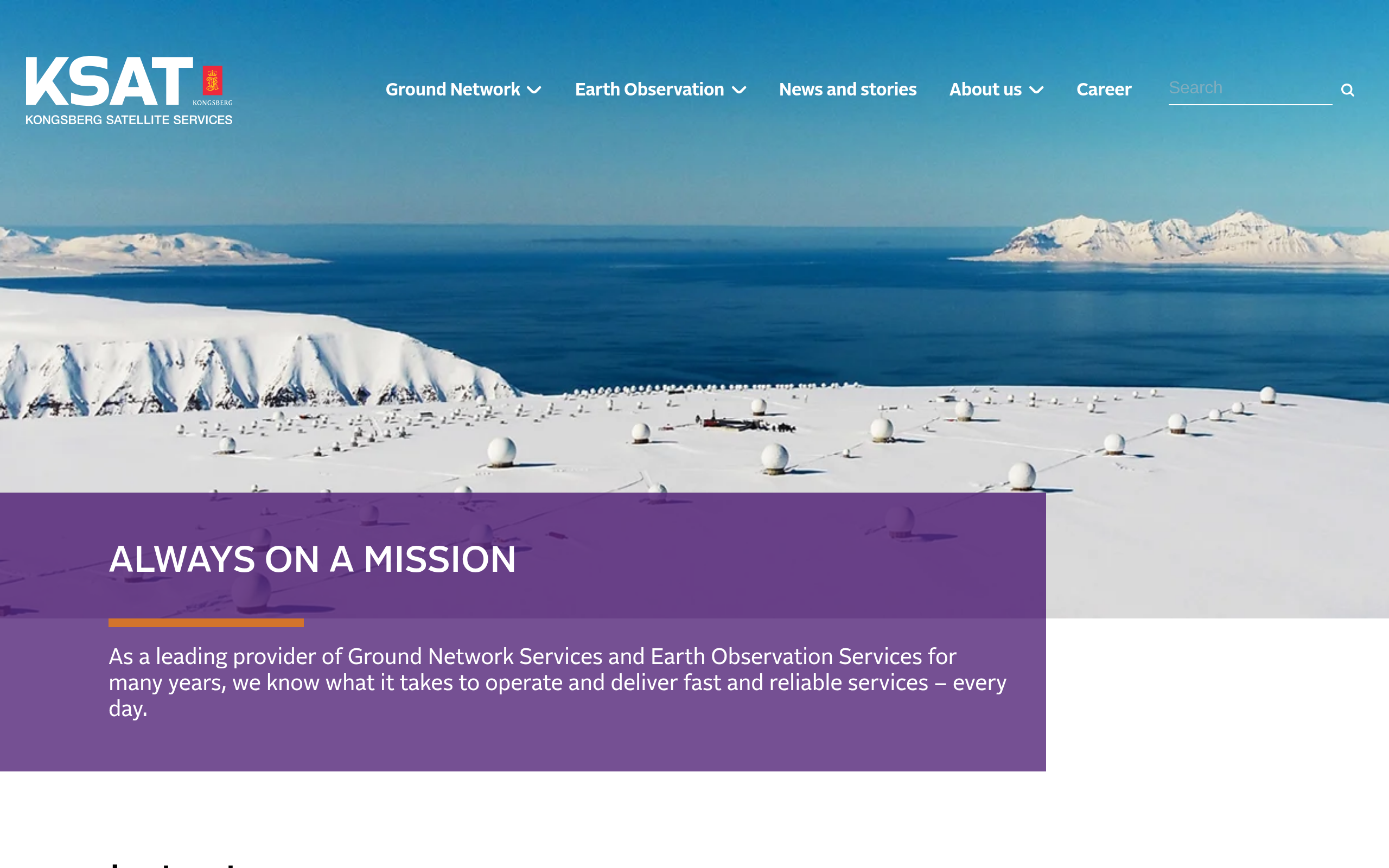
 KSAT is a Norwegian ground station operator with unmatched polar network coverage.
Yes, legitimate: a state-linked joint venture with over 50 years of operations.
This review covers the network, KSATlite, pricing and the fit for your mission.
Table of Contents
Key Takeaways
- KSAT leads commercial ground station services for operators needing polar and high-latitude downlink coverage rivals cannot match
- The standout edge is its fully automated tri-band KSATlite with a 99.75%+ scheduling success rate across ~145,000 monthly contacts
- The key caveat: KSAT publishes no pricing, so every evaluation begins with a direct sales conversation
About KSAT
KSAT operates a global ground station network as its primary business, serving over 150 satellite operators through a mix of standardized smallsat services, premium government programs, and custom ground infrastructure deployments. The key facts below are drawn from KSAT’s own published pages as of June 2026.
| Name | KSAT |
|---|---|
| Website | ksat.no |
| Legal name | Kongsberg Satellite Services AS |
| Address | Prestvannveien 38, Tromsø 9011, Troms og Finnmark, Norway |
| Founded | 2002 (predecessor Tromsø Telemetry Station from 1967) |
| Ownership | Private joint venture: Space Norway AS (50%, state-owned enterprise) and Kongsberg Defence & Aerospace AS (50%, subsidiary of Kongsberg Gruppen) |
| Leadership | Marte Indregard (President and CEO); Amund Nylund (Chief Operation Officer); Marianne Larsen (Chief Financial Officer); Arnulf Kjeldsen (EVP, Strategy & Technology) |
| Employees | ~600+ globally |
| Products & data | KSATlite (GSaaS for small satellites and mega-constellations); KSATmax (high-reliability TT&C for premium missions); KSAT Launch & LEOP; KSAT Hosted (custom IaaS ground networks); KSAT Lunar (commercial lunar comms); Earth Observation Services (environmental monitoring, maritime surveillance, imagery brokerage) |
| Pricing | Contract and quote-based; KSATlite uses a pay-per-contact model; no public rates published |
| Languages | English, Norwegian |
KSAT’s own site documents a network scale that few commercial ground segment operators can approach. Published figures vary by page, reflecting a fast-growing network, but the company reports several hundred antennas across more than two dozen to over forty locations worldwide, including the strategically critical SvalSat polar site on Svalbard and TrollSat in Antarctica. Named customers on KSAT’s own pages include ESA, NASA, NOAA, and Sateliot.
Is KSAT legit?
In my analysis, KSAT’s legitimacy is not a serious question. The company is a joint venture between a Norwegian state enterprise and a defense and aerospace subsidiary of Kongsberg Gruppen, has operated in some form since 1967, and holds ISO 9001:2015 certification and Achilles qualification. The more useful question for a buyer is whether KSAT’s network architecture and service tier match your specific mission profile.
Ownership and funding
KSAT is owned equally by Space Norway AS, a state-owned enterprise under Norway’s Ministry of Trade, Industry and Fisheries, and Kongsberg Defence and Aerospace AS, a wholly owned subsidiary of the publicly listed Kongsberg Gruppen. This dual government-industrial ownership structure means KSAT operates with institutional backing rather than venture capital or market-driven funding pressure.
The company is not publicly traded, and no total funding figure is disclosed. The ownership structure nonetheless provides a strong financial foundation, and the strategic importance of KSAT’s polar sites to the Norwegian government adds an additional layer of institutional stability that private-equity-backed competitors cannot replicate.
Track record and customers
KSAT’s predecessor, the Tromsø Telemetry Station, began operations in 1967. The company as a legal entity was established in 2002 and has built a documented customer base spanning civil, scientific, and government segments. Named customers on KSAT’s own news and case study pages include ESA (Arctic Weather Satellite end-to-end ground segment and SatOps), NASA (Near Space Network Ka-band antenna integration in 2023), NOAA (ground station architecture study in 2024), and Sateliot.
KSAT’s KSATlite service reports approximately 145,000 ground station contacts per month in 2025, with a historical scheduling success rate above 99.75% globally, both figures cited on KSAT’s live site. Strategic partnerships announced in 2026 with Kongsberg NanoAvionics and Apex for end-to-end mission capabilities confirm continued expansion into the commercial smallsat market.
Compliance and certifications
KSAT holds ISO 9001:2015 quality management certification and is qualified under the Achilles supplier verification system, which is commonly required for energy sector and government procurement in Norway. KSAT Hosted and KSATmax serve government and defense customers, though ITAR and export control status is not stated on the public site. Buyers with defense or intelligence requirements should raise this directly with KSAT’s government programs team.
For EO imagery brokerage services, KSAT names some imagery partners in its news releases but does not publish a consolidated list of the source operators behind its brokered catalog, so buyers with specific data-rights requirements will need to request the full licensing chain for their target imagery type during the sales process.
Data and capabilities
KSAT’s primary business is ground station infrastructure, not satellite ownership. Its services split into two main pillars: ground network services for satellite operators, and Earth observation data services for imagery end users. The network layer and the data layer are related but serve different buyer personas, so it is worth treating them separately.
Ground network: KSATlite, KSATmax, and the polar advantage
KSATlite is KSAT’s standardized Ground-Segment-as-a-Service for small satellites and mega-constellations. The KSATlite network covers 26 globally distributed stations with over 150 antennas sized at 3.7 to 6.1 meters, supporting S-band uplink and downlink, X-band downlink, and Ka-band downlink at 25.5 to 27.0 GHz. Scheduling and tasking are fully automated via API, with machine-to-machine interfaces for autonomous, hands-off ground operations.
Ka-band capability was expanded in 2023, with KSAT announcing that downlink capabilities of 10 Gbps and more are achievable with the right radio hardware selection. The KSATlite Customer Portal provides real-time visibility and control of passes, data flows, and performance metrics.
KSATmax serves premium and government missions requiring high-reliability data acquisition and TT&C. This tier covers missions where the cost of a missed contact is high: science payloads with limited downlink windows, government surveillance programs, and missions requiring rigorous commanding and telemetry monitoring.
KSAT’s structural advantage over all competitors is its polar network. The SvalSat facility on Svalbard, Norway, is the world’s largest commercial ground station for polar-orbit satellites, positioned at approximately 78 degrees North. TrollSat in Antarctica provides coverage from the opposing pole. For any satellite in a polar or sun-synchronous orbit, SvalSat provides more pass opportunities per orbit than any mid-latitude site can. No other commercial ground station operator has an equivalent facility at that latitude.
KSAT Hosted and Lunar
KSAT Hosted is the company’s Infrastructure-as-a-Service offering: KSAT designs, deploys, and operates custom ground station networks for customers who need a sovereign or mission-specific installation rather than a shared commercial network. Deliverables include antenna installation at remote sites, system integration, and ongoing satellite operations.
KSAT Lunar extends the network to deep-space applications. Launched commercially in 2025 to 2026, this service provides TT&C, payload downlink, and ranging for lunar missions using X-band and Ka-band. It positions KSAT as a ground segment provider for the emerging commercial lunar economy, beyond its well-established LEO franchise.
Earth Observation Services and cloud integration
KSAT also brokers SAR and optical imagery through its EO Services division, offering rapid tasking via a 24/7 Order Desk. Environmental monitoring products cover oil spill detection, fisheries surveillance, greenhouse gas monitoring, algae detection, and InSAR-based land subsidence. Maritime surveillance is delivered through the Vake platform, which specializes in dark vessel detection and maritime domain awareness.
Cloud integration ties KSAT’s ground stations into public cloud platforms including AWS, Azure, and GCP, enabling satellite data to flow directly into cloud storage and processing pipelines at or near the ground station site. Edge computing solutions are available at remote locations for preprocessing data before backhaul, reducing latency and transmission costs for high-volume downlinks.
Pricing
KSAT does not publish pricing on its website for any service line. The KSATlite model is described as pay-per-contact in a 2026 anniversary publication, meaning operators pay based on the number of scheduled ground station passes rather than a flat subscription, but no rate card or indicative pricing is available publicly.
This is standard practice for commercial ground station networks operating at scale: contract terms depend on mission profile (orbit, frequency band, contact duration, data volume, reliability tier), committed volume, and contract length. The table below summarizes what is known about KSAT’s service pricing model.
| Service | Model | Public rate | Notes |
|---|---|---|---|
| KSATlite (GSaaS) | Pay-per-contact | Not published | Model referenced in 2026 KSAT news article. Rates require direct engagement |
| KSATmax (premium TT&C) | Contract/quote | Not published | High-reliability tier for government and premium missions, with custom SLA |
| KSAT Hosted (IaaS) | Project/contract | Not published | Custom ground station design and deployment (scope-dependent) |
| KSAT Lunar | Contract/quote | Not published | Commercial lunar comms, contact [email protected] |
| EO Imagery Brokerage | Per order / contract | Not published | SAR and optical via 24/7 Order Desk. Pricing depends on operator and resolution |
| Free tier | None | N/A | No free trial or self-serve tier available |
For buyers evaluating KSATlite, the absence of published pricing does not reflect opacity so much as the highly variable cost structure of satellite communications. A smallsat in a low inclination orbit makes fewer polar passes than one in a sun-synchronous orbit, and Ka-band contacts carry different infrastructure costs than S-band. Reaching out to [email protected] with your orbit parameters and volume estimates is the fastest path to a usable quote.
Who it’s for
KSAT’s services map onto a narrower buyer set than an imagery provider: the primary customer is a satellite operator or mission team that needs ground communications infrastructure, not an analyst or developer who wants imagery. Understanding this distinction is critical before evaluating the alternatives.
Smallsat and constellation operators
For teams launching small satellites or building a commercial constellation, KSATlite is the most directly relevant product. Its automated API-driven scheduling, tri-band capability, and high-latitude network mean that a smallsat operator can get near-complete polar orbit coverage from a single provider without building custom ground infrastructure.
The 150-plus operator customer base and 145,000 monthly contacts figure indicate that KSAT already handles a large share of commercial smallsat ground communications globally. Operators with high data-volume payloads benefit particularly from Ka-band availability and the proximity of SvalSat to polar orbit ground tracks.
Government and science missions
ESA, NASA, and NOAA are all named KSAT customers, reflecting the company’s position as a preferred ground segment provider for civil and scientific missions. KSATmax serves this segment with higher-reliability SLAs and dedicated mission control services. KSAT Launch and LEOP adds coverage during the highest-risk phase of any mission: the first hours after separation from the launch vehicle.
Government buyers in jurisdictions with defense-adjacent requirements should note that KSAT’s Norwegian state ownership and Kongsberg Defence and Aerospace parentage create a politically stable partner profile. The company’s Achilles qualification and ISO 9001:2015 certification satisfy common government supplier validation requirements.
EO imagery buyers and environmental monitoring teams
For teams that do not operate satellites but need derived environmental intelligence, KSAT EO Services provides maritime surveillance through the Vake platform and environmental monitoring products covering oil spills, fisheries, GHG emissions, and land subsidence. The 24/7 Order Desk for rapid SAR and optical tasking is suited to near-real-time monitoring workflows in maritime and environmental response contexts.
Where it is less competitive
KSAT is not a self-serve platform. There is no free trial, no transparent pricing page, and no self-serve imagery catalog. Buyers needing quick, low-budget imagery access are better served by self-serve marketplaces. KSAT’s imagery brokerage also does not publish a consolidated list of the source operators behind its SAR and optical catalog, so buyers who need to track and verify data lineage will need to work this out during contract negotiation.
For buyers in equatorial orbits or low-inclination constellations, the polar network advantage diminishes because these spacecraft make fewer high-latitude passes. Competing providers with denser mid-latitude antenna networks may offer more cost-effective per-contact rates for non-polar orbital profiles.
Strengths and limitations
KSAT’s dominant competitive position in polar ground station services creates a pattern of structural advantages that compound across the GSaaS market. The strengths concentrate in network geography, automation, and institutional credibility:
- Unmatched polar and high-latitude coverage: SvalSat (Svalbard) and TrollSat (Antarctica) give KSAT more pass opportunities per orbit for polar and sun-synchronous satellites than any mid-latitude competitor can provide
- KSATlite’s fully automated tri-band (S/X/Ka) network, API-driven scheduling, and historical scheduling success above 99.75% across approximately 145,000 monthly contacts reduces operational overhead for constellation operators
- Fifty-plus years of continuous operational heritage (from the 1967 Tromsø Telemetry Station) and joint ownership by a Norwegian state enterprise and a Kongsberg Gruppen subsidiary provide long-term institutional stability
- Breadth of service tiers: KSATlite for smallsats, KSATmax for premium government missions, KSAT Hosted for sovereign infrastructure, KSAT Lunar for deep-space applications, and EO data services for imagery buyers, all from one provider
- ISO 9001:2015 certification, Achilles qualification, and established contracts with ESA, NASA, and NOAA demonstrate compliance-grade operational standards
The limitations are worth mapping against your requirements before opening a procurement conversation:
- No published pricing: every engagement starts with a quote request, which adds friction for buyers who want to run a competitive evaluation before committing sales time
- Inconsistent network size figures across live pages on ksat.no (ranging from 280 to several hundred antennas, and 26 to 40-plus sites depending on which page) make it difficult to state a definitive network scale, as the number is growing fast enough that any published figure ages quickly
- EO imagery brokerage does not publish a consolidated source-operator list, so data lineage and licensing verification require direct clarification for compliance-sensitive buyers
- No self-serve access, free trial, or low-commitment entry point: the minimum engagement is a direct sales process
- ITAR and export control status is not stated publicly, which is a gap for defense buyers who need to qualify KSAT against program requirements before shortlisting
In my analysis, the core commercial consideration is whether your satellite’s orbit and data-volume requirements place KSAT’s polar network at a strategic premium. For polar-orbit LEO operators, the case for KSAT’s network is structurally difficult to compete away. For equatorial or mid-inclination programs with modest data volumes, alternatives may offer more transparent pricing for comparable pass counts.
KSAT alternatives
If KSAT’s pricing model or network geography does not match your program, three other commercial ground station providers offer meaningfully different network architectures, pricing models, or target customer profiles. The table below draws on verified specifications from primary sources for each provider.
| Provider | Network scale | Pricing model | Key differentiator |
|---|---|---|---|
| KSAT | Several hundred antennas, 26–40+ sites (including SvalSat and TrollSat polar) | Pay-per-contact / contract, no public rates | World’s largest polar ground station network, 50+ years of heritage, tri-band KSATlite automation |
| AWS Ground Station | ~12 global antenna locations integrated with AWS cloud | Per-minute pricing, publicly listed on AWS website | Native cloud integration: data lands directly in AWS S3, with transparent self-serve pricing and no sales engagement required for most missions |
| Leaf Space | Global network of ground stations with European focus and growing smallsat customer base | Contact-based, pricing by mission type | European-headquartered smallsat GSaaS specialist with strong integration in ESA-adjacent programs and a growing footprint for commercial constellation operators |
| Atlas Space Operations | Global network with purpose-built small-aperture antenna arrays | Software-defined ground station, flexible per-use model | Software-defined, fully virtualized architecture purpose-built for high-throughput smallsat downlink with a cloud-native operations philosophy |
AWS Ground Station is the most self-serve-friendly option: published per-minute pricing, a trial credits model, and native S3 data delivery mean a mission team can evaluate and begin downlinking without a procurement process. Leaf Space targets the European commercial smallsat market, making it a natural comparison for operators who value ESA-adjacent compliance or a European data sovereignty footprint.
Atlas Space Operations takes a software-defined approach to ground infrastructure, which suits operators who want cloud-native, highly automated operations without the legacy infrastructure model.
KSAT’s differentiation remains its polar network depth and its breadth of service tiers. For missions where SvalSat coverage is operationally significant, no alternative in this table offers a comparable polar facility.
KSAT leads our guide to the best ground station services.
Verdict
Legitimacy is not the question with KSAT: it is a Norwegian joint venture with government and industrial shareholders, 50-plus years of operational heritage, ISO 9001:2015 certification, and named contracts with ESA, NASA, and NOAA. The real question is fit, and that splits along the orbital geometry and buyer-type axis.
For satellite operators in polar or sun-synchronous orbits, KSAT is the strongest single-provider choice for ground communications. SvalSat’s position at approximately 78 degrees North gives every polar-orbit spacecraft multiple high-elevation passes per day that mid-latitude stations cannot replicate, and KSATlite’s automated tri-band network with a 99.75-plus percent scheduling success rate delivers that coverage with minimal operational overhead.
The caveats are structural. KSAT publishes no pricing, so every evaluation requires a direct sales engagement. The EO imagery brokerage does not publish a full source-operator list, which can complicate data-rights audits. For equatorial or low-inclination missions, the polar advantage diminishes and competing providers with transparent pricing may offer better commercial terms. And buyers needing self-serve access or a free evaluation tier will need to look elsewhere.
For polar-orbit LEO operators, government and science mission teams, and EO programs needing near-real-time maritime or environmental monitoring, KSAT is a well-matched choice with exceptional network credentials. The alternatives table above is the practical starting point if transparent pricing or a cloud-native architecture is a higher priority than polar coverage depth.
Frequently asked questions
Below are answers to the questions buyers most commonly ask about KSAT. Each answer points to the section where the full detail lives.
How does KSAT work?
KSAT operates a global network of ground station antennas and offers satellite operators access via its API or customer portal. Satellite data is received at each pass and delivered to the operator or a connected cloud platform. Beyond the spacecraft’s own RF system, no dedicated ground hardware is required on the buyer’s side. Full detail is in the “Data and capabilities” section.
Is KSAT a legit company?
Yes. KSAT is a joint venture owned equally by Space Norway AS (a Norwegian state enterprise) and Kongsberg Defence and Aerospace AS (a subsidiary of the publicly listed Kongsberg Gruppen). It holds ISO 9001:2015 certification, Achilles qualification, and has operated in some form since the 1967 Tromsø Telemetry Station. See “Is KSAT legit?“
Who owns KSAT?
KSAT is a 50/50 joint venture. Space Norway AS, a state-owned enterprise under Norway’s Ministry of Trade, Industry and Fisheries, holds 50%. Kongsberg Defence and Aerospace AS, a wholly owned subsidiary of Kongsberg Gruppen, holds the other 50%, meaning KSAT has no single controlling parent company. Ownership details are in “Is KSAT legit?“
How much does KSAT cost?
KSAT does not publish pricing. KSATlite operates on a pay-per-contact model, meaning operators pay per scheduled ground station pass, but no rate card is publicly available. All services require a direct quote request via [email protected]. Full context is in the “Pricing” section.
Where is KSAT based?
KSAT’s headquarters is in Tromsø, Norway (Prestvannveien 38, 9011 Tromsø). The company also has offices in Oslo, Svalbard (Longyearbyen), Stockholm, Denver (KSAT Inc.), and Tokyo. Its most strategically important site is SvalSat on Svalbard, positioned at approximately 78 degrees North for polar satellite coverage. See “About KSAT“.
Who are KSAT’s customers?
KSAT’s own pages name customers including ESA (Arctic Weather Satellite SatOps), NASA (Near Space Network Ka-band integration), NOAA (ground station architecture study), and Sateliot. The company reports serving over 150 satellite operators via KSATlite, with approximately 145,000 ground station contacts per month in 2025. Full customer context is in “Is KSAT legit?“
How does KSAT make money?
KSAT earns revenue from ground station service contracts: KSATlite on a pay-per-contact basis, KSATmax and KSAT Hosted as custom-priced agreements, and EO data services through order-based and subscription arrangements. No revenue figures are publicly disclosed, consistent with its status as a private joint venture. See “Pricing“.
When was KSAT founded?
KSAT as a legal entity was established in 2002 as a joint venture between NSC (now Space Norway) and Kongsberg Defence and Aerospace. Its operational heritage, however, traces back to 1967, when the Tromsø Telemetry Station began operations as its predecessor. Background is in “About KSAT“.
What are the best alternatives to KSAT?
The closest matches depend on your requirements: AWS Ground Station for self-serve pricing and native cloud integration, Leaf Space for European-headquartered smallsat GSaaS, and Atlas Space Operations for a software-defined cloud-native architecture. A full comparison is in “KSAT alternatives“.
What use cases is KSAT best suited for?
KSAT is strongest for polar-orbit and sun-synchronous LEO satellite operators needing high-frequency downlink contacts, government and science missions requiring high-reliability TT&C, maritime and environmental monitoring programs needing near-real-time EO data, and teams that need a single provider to handle both standard and launch-phase ground communications. It is less suited for buyers who need self-serve imagery access or transparent published pricing. Details are in “Who it’s for“.

My passions are Earth Observation and Satellites, and my profession is Data Analysis. I combine both within ObservationData.com to show you the use cases of Earth Observation, to help you find the right provider, and to share your experiences.
