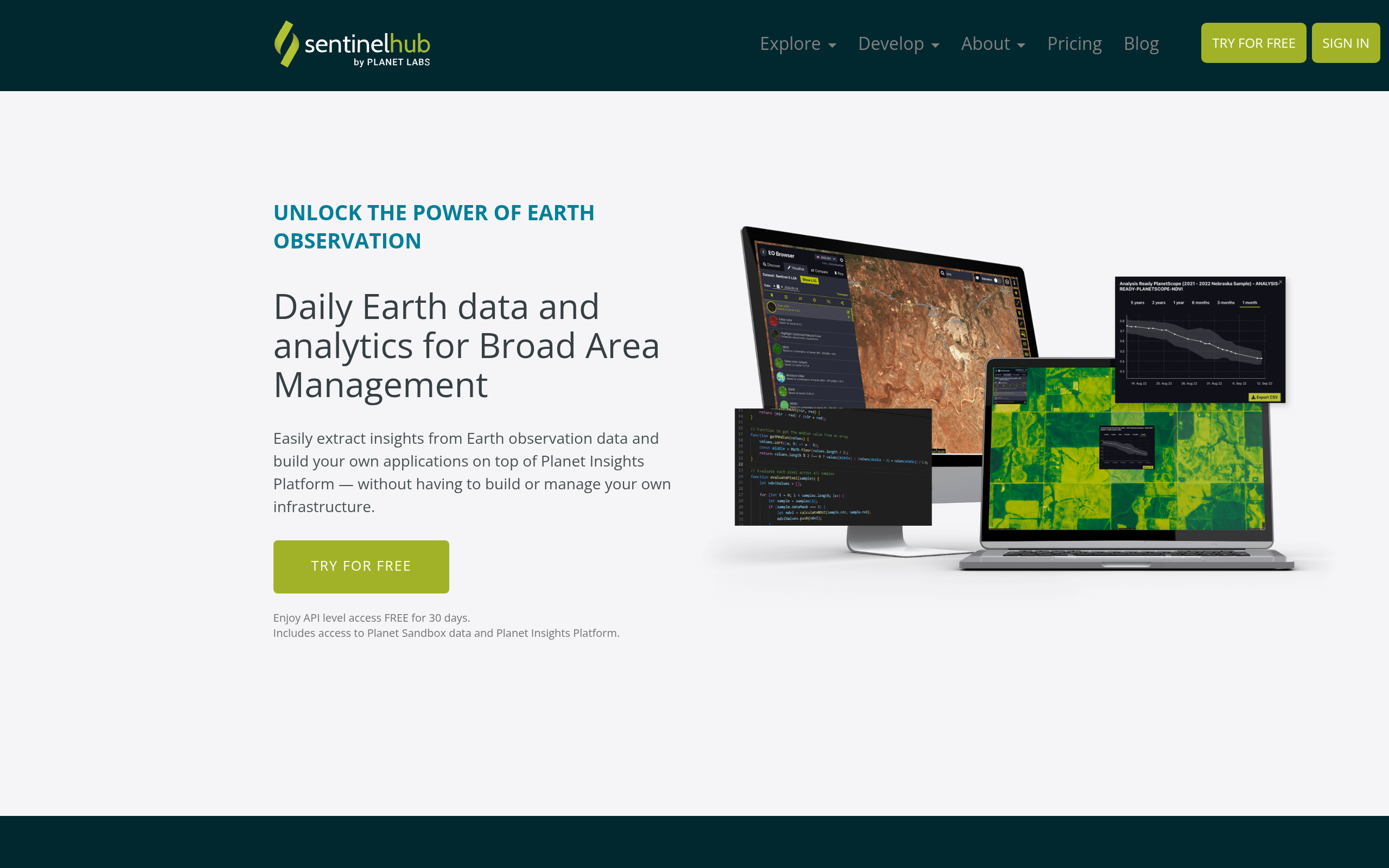
 Sentinel Hub is a Slovenian-built cloud API for satellite data, now part of the Planet group.
Yes, real: its entity Sinergise is a wholly owned Planet subsidiary.
This review covers the API, the Processing Unit pricing model and where another approach fits.
Table of Contents
Key Takeaways
- Sentinel Hub fits developers and analysts who need API-first access to open archives without managing downloads or storage
- The platform powers the Copernicus Data Space Ecosystem, proven ESA-contracted infrastructure at global scale
- After weighing all the strengths and limitations, the key caveat: commercial data costs layer on top of the subscription fee
About Sentinel Hub
Sentinel Hub is the developer and analyst platform of Sinergise Solutions d.o.o., a Ljubljana-based company that built one of the first cloud-native APIs for satellite data processing. Planet Labs PBC completed its acquisition of Sinergise in August 2023, and pricing now lives on planet.com/pricing under the Planet Insights Platform umbrella. The Sentinel Hub brand, API endpoints, and EO Browser web application remain intact at sentinel-hub.com. Key facts below are drawn from the Sentinel Hub published pages as of May 2026.
| Name | Sentinel Hub |
|---|---|
| Website | sentinel-hub.com |
| Legal name | Sinergise Solutions d.o.o. |
| Address | Cvetkova ulica 29, SI-1000 Ljubljana, Slovenia |
| Founded | Operational by 2016 (2016 Copernicus Masters winner); Sinergise founded approximately 2008 |
| Ownership | Subsidiary of Planet Labs PBC (NYSE: PL), via Planet Labs Germany GmbH |
| Leadership | Grega Milcinski (co-founder and key figure) |
| Products & data | Cloud API access to Sentinel-1/2/3/5P, Landsat 9/8/7/4-5/1-5 MSS, MODIS, ENVISAT, Copernicus DEMs and land services; commercial add-ons: PlanetScope (3 m), SkySat Archive (0.5 m), Vantor WorldView/GeoEye (0.5 m); EO Browser visualization tool; BYOC for custom COG data |
| Pricing | Subscription from $28/month (Exploration tier, billed annually); commercial data purchased separately by area |
| Languages | English |
The platform does not operate any satellites. Its role is the API and processing layer on top of archives maintained by ESA, USGS/NASA, Planet, and Vantor. Sentinel Hub’s most visible public deployment is the Copernicus Browser (dataspace.copernicus.eu/browser), which is an EO Browser instance built on Sentinel Hub infrastructure and launched in early 2023 as the official successor to the Copernicus Open Access Hub.
Is Sentinel Hub legit?
Sentinel Hub is a real, active platform with a verifiable ownership chain, a decade of operational history, and a contract with ESA and the European Commission to power the Copernicus Data Space Ecosystem. Any question about legitimacy here is about fit and value for your use case, not about whether the company exists or delivers.
Ownership and funding
Sinergise Solutions d.o.o. is headquartered in Ljubljana, Slovenia (registration number 9375287000, VAT ID: SI 16991214), confirmed in its own Terms of Use as a wholly owned subsidiary of Planet Labs Germany GmbH, itself part of Planet Labs PBC. Planet Labs is a NYSE-listed public benefit corporation, which means the August 2023 acquisition of Sinergise brings Sentinel Hub inside a publicly accountable structure. Most enterprise procurement teams treat that as a positive trust signal.
The platform does not disclose the founding team in detail on its public pages. Grega Milcinski is identified as co-founder through a published interview, but executive team information is not listed on the site, which is worth noting for procurement teams running vendor assessments.
Track record and credibility signals
The single strongest legitimacy signal is institutional. Sentinel Hub was selected by ESA and the European Commission to power the Copernicus Data Space Ecosystem, the official gateway to Sentinel satellite data, launched in early 2023. That contract displaced the previous Copernicus Open Access Hub and covers access for the entire European EO user community. The platform also won the 2016 Copernicus Masters competition and was named EARSC European EO Company of the Year in 2018.
The 99% monthly uptime SLA and published support for GIS interoperability standards (WMS, WCS, WMTS, WFS, STAC, openEO, COG) are consistent with infrastructure-grade deployments rather than experimental tooling. The main site does not publish prominent enterprise customer references. The industries showcase section lists a small number of application examples (SataMap, CropWatch) rather than named procurement-level clients.
Compliance and data rights
Open data collections (Sentinel, Landsat, MODIS, Copernicus services) are provided under their originating programs’ open access terms. Commercial data added through the Third Party Data Import (TPDI) flows under each originating operator’s license. The platform is governed by Slovenian law. From a procurement standpoint, the data rights situation mirrors any aggregator: open data is broadly permissive, while commercial data carries per-provider restrictions.
One change to flag for active users: as of May 2026, Planet’s TPDI integration is deprecated and will cease after November 11, 2026. Planet data will migrate to Planet’s native Orders and Subscriptions APIs. If you depend on PlanetScope or SkySat Archive via Sentinel Hub’s TPDI, verify your workflow is updated before that deadline.
Data and capabilities
Sentinel Hub provides cloud API and web access to multiple satellite data collections. Because it is a platform, not a satellite operator, the data it serves depends on its data agreements with ESA, USGS/NASA, Planet, and Vantor. The resolution range across the catalog runs from roughly 3 m (PlanetScope) to coarser Sentinel-3 and MODIS bands near 1,000 m, with SkySat Archive providing 0.5 m imagery as a commercial add-on.
Open and free collections
The free tier of collections is substantial. Sentinel-2 L1C and L2A cover visible and NIR bands at 10 m, Red-Edge and SWIR bands at 20 m, with a roughly 5-day global revisit. Sentinel-1 GRD provides C-band SAR imagery at 10–20 m across all land areas.
Sentinel-3 covers ocean and land surface at medium resolution (OLCI and SLSTR). Sentinel-5P covers the atmosphere (NO2, CO, methane, ozone). The Landsat archive runs back to 1972 (MSS), with Landsat 8 OLI-TIRS and Landsat 9 as the most recent additions.
MODIS MCD43A4 v6, ENVISAT, Copernicus Digital Elevation Models (10 m and 30 m), Corine Land Cover, Global Land Cover, and Water Bodies datasets complete the subscription catalog. All are accessed through the same Process API endpoint, so you never manage file download, reprojection, or mosaicking yourself.
Commercial collections
Three commercial collections are available for purchase on top of the platform subscription. PlanetScope provides 3 m multispectral daily imagery using a Hectares-under-Management (HUM) billing model: one quota package covers 100 hectares of a defined parcel for a full year of archive and new data. SkySat Archive provides 0.5 m high-resolution optical, billed by area.
Vantor WorldView and GeoEye, distributed through European Space Imaging, add sub-meter optical archive from the WorldView constellation, also billed by quota package. Sentinel Hub still catalogues that collection under the vendor’s former Maxar name, which is what you will see in the ordering interface.
A published pricing reference: a Pleiades quota package costs €100 for 11 km² (one acquisition), and additional acquisitions multiply cost proportionally. Exact per-km² rates for other commercial collections are only visible inside the billing dashboard after account creation, which is worth checking before budgeting a commercial data workflow.
Platform and API access
The platform exposes a full suite of REST APIs. The Process API handles on-the-fly rendering and processing. The Batch Processing API covers large-area or long-period requests. The Statistical API and Batch Statistical API handle server-side histogram, percentile, and time-series computation. The Catalog API is STAC-compatible, and OGC endpoints (WMS, WCS, WMTS, WFS) let you connect any standards-compliant GIS tool directly without additional middleware.
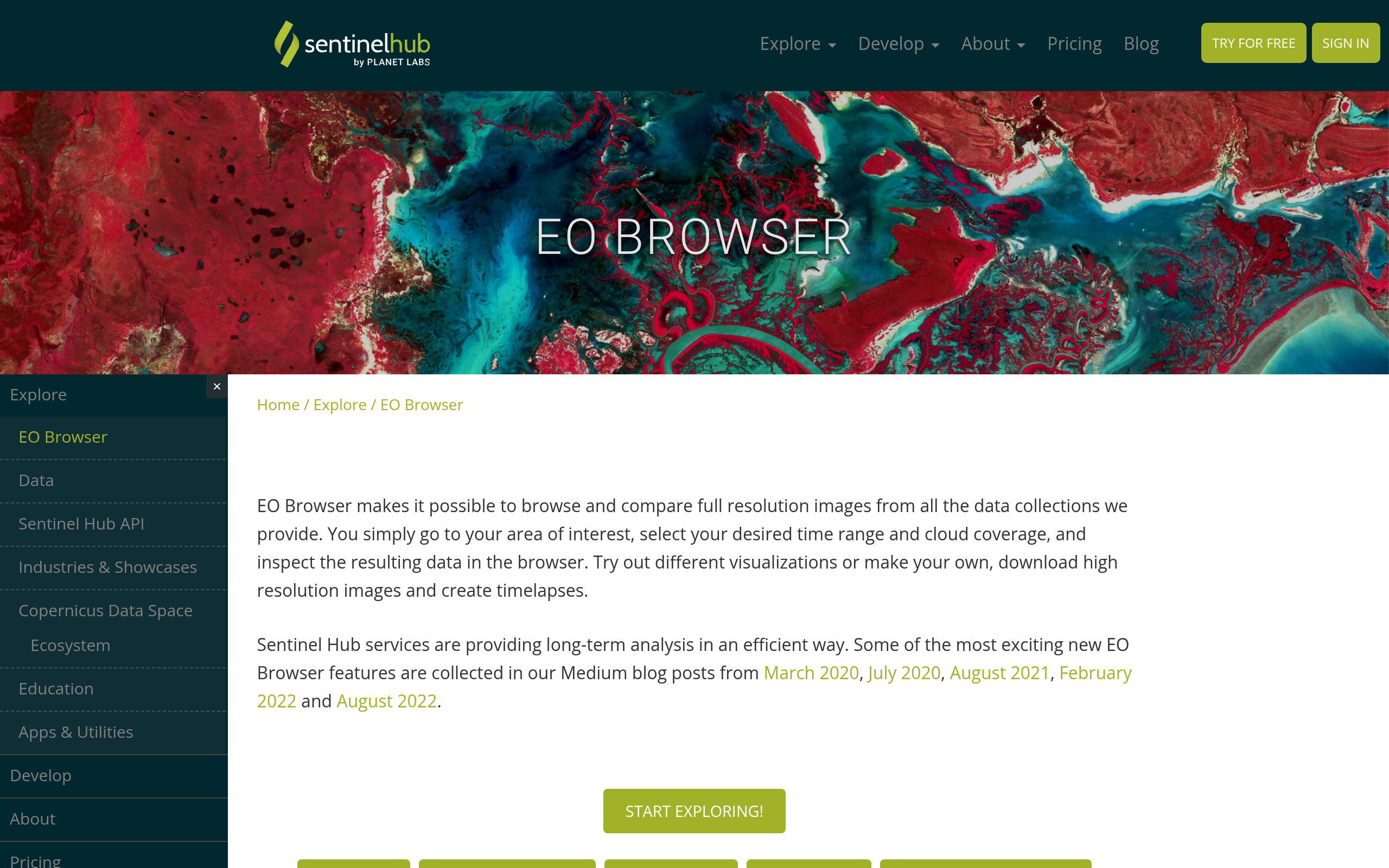
For desktop integration, a QGIS plugin and ArcGIS WMS/WCS connector handle the Sentinel Hub connection without custom code. The Python SDK (sentinelhub-py) and JavaScript SDK give developers a higher-level integration path. EO Browser, the free web visualization app, lets anyone access any collection without an account. The Requests Builder provides a visual API editor to prototype evalscripts before writing code. All processing runs in the cloud using the JavaScript evalscript engine, covering band math, vegetation indices, composites, and custom algorithms.
One capability worth calling out is Bring Your Own Data (BYOC). Users can ingest their own Cloud Optimized GeoTIFF (COG) data from S3 and process it through the same Sentinel Hub API alongside public collections. Supported hosting environments include AWS EU-Central-1 (Frankfurt), AWS US-West-2 (Oregon), and Mundi Web Services. (The CreoDIAS deployment was deprecated in March 2025 following the discontinuation of CloudFerro’s CF2 infrastructure.) This makes the platform a processing layer for internal raster data, not just a data catalog.
Pricing
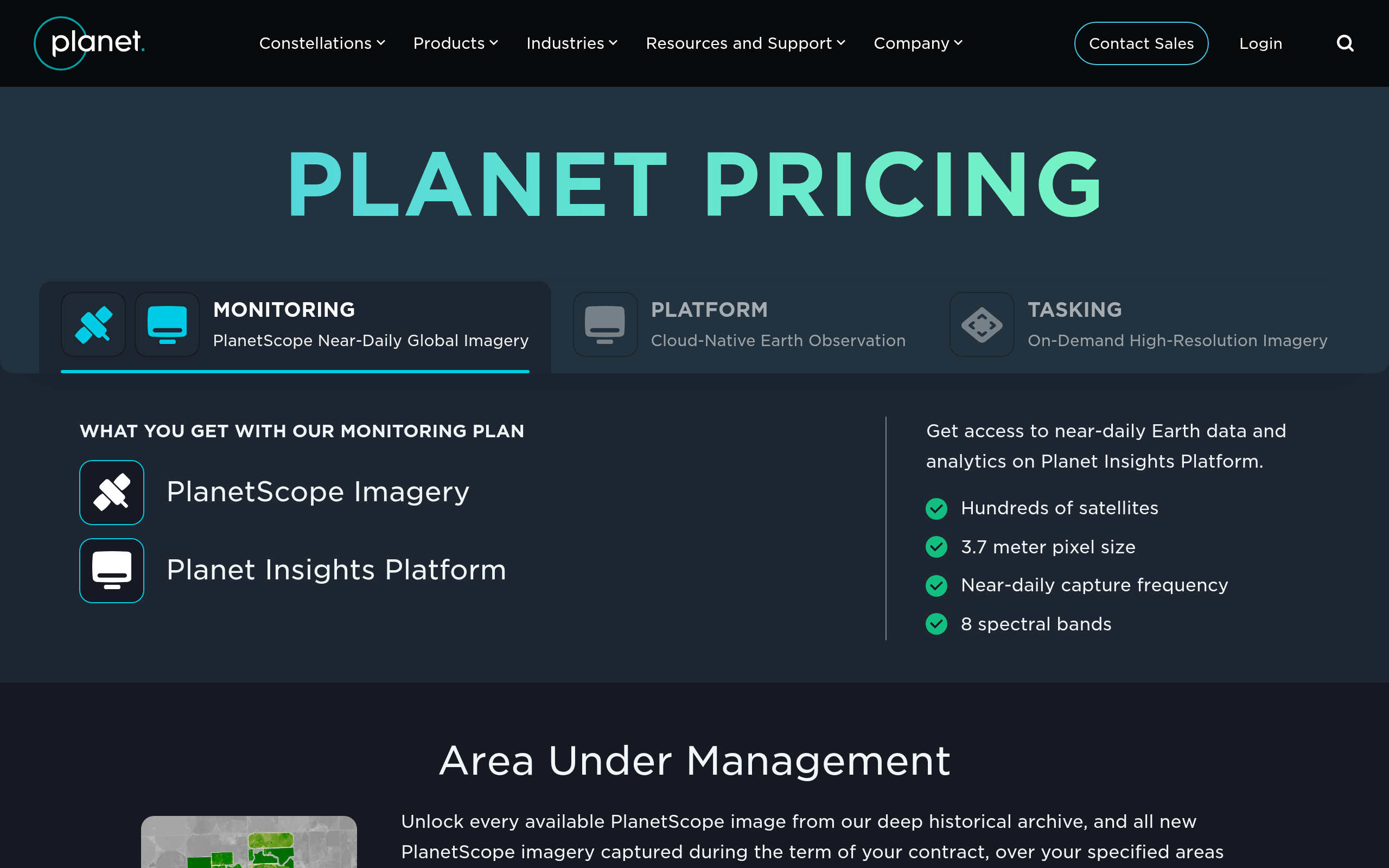
Sentinel Hub pricing moved to planet.com/pricing after the Planet acquisition, where it is now sold under the “Planet Insights Platform” label. The core billing unit is the Processing Unit (PU). PU cost depends on the output pixel count, number of bands, number of observations, output format, and processing complexity. Monthly quota is fixed per plan, and unused PUs do not roll over to the following month. Prices below are as of May 2026.
| Plan | Monthly (annual billing) | PU/month | Notes |
|---|---|---|---|
| Exploration (Non-Commercial) | $28 | 30,000 | 300 PU/min; 100,000 requests/month; 1 OAuth client; no SLA |
| Basic | $91 | 70,000 | 500 PU/min; 700,000 requests/month; 5 OAuth clients; 10 users; PU top-ups available |
| Enterprise Small | $458 | 400,000 | 1,000 PU/min; 8M requests/month; 10 OAuth clients; 50 users; SLA; batch APIs |
| Enterprise Large | $916 | 1,000,000 | 2,000 PU/min; 10M requests/month; 50 OAuth clients; SLA; batch APIs |
| PU Top-Up (one-time) | $150 per purchase | 100,000 | Valid 12 months; addable to Basic or Enterprise; good for usage spikes |
To calibrate PU spend: Sentinel-2 True Color at 10 m resolution processes roughly 26 km² per PU, while Sentinel-2 all 13 bands at 10 m processes about 6 km² per PU. SAR (Sentinel-1 VV gamma0 at 20 m) is cheaper at around 157 km² per PU. A 30-day free platform trial is available without a credit card, and academic and research users who qualify can apply for ESA-sponsored accounts at no cost.
Commercial data (PlanetScope, SkySat Archive, Vantor WorldView) is purchased separately on top of the platform subscription, billed by area or HUM model. The Pleiades quota package example (€100 for 11 km², one acquisition) is the clearest published reference point. Other rates are in the billing dashboard. Monthly billing is available, but annual billing saves roughly 17% across all tiers.
Who it’s for
Sentinel Hub suits buyers who want programmatic access to large-scale satellite archives without the overhead of downloading, storing, or preprocessing imagery. The typical fit is a developer or data engineer building an EO application or analysis pipeline where the data access infrastructure should be handled by someone else.
Agricultural monitoring teams analyzing large field areas benefit from the PU model’s efficiency. Sentinel-2 NDVI time series across a regional footprint costs a fraction of equivalent commercial data. Researchers and data journalists using EO Browser can access the full open catalog free without an API subscription. Insurance and environmental risk modelers who work across global AOIs can combine open SAR, optical, and atmospheric bands through a single endpoint rather than managing several separate data pipelines.
The platform is less competitive for buyers who need fresh commercial tasking. Sentinel Hub does not offer tasking. It provides archive access and near-real-time streams. Tasking requests for Planet, SkySat, or Vantor go through those operators’ direct channels. If your workflow requires on-demand commercial image acquisition with a turnaround SLA, a dedicated tasking platform or imagery marketplace is the right starting point, not Sentinel Hub.
Defense and intelligence buyers with classified infrastructure requirements will find the public cloud hosting on AWS Frankfurt and Oregon a potential constraint. The platform makes no mention of sovereign or air-gapped deployment on its public pages, which is a relevant gap for classified environments.
Strengths and limitations
In my analysis of Sentinel Hub’s platform structure, a few properties stand out clearly on both sides.
- Cloud-native API processes open satellite archives on-the-fly, eliminating download, storage, and reprojection overhead entirely
- Powers the Copernicus Data Space Ecosystem: proven infrastructure under an ESA/EC contract with a 99% monthly uptime SLA
- Free open-data catalog is substantial: Sentinel-1 SAR, Sentinel-2 multispectral, Landsat archive back to 1972, MODIS, Copernicus DEMs, and land services
- BYOC enables the same API pipeline for users’ own COG raster data alongside hosted collections
- EO Browser provides free, no-account web access to the full catalog for visualization
- Commercial data (PlanetScope, SkySat, Vantor WorldView) costs layer on top of the subscription fee, with most per-km² rates not published publicly
- No tasking capability: archive and near-real-time only (fresh commercial acquisition requires the originating operator’s own tools)
- PlanetScope and SkySat TPDI deprecated after November 2026, requiring workflow migration for affected users
- Leadership and employee information not published on the public site, which can create friction for procurement teams doing vendor assessments
The strengths-to-limitations ratio here is favorable for archive-first workflows. The limitations are real but bounded: the tasking gap and commercial pricing opacity are structural, not signs of a weak platform, and both can be addressed by pairing Sentinel Hub with an operator-direct channel when needed.
Sentinel Hub alternatives
Sentinel Hub occupies a distinctive position as an API processing platform for open satellite archives, with commercial data as an add-on. The alternatives below cover platforms and marketplaces that serve overlapping but distinct needs.
| Provider | Type | Key differentiator | Best fit vs. Sentinel Hub |
|---|---|---|---|
| UP42 | Data marketplace + processing (Airbus subsidiary) | Credit-based marketplace combining commercial data ordering with hosted analytics algorithms | Want both commercial satellite data ordering and analytics processing in one Airbus-backed platform |
| SkyFi | Self-serve imagery marketplace | Pay-per-image, no contract, transparent pre-checkout pricing across optical, SAR, and aerial | Need a simple, contract-free way to buy commercial satellite or aerial imagery without a subscription |
| Sfera Technologies | Multi-operator imagery aggregator with commercial tasking | Single platform aggregating optical, SAR, thermal, hyperspectral, and RF from multiple operators with commercial tasking and access to global ground stations | Need commercial tasking across multiple sensor types and operators in one place, rather than API access to a mostly open-data archive |
| Geocento | Enterprise procurement platform (UK-based) | Pyxis/Lyra search across archived and tasked imagery from multiple operators, contracted per deployment | Want an advisory-led procurement layer for complex high-resolution commercial orders |
| Apollo Mapping | Imagery reseller and broker | ImageHunter search platform across 60-plus satellite datasets from 19 operators; quote-based with personal service | Need a consultative reseller relationship for high-resolution archive or tasked imagery across many upstream operators |
The clearest split is between Sentinel Hub’s API-first, open-archive model and the commercial-tasking-first platforms. If your workflow centers on Sentinel or Landsat data at scale, Sentinel Hub is hard to beat on convenience and cost. If you primarily need to order and receive commercial satellite imagery, the aggregators and brokers above have more suitable workflows.
Sentinel Hub features in our side-by-side ranking of the best satellite imagery aggregators.
Verdict
Legitimacy is not the question with Sentinel Hub. The question is whether the platform’s design matches your data workflow. It is specifically built for API-driven, archive-first access to open satellite data at scale, with commercial collections as a well-integrated but separately priced extension. For that use case, it is one of the most mature and institutionally validated platforms available: its role as the backbone of the Copernicus Data Space Ecosystem is a stronger proof point than any marketing claim.
What I would flag for a buyer is the pricing layer complexity. The platform subscription covers PU compute and open-data access, but commercial data (PlanetScope, SkySat, Vantor) is a second billing line and per-area rates are not on the public site. For a straightforward open-data use case, the Exploration tier at $28/month is a low-cost entry point. For workflows mixing open and commercial data at scale, run the PU and area estimates before committing to a tier.
For developers building EO applications, researchers needing archive access, or anyone processing Sentinel or Landsat data programmatically, Sentinel Hub is a well-founded, proven choice. For buyers who primarily need to order and receive fresh commercial satellite imagery, a dedicated marketplace or tasking platform will serve you better.
Frequently asked questions
Below are quick answers to the most common questions about Sentinel Hub from buyers and developers.
How does Sentinel Hub work?
Sentinel Hub is a cloud API platform. You send a REST API request specifying a location, date range, data collection, and output format. The platform fetches, processes, and returns the result without you downloading raw data. The Processing Unit (PU) system charges based on output size and processing complexity. Read more in the section “Data and capabilities“.
Who is Sentinel Hub and what do they do?
Sentinel Hub is the cloud platform brand of Sinergise Solutions d.o.o., a Ljubljana, Slovenia company now wholly owned by Planet Labs PBC. It provides API and web access to satellite imagery archives, including Sentinel, Landsat, MODIS, and commercial collections. More detail in the section “About Sentinel Hub“.
Is Sentinel Hub a reliable company?
Yes. Sentinel Hub holds a contract with ESA and the European Commission to run the Copernicus Data Space Ecosystem, its parent Planet Labs is publicly listed on the NYSE, and the platform offers a 99% monthly uptime SLA on Enterprise plans. See the section “Is Sentinel Hub legit?” for the full picture.
How much does Sentinel Hub cost?
The platform subscription starts at $28/month (Exploration tier, billed annually) for open satellite data access. Commercial data (PlanetScope, SkySat, Vantor WorldView) is purchased separately by area on top of the subscription. The platform also offers a 30-day free trial without a credit card. All current pricing lives at planet.com/pricing. Details in the “Pricing” section.
Does Sentinel Hub have a free tier?
Yes. EO Browser at apps.sentinel-hub.com gives free, no-account access to the full open catalog for visualization. A 30-day platform trial with API access is also free. ESA-sponsored accounts are available at no cost to qualifying academic and research users. Check the section “Pricing” for the full picture.
Who owns Sentinel Hub?
Sinergise Solutions d.o.o. (the legal entity behind Sentinel Hub) is a wholly owned subsidiary of Planet Labs Germany GmbH, which is part of Planet Labs PBC (NYSE: PL). Planet completed the acquisition of Sinergise in August 2023. Full ownership context in “Is Sentinel Hub legit?“.
When was Sentinel Hub founded?
Sinergise was founded approximately 2008 (inferred from a “10 years” reference on the about page). Sentinel Hub itself was operational by 2016, when it won the Copernicus Masters competition. See “About Sentinel Hub“.
Where is Sentinel Hub based?
Sentinel Hub’s operating company, Sinergise Solutions d.o.o., is based at Cvetkova ulica 29, SI-1000 Ljubljana, Slovenia. A related entity, Sentinel Hub GmbH, is in Graz, Austria. See “About Sentinel Hub“.
What are the best Sentinel Hub alternatives?
The main alternatives depend on what you need. For commercial imagery ordering with tasking, UP42 and SkyFi are the most direct peers. For a multi-operator platform covering commercial tasking across optical, SAR, and other modalities, aggregators like Geocento or Apollo Mapping cover that ground. All options are compared in “Sentinel Hub alternatives“.

My passions are Earth Observation and Satellites, and my profession is Data Analysis. I combine both within ObservationData.com to show you the use cases of Earth Observation, to help you find the right provider, and to share your experiences.
