 Planet is a US satellite operator running the largest commercial EO fleet, near-daily at 3 m.
Yes, it is legitimate: NYSE-listed since 2021 and serving over 700 customers.
This review covers constellations, pricing and limits, so you can judge the fit for your use case.
Table of Contents
Key Takeaways
- Planet Labs is the go-to operator for buyers who need near-daily global optical monitoring at scale
- Its standout edge is a multi-constellation architecture spanning monitoring, 50 cm tasking, and hyperspectral in one platform
- Across all the strengths and limitations we weighed, the key caveat is that Planet is optical-only, with no SAR capability
About Planet Labs
Planet Labs PBC operates four distinct, operational sensor constellations from a single unified platform, making it one of the few operators where both broad-area monitoring and high-resolution tasking come from the same vendor. The key facts below are drawn from Planet’s own published pages as of May 2026.
| Name | Planet |
|---|---|
| Website | planet.com |
| Legal name | Planet Labs PBC |
| Address | 645 Harrison St., Floor 4, San Francisco, CA 94107, USA |
| Founded | 2010 |
| Ownership | Public (NYSE: PL) |
| Leadership | Will Marshall (Co-founder and CEO); Robbie Schingler (Co-Founder and Chief Strategy Officer); Ashley Fieglein Johnson (President and CFO) |
| Products & data | PlanetScope 3 m near-daily monitoring; SkySat 50 cm sub-daily tasking; Pelican 50 cm next-gen tasking (30 cm Gen-2 planned); Tanager hyperspectral (424 bands, 30 m); Planetary Variables (soil water content, land surface temperature, forest carbon); Planet Insights Platform API |
| Pricing | AUM monitoring from $2,700/yr; Platform (Sentinel Hub) from $28/mo; SkySat tasking from $6/km²; 30-day free trial |
| Languages | English |
Planet’s own FAQs document a scale that few commercial operators can match: approximately 200 satellites in orbit, 462 satellites deployed since 2013, and more than 25 terabytes of imagery captured each day. The company reports over 700 customers and 200 partners, with named accounts including Bayer, Syngenta, Google, L3Harris, the Rural Payments Agency (UK), and the Kazakhstan Space Agency.
Is Planet Labs legit?
In my analysis, Planet’s legitimacy is not a serious question. The company is publicly traded on the NYSE, incorporated as a Public Benefit Corporation, and has operated continuously since it launched its first Dove satellite in 2013. The more useful question for a buyer is whether Planet’s particular architecture fits your requirements.
Ownership and funding
Planet Labs PBC went public on December 8, 2021 via a SPAC merger with dMY Technology Group IV, trading as NYSE: PL. As a publicly traded company, Planet files quarterly financial disclosures, giving enterprise buyers financial transparency that most private EO operators cannot match.
The PBC designation also encodes the company’s mission, imaging all of Earth’s landmass every day, into its corporate charter. Confirmed subsidiaries span the US, Canada, Netherlands, Germany, UK, Slovenia, Austria, and Singapore.
Track record and customers
Thirteen years of continuous operations and a publicly disclosed base of 700-plus customers make Planet one of the most track-record-tested operators in the sector. Named customers on Planet’s own product pages include Bayer and Syngenta in agriculture, L3Harris and the Kazakhstan Space Agency in defense and government, and Google in commercial analytics.
The Tanager hyperspectral mission was developed in partnership with NASA’s Jet Propulsion Laboratory and sponsored by Carbon Mapper, a technical endorsement of meaningful weight.
Compliance and data rights
Planet licenses imagery under its Master Content License Agreement (MCLA). The pricing page confirms data may be used to develop derivative applications, while defense and intelligence use cases require direct sales engagement rather than self-serve ordering.
The Planet Insights Platform bundles Planet’s commercial data alongside public Sentinel and Landsat datasets, so buyers with strict data-rights requirements should verify the licensing chain for each source. Planet Select (self-serve tasking, powered by SkyFi) operates with per-area minimums and restricted geographies for certain targets.
Data and capabilities
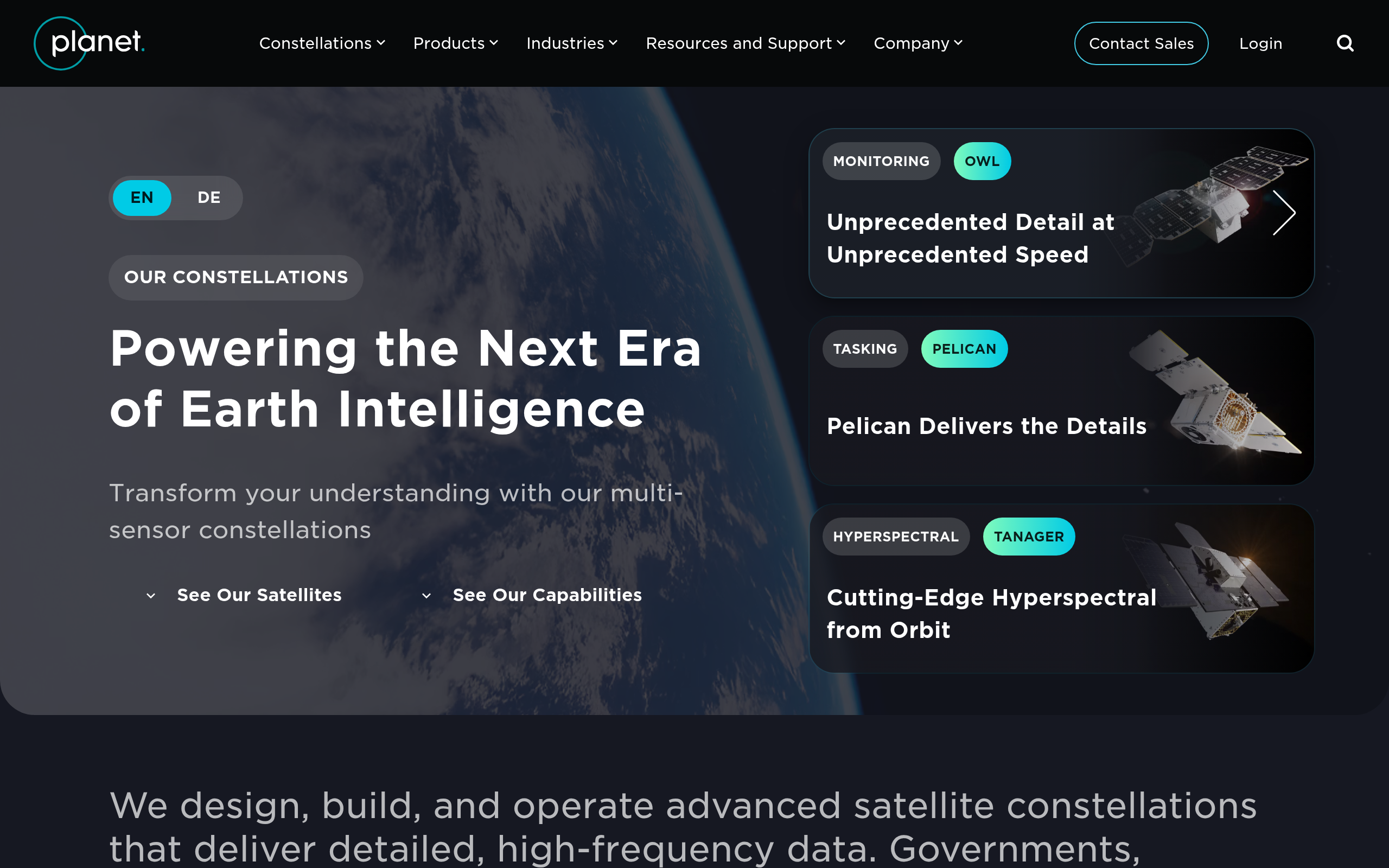
Planet’s architecture spans four operational constellations, all accessible through the Planet Insights Platform. The monitoring and tasking constellations serve fundamentally different buyer workflows, so it is worth treating them separately before looking at the platform layer that ties them together.
PlanetScope: near-daily monitoring
The PlanetScope constellation, powered by SuperDove (Dove Gen-3+) satellites, delivers 3.7 m GSD 8-band multispectral imagery at near-daily global frequency. The eight spectral bands include Red Edge and NIR alongside standard RGB, supporting a wide range of NDVI and vegetation index workflows.
Planet’s site states the company captures over 350 million square kilometers of imagery daily, making this the broadest-coverage single-source optical product commercially available. A Planet SuperRes product uses generative AI to enhance 3 m imagery to approximately 2 m visual resolution, though buyers should treat this as a derived product rather than a native sensor specification.
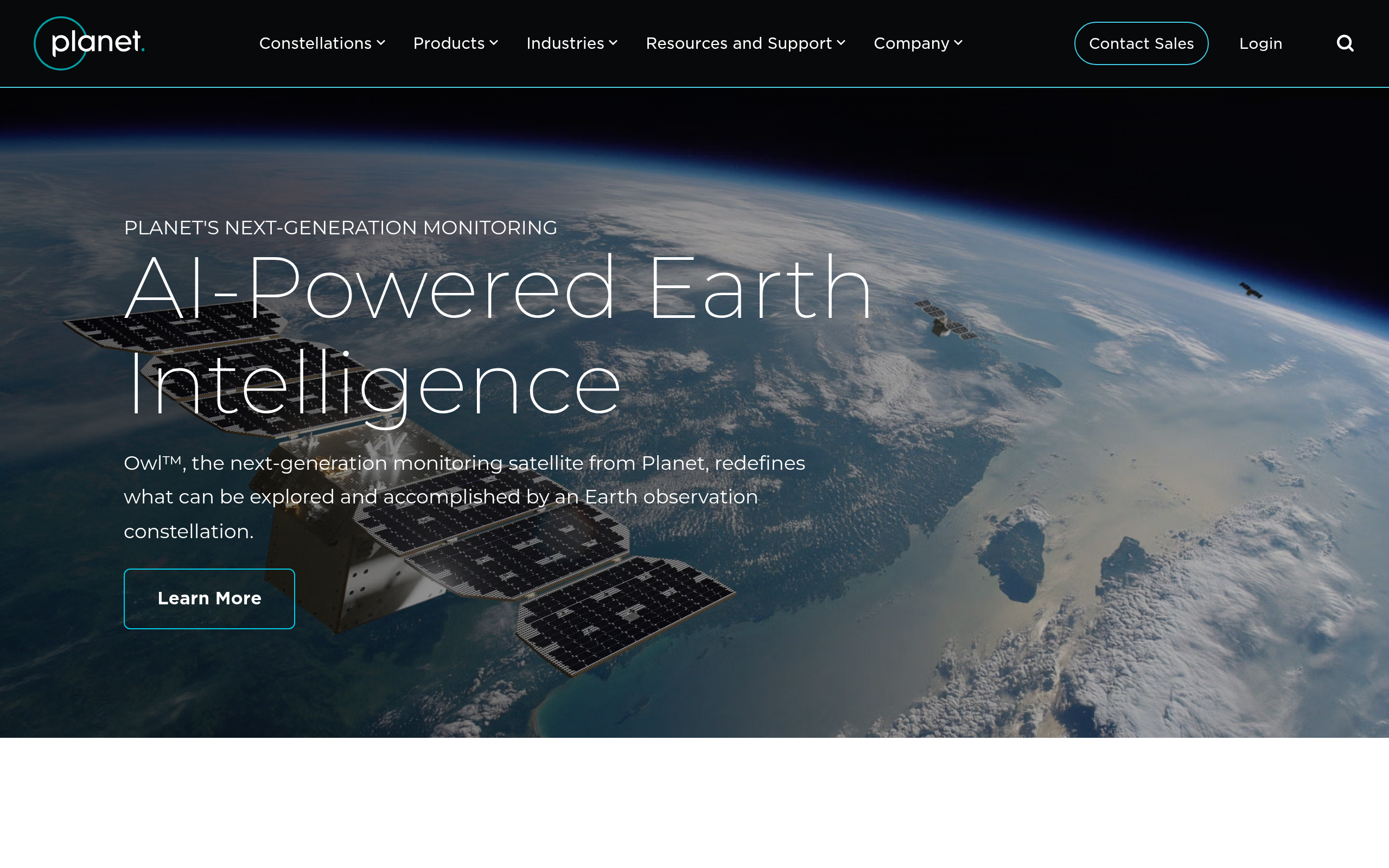
The forthcoming Owl constellation targets approximately 1 m near-daily monitoring but remains pre-launch as of mid-2026.
SkySat and Pelican: high-resolution tasking
SkySat is Planet’s established 50 cm sub-daily revisit tasking constellation, comprising 15 operational satellites. Pelican Gen-1 is the next-generation tasking platform at the same 50 cm resolution, with an 8 km swath and an NVIDIA Jetson Orin on-board AI platform for on-orbit edge computing, allowing object detection and data pre-processing before downlink.
Pelican Gen-2, planned for 2026, targets 30 cm with a 6 km swath. Geolocation accuracy is under 10 m CE90 with Planet ground control points. Delivery from SkySat tasking is documented at as fast as 3 hours from capture.
Tanager: hyperspectral
Tanager-1, launched in August 2024 with a JPL-engineered sensor sponsored by Carbon Mapper, covers the VSWIR range from 400 to 2,500 nm across 424 bands at ~5 nm FWHM spacing. It delivers 30 m resolution with an 18 km swath and weekly global revisit.
Planet claims 3 to 6 times the sensitivity of comparable spaceborne systems. The primary application is methane and CO2 point-source detection, and the full VSWIR coverage also supports vegetation species mapping. As a single-satellite system, the weekly revisit is a firm constraint for programs requiring higher temporal density.
Platform and API
Planet Insights Platform, built on the acquired Sentinel Hub technology, provides a unified API and web interface for all Planet constellations alongside public datasets including Sentinel, Landsat, and MODIS. The platform uses a processing-unit (PU) model for metered access, resetting monthly.
Planet Analytic Feeds add ML-powered object detection and change detection layers, while Planetary Variables deliver derived data products: Soil Water Content (daily, 100 m and 1 km resolution), Land Surface Temperature, Crop Biomass, and Forest Carbon. All these products are accessible through a single API endpoint, which meaningfully reduces integration overhead for buyers combining monitoring, tasking, and derived analytics in one workflow.
Pricing
Planet publishes a tiered pricing structure across its main product lines, with transparent self-serve rates for monitoring subscriptions and per-km² tasking, and enterprise pricing for large-area programs and analytics products. The table below maps the documented rates from Planet’s pricing page as of May 2026, which Planet notes are subject to change.
| Product | Model | From | Notes |
|---|---|---|---|
| PlanetScope Monitoring (AUM) | Annual subscription | $2,700/yr | Tier Three, 50 km² over 189 locations. Global coverage tier $9,650/yr for 50 km². |
| Planet Insights Platform (Exploration) | Monthly tiered | $28/mo | Non-commercial, 30,000 PU/mo, 17% discount for annual billing |
| Planet Insights Platform (Basic) | Monthly tiered | $91/mo | 70,000 PU/mo, priority email support |
| Planet Insights Platform (Enterprise Small) | Monthly tiered | $458/mo | 400,000 PU/mo, SLA included |
| Planet Insights Platform (Enterprise Large) | Monthly tiered | $916/mo | 1M PU/mo, 50 OAuth clients, SLA included |
| SkySat Archive (self-serve) | Per km² | $6/km² | Minimum 25 km² via Planet Select (SkyFi) |
| SkySat Flexible Tasking | Per km² | $12/km² | Planet selects the optimal time, auto-retry until the window expires |
| SkySat Assured Tasking | Per km² | $40/km² | Prioritized collection regardless of cloud cover |
| Tropical Forest Observatory | Annual subscription | $180/mo | Non-commercial. Billed annually at a discounted $1,800/yr. Monthly PlanetScope mosaics over the tropics, archive from 2015. |
The AUM monitoring subscription covers the full historical archive plus all new captures during the subscription period for the defined area of interest, making it a predictable cost model for buyers running ongoing monitoring programs.
For new accounts, a 30-day free trial including Planet Sandbox Data is available without a credit card requirement, which meaningfully lowers the evaluation barrier compared to operators that require a direct sales conversation before granting access. Defense and intelligence use cases, and large-area custom programs beyond 300 km², require direct contact with Planet’s sales team.
Who it’s for
Planet’s architecture maps onto a wide range of buyer segments, though the strongest fits cluster around use cases where temporal frequency and global coverage outweigh the need for VHR sub-meter resolution. Being clear about where the fit weakens is as useful as the affirmative pitch.
Agriculture and food security
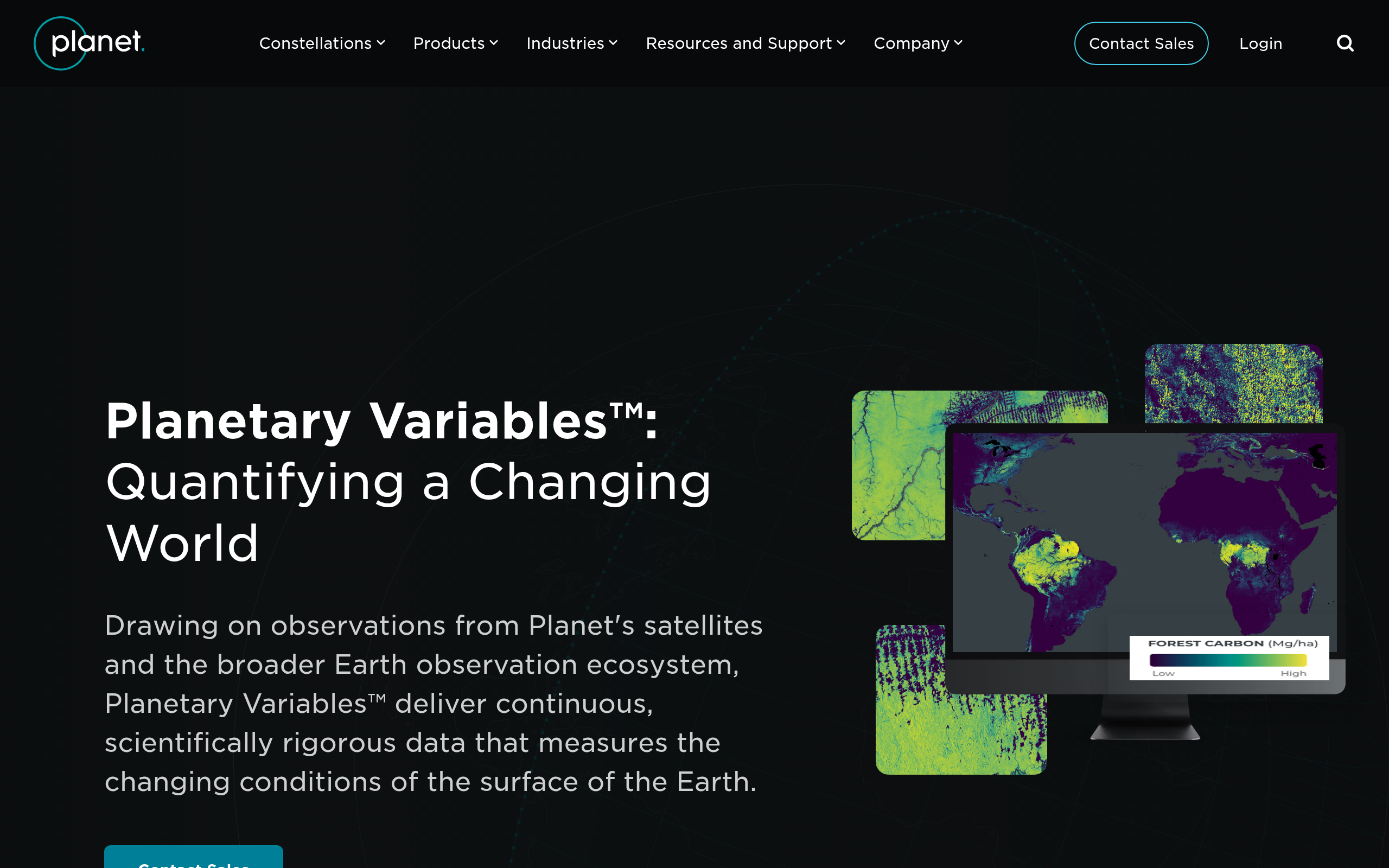
For precision agriculture teams and food security programs, PlanetScope’s near-daily cadence and 8-band spectral design, including Red Edge and NIR, are well-matched to crop monitoring, field boundary mapping, and yield estimation. Planetary Variables add derived daily Soil Water Content and Crop Biomass products at 100 m and 1 km.
This reduces the data-processing burden for teams that do not want to run their own vegetation index pipelines, and named customers like Bayer and Syngenta confirm that the platform holds up under enterprise agricultural use at scale.
Government, defense, and intelligence
Government agencies and defense buyers benefit from daily 3 m monitoring and sub-daily 50 cm tasking through a single vendor and contract. The Planet Labs Federal subsidiary (Arlington, VA) is structured for US government procurement.
L3Harris and the Kazakhstan Space Agency on the public customer list confirm active defense and civil-government engagement. Defense and intelligence orders route through direct sales rather than self-serve channels, and restricted geographies apply to certain tasking requests.
Sustainability, forestry, and carbon
The combination of PlanetScope optical monitoring, Forest Carbon Diligence (aboveground carbon estimates), and Tanager’s methane and CO2 detection makes Planet a credible single-vendor choice for corporate sustainability teams running supply-chain ESG programs or forestry monitoring.
The Tropical Forest Observatory provides a low-cost non-commercial track for NGOs and researchers covering tropical forest change. The weekly Tanager revisit is a constraint for continuous emissions monitoring programs that require higher temporal density.
Where it’s less competitive
Planet is an optical-only operator, so buyers needing all-weather SAR coverage for persistent monitoring under cloud cover will require a separate provider. The 30 m Tanager resolution covers methane point sources but is not suited to high-resolution land cover classification.
For buyers whose primary need is VHR tasking below 30 cm, the Pelican Gen-2 roadmap targets 30 cm but remains planned rather than operational as of mid-2026. Teams working in jurisdictions with active access restrictions should verify their target geography against Planet’s restricted areas list before committing to a self-serve subscription.
Strengths and limitations
Planet’s position as the world’s largest commercial EO fleet creates a clear pattern of structural advantages. The strengths concentrate in scale, coverage, and platform breadth:
- Largest commercial fleet by count (~200 satellites), delivering near-daily global 3 m optical monitoring that no single competitor replicates
- Multi-constellation architecture covering monitoring (SuperDove), 50 cm tasking (SkySat/Pelican), and hyperspectral (Tanager) through one unified API and data contract
- Transparent self-serve pricing with published rates starting from $2,700/yr for AUM monitoring and $6/km² for SkySat archive, plus a 30-day free trial with no credit card required
- On-orbit AI edge compute (NVIDIA Jetson Orin on Pelican) enabling pre-processed outputs before ground downlink, with delivery as fast as 3 hours from tasking capture
- Planet Insights Platform (Sentinel Hub) provides a unified API that combines Planet’s own data with public Sentinel, Landsat, and MODIS datasets, reducing integration work for multi-source workflows
The limitations are worth mapping against your specific requirements before committing to a program:
- Optical-only: no SAR capability, which limits all-weather persistent monitoring, flood mapping under cloud cover, and ground-deformation detection
- PlanetScope 3 m resolution is sufficient for change detection and vegetation monitoring but below the threshold for target characterization, infrastructure inspection, or any workflow requiring sub-meter detail
- Tanager’s 30 m resolution and weekly revisit constrain its use to point-source emissions monitoring; it is not suitable for high-resolution land cover classification
- Pelican Gen-2 (30 cm) and the Owl next-generation monitoring constellation remain on the roadmap rather than confirmed operational, so buyers planning around sub-30 cm or 1 m near-daily imagery are scheduling against announced intent
- Defense, intelligence, and large custom programs require direct sales engagement, with no self-serve route for those use cases
In my analysis, the core commercial tension is between Planet’s exceptional temporal frequency and its optical-only architecture. For workflows where daily revisit and global coverage are the decision drivers, no other single operator comes close. For workflows where cloud-penetrating SAR or sub-30 cm detail is the requirement, Planet works best as part of a multi-provider stack rather than a standalone solution.
Planet Labs alternatives
If Planet’s optical-only, monitoring-first architecture does not align with your primary requirement, three operators offer meaningfully different capability profiles at comparable scale. The table below draws on verified specifications from primary sources for each provider.
| Provider | Best resolution | Revisit | Constellation size | Key differentiator |
|---|---|---|---|---|
| Planet Labs | 50 cm (SkySat/Pelican), 3 m PlanetScope | Near-daily monitoring, sub-daily tasking | ~200 satellites | World’s largest commercial fleet, near-daily global 3 m optical coverage |
| Vantor | 30 cm class (15 cm HD upsampled) | Multiple times per day over targets | WorldView constellation | Highest-resolution commercial optical imagery, the benchmark for VHR tasking |
| Airbus | 30 cm (Pléiades Neo) | Daily revisit at 30 cm | Pléiades Neo + Pléiades + SPOT | 30 cm daily revisit with a multi-satellite optical archive dating to SPOT-1 |
| BlackSky | 35 cm (Gen-3) | Sub-daily (scaling toward hourly) | Gen-3 fleet operational | Mid-inclination orbits for time-diverse intraday revisit, strong defense analytics |
Vantor’s WorldView Legion delivers 30 cm-class native imagery (with a 15 cm HD upsampled product) and is the benchmark for VHR tasking where resolution drives the decision over revisit frequency. Airbus Pléiades Neo delivers 30 cm daily revisit with an extensive optical archive spanning decades. BlackSky’s Gen-3 constellation and mid-inclination orbit design produce time-diverse intraday revisit particularly suited to change detection and defense monitoring workflows.
Planet’s differentiation remains the breadth of its monitoring fleet and the span of its multi-constellation platform, which none of these three replicates at equivalent monitoring scale.
Verdict
Legitimacy is not the question with Planet Labs: it is a publicly traded, Public Benefit Corporation with a 13-year operational history, 200-plus satellites in orbit, and hundreds of documented enterprise customers. The real question is fit, and that splits along the monitoring-versus-tasking axis.
For buyers whose core requirement is near-daily global optical monitoring at 3 m, Planet is the most capable single-vendor solution on the market, and the self-serve AUM pricing with transparent rates and a free trial makes evaluation straightforward. The platform depth, combining monitoring data, Planetary Variables, and a unified Sentinel Hub API, adds genuine value for buyers who would otherwise stitch together multiple providers.
The caveats are structural. Planet is optical-only, so if all-weather SAR coverage is part of your requirement, a separate provider is needed. If sub-30 cm VHR tasking is the primary need, Pelican Gen-2 is on the roadmap but not yet operational, and Vantor or Airbus serve that need now. For programs that are cloud-sensitive or geography-restricted, verify your AOI against Planet’s restricted areas before committing to self-serve ordering.
For broad-area monitoring, agricultural and forest carbon programs, and multi-sensor analytics workflows, Planet is a well-matched choice with low evaluation friction. The alternatives table above is the practical starting point if VHR tasking or SAR coverage falls outside Planet’s optical envelope.
Frequently asked questions
Below are answers to the questions buyers most commonly ask about Planet. Each answer points to the section where the full detail lives.
How does Planet Labs work?
Planet operates multiple satellite constellations (PlanetScope, SkySat, Pelican, Tanager) and makes their data accessible via the Planet Insights Platform, a cloud-native API and web interface built on Sentinel Hub technology. Buyers subscribe to monitoring coverage by area, order tasking on a per-km² basis, or access derived analytics products. No satellite hardware is required on the buyer’s side. Full detail is in “Data and capabilities.”
Is Planet Labs a legit company?
Yes. Planet Labs PBC is publicly traded on the NYSE (ticker: PL), founded in 2010, and has operated continuously since its first satellite launch in 2013. Its public benefit corporation structure and 13-year operational history are the primary legitimacy markers. See “Is Planet Labs legit?“
Who owns Planet Labs?
Planet Labs PBC is publicly traded on the New York Stock Exchange as ticker PL and has no majority controlling shareholder listed on its public pages. The company was founded by Will Marshall, Robbie Schingler, and a third NASA scientist co-founder, with Will Marshall serving as Co-founder and CEO. Ownership details are in “Is Planet Labs legit?“
How much does Planet Labs cost?
PlanetScope area-based monitoring subscriptions start at $2,700/yr for a 50 km² Tier Three area. The Planet Insights Platform starts at $28/mo. SkySat tasking runs from $6/km² for archive to $40/km² for Assured Tasking. A 30-day free trial is available. Full pricing is in the “Pricing” section.
Does Planet Labs have a free tier?
Planet offers a 30-day free trial including Planet Sandbox Data, with no credit card required. This provides genuine API and platform access for evaluation, though it is a time-limited trial rather than a permanent free tier. Details are in “Pricing.”
Who are Planet Labs’ customers?
Planet’s own pages name customers including Bayer, Syngenta, Google, L3Harris, the Rural Payments Agency (UK), the Kazakhstan Space Agency, and Carbon Mapper. The company reports over 700 customers across agriculture, government, defense, and commercial sectors. The full customer context is in “Is Planet Labs legit?“
How does Planet Labs make money?
Planet’s primary revenue model is subscription-based data licensing: buyers pay annual AUM subscriptions for monitoring coverage, monthly platform fees for API access, and per-km² fees for tasking orders. Enterprise programs and government contracts are priced via direct sales. Planet is NYSE-listed and reports quarterly financial results. See “Pricing” for the rate structure.
When was Planet Labs founded?
Planet was founded in 2010 by three NASA scientists, with its first satellite launched in 2013. The company became publicly traded on December 8, 2021 via a SPAC merger with dMY Technology Group IV. Background is in “About Planet Labs.”
What are the best alternatives to Planet Labs?
The closest matches depend on your primary requirement: Vantor for the highest-resolution VHR tasking, Airbus Pléiades Neo for 30 cm daily revisit with deep optical archive, and BlackSky for sub-daily intraday change detection with a defense analytics layer. A full comparison is in “Planet Labs alternatives.”
What use cases is Planet Labs best suited for?
Planet is strongest for near-daily global monitoring, change detection, agricultural and forestry programs, sustainability and carbon workflows, and any use case where temporal frequency and global coverage are the primary drivers over sub-meter resolution. It is less competitive for all-weather SAR monitoring or sub-30 cm VHR tasking. Details are in “Who it’s for.”

My passions are Earth Observation and Satellites, and my profession is Data Analysis. I combine both within ObservationData.com to show you the use cases of Earth Observation, to help you find the right provider, and to share your experiences.
