
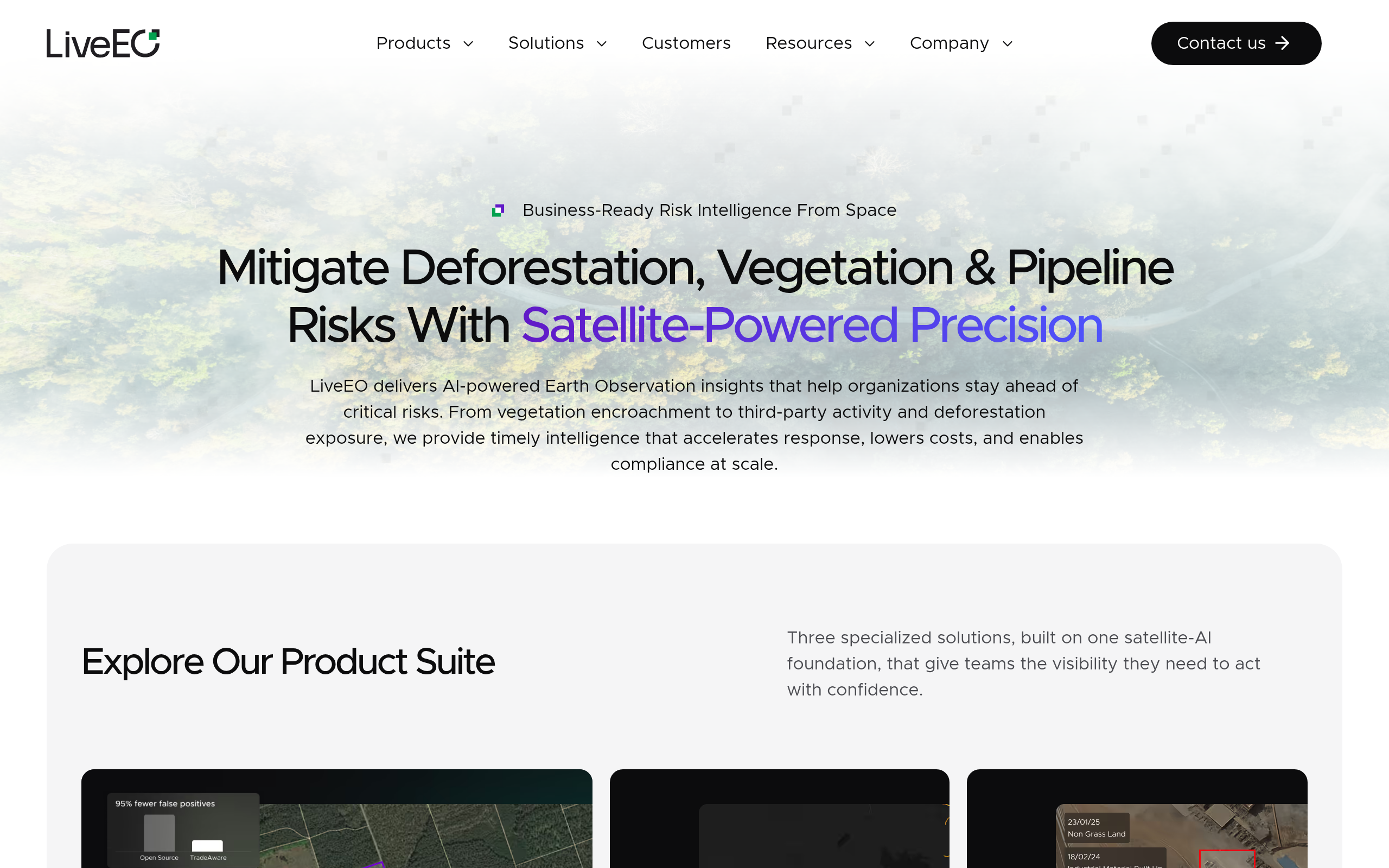
 LiveEO is a German satellite analytics provider for critical infrastructure operators, delivering AI-processed monitoring insights for electric grids, rail networks, and pipelines without requiring customers to touch raw satellite data.
It is a legitimate company, backed by over $60 million in funding and trusted by named clients including Deutsche Bahn, E.ON subsidiary E.DIS, and MITNETZ GAS, with a growing international footprint spanning six continents.
This review covers LiveEO’s three core products, its pricing model, where it genuinely fits, and where a different solution may serve you better.
Table of Contents
Key Takeaways
- LiveEO fits infrastructure operators who need finished AI monitoring reports, not raw imagery pipelines
- Its standout edge is SAR all-weather change detection for pipeline corridors, with reports in under 24 hours
- Across all strengths and limitations we weighed, the main caveat is quote-only pricing with no self-serve option
About LiveEO
Founded in Berlin in 2018, LiveEO processes satellite imagery from a global network of third-party providers and delivers the outputs as finished, audit-ready intelligence through three vertical SaaS products. Customers receive actionable insights rather than raw data and engage entirely through a managed service model. The key facts below are drawn from LiveEO’s published pages as of June 2026.
| Name | LiveEO |
|---|---|
| Website | live-eo.com |
| Legal name | LiveEO GmbH |
| Address | Cuvrystraße 3–4, 10997 Berlin, Germany |
| Founded | 2018 |
| Ownership | Private, $60M+ in funding (no parent company) |
| Leadership | Daniel Seidel (Co-Founder & Co-CEO, Tech); Sven Przywarra (Co-Founder & Co-CEO, Business) |
| Employees | 160+ globally, from 30+ countries |
| Products & data | Treeline (vegetation management for utilities and rail); SurfaceScout (pipeline corridor monitoring, SAR + optical); TradeAware (EUDR deforestation compliance); REST/webhook API integrations; mobile field app |
| Pricing | Enterprise contract, quote-based. No published rates. Supplier onboarding within TradeAware is free for the supplier side |
| Languages | English |
LiveEO’s own about page reports monitoring over one million kilometers of grid across six continents, a scale that reflects a customer base spanning European utilities, North American pipeline operators, and supply-chain compliance buyers in Southeast Asia. The Red Dot Design Award 2025 and SOC 2 Type II certification are the company’s two principal trust signals visible on the public site.
Is LiveEO legit?
Yes, LiveEO is a real, established company. LiveEO GmbH is registered at the local court Charlottenburg under HRB 200660, publishes a full statutory imprint, and operates subsidiaries in New York and Latvia. The more useful buyer question is whether its vertical SaaS model fits your monitoring requirement, not whether the company is credible.
Ownership and funding
LiveEO is privately held with over $60 million in total funding. A May 2026 round of €28 million named investors in the company’s own press release: new investors Helantic, b2ventures, and EIC, alongside returning investors Nordic Ninja, DTCF, Matterwave Ventures, MMC Ventures, Segenia Capital, and Greencode Ventures. The company additionally secured €6.6 million in public GRW funding, administered by Investitionsbank Berlin, to advance the Twinspector constellation. LiveEO does not trade publicly.
The confirmed legal structure is a multi-jurisdiction arrangement: LiveEO GmbH (Berlin) is the German operating entity, LiveEO Inc. (New York) serves North American customers, and SIA LiveEO Services LLC (Daugavpils, Latvia) rounds out the footprint.
Two co-CEOs split responsibilities by domain: Daniel Seidel (Tech) and Sven Przywarra (Business), both documented as managing directors in the German statutory imprint.
Track record and customers
LiveEO’s published case studies give concrete evidence of enterprise deployment at scale. E.DIS, the E.ON subsidiary managing Germany’s northeastern grid, achieved a 15% increase in reliability with a reduction in vegetation-caused outages using Treeline. MITNETZ GAS validated satellite-based monitoring across its full 7,000-kilometer gas network using SurfaceScout. Deutsche Bahn, British Pipeline Agency, Liberty Utilities, Plains Midstream Canada, and First Gas (New Zealand) all appear as named customers on the product and case-study pages.
SurfaceScout’s product page claims the system detects four times more pipeline threats than traditional aerial patrols and saves over €5M in risk exposure per 1,000 km. These are vendor-asserted marketing figures, not independently audited, which is worth bearing in mind for procurement comparisons.
Compliance and data rights
SOC 2 Type II certification is the primary trust signal for enterprise buyers concerned with data handling. LiveEO processes imagery from what it describes as a “global network of satellite providers,” but the specific imagery vendors are not named on the public site, a gap for buyers needing to validate their data supply chain or comply with jurisdiction-specific sourcing requirements.
The company does name European industrial partners for Twinspector hardware development (Reflex Aerospace, Kampf Telescope Optics, Engineering Minds Munich), but these are constellation development contractors, not current imagery suppliers.
For regulated industries such as pipeline operators subject to PHMSA oversight, LiveEO does offer audit-ready reporting as a product feature, which partially addresses the compliance documentation need.
Data and capabilities
LiveEO’s model is product-first, not data-first. Rather than offering access to a satellite data catalog, it applies AI processing to imagery from a global network of optical and SAR providers and returns finished alerts, risk scores, and compliance reports. Buyers do not select sensors or manage imagery downloads; the satellite sourcing is LiveEO’s responsibility. The three current products each address a specific infrastructure monitoring vertical.
Treeline: vegetation management
Treeline targets electric utilities and rail operators with AI-powered vegetation risk detection across their right-of-way corridors. The system detects grow-in (lateral encroachment), fall-in (tree fall risk), and vitality decline, and it generates prioritized work orders for field vegetation management crews. Utilities use Treeline to reduce outage frequency caused by vegetation contact, optimize trim cycles, and build a defensible audit trail for regulatory reporting.
The E.DIS deployment produced 50,866 AI-prioritized vegetation management tasks, contributing to the documented 15% reliability improvement. In my analysis of LiveEO’s use-case documentation, wildfire risk mitigation is increasingly central to the Treeline pitch for utilities in fire-prone regions of North America and Australia, supplementing the traditional outage-prevention framing.
SurfaceScout: pipeline corridor monitoring
SurfaceScout monitors pipeline rights-of-way for third-party activity (unauthorized excavation, construction encroachment) and natural hazards including ground deformation and flooding. It combines optical imagery with SAR-based change detection for all-weather, day-or-night coverage, with reports in under 24 hours (12-hour option available). The SAR component matters because cloud cover and seasonal darkness are routine pipeline corridor conditions where optical-only monitoring has blind spots.
SurfaceScout includes a digital audit trail aligned to PHMSA requirements for US pipeline integrity programs. MITNETZ GAS, British Pipeline Agency, Plains Midstream Canada, Targa Resources, Exolum (Spain), and First Gas (New Zealand) are named customers. The detection figures (4x aerial patrols, €5M+ savings per 1,000 km) are vendor-asserted marketing claims, not independently validated.
TradeAware: EUDR compliance
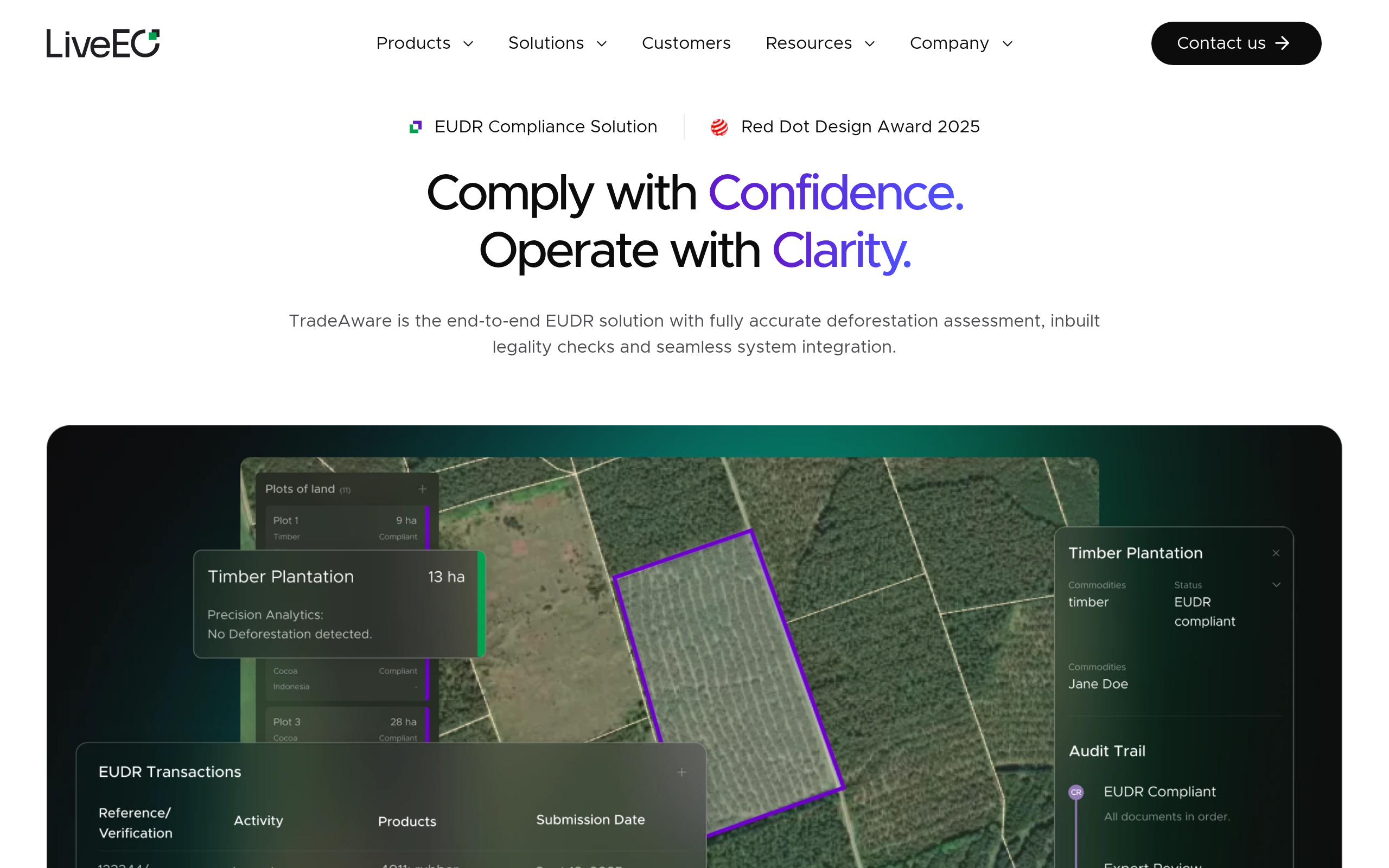
TradeAware addresses the EU Deforestation Regulation, which came into force in 2023 and requires companies placing certain commodities on the EU market to demonstrate that supply-chain production did not drive deforestation after December 2020. The product handles supplier onboarding, precision deforestation analytics, legal analysis, ERP integration, and submission of Due Diligence Statements to TRACES NT, the EU’s official compliance portal.
Named TradeAware customers include Bauhaus & Co KB (Germany), Auchan (France), Sri Trang Agro-Industry (Thailand), and Kirana Megatara (Indonesia). For procurement teams evaluating EUDR tooling, TradeAware is a deforestation monitoring product that functions closer to regulatory workflow software than to satellite analytics.
Twinspector: planned constellation
LiveEO is also developing Twinspector, a planned stereo satellite pair for 3D vegetation height measurement and corridor monitoring. The constellation is “currently under development” per the site, with no published launch timeline, and Twinspector is not operational as of June 2026 and should not factor into current procurement decisions.
Pricing
LiveEO publishes no pricing on its website. All three products (Treeline, SurfaceScout, TradeAware) are sold through enterprise sales engagement, with pricing structured as custom contracts. There is no self-serve option for buyers, and no published starting rate.
One partial exception: the TradeAware product page states that supplier onboarding is free for suppliers invited to submit geolocation data and documentation, reducing friction in the EUDR compliance workflow. This is a supplier-side tool, not a buyer-facing free tier or trial.
| Product | Model | Entry point | Notes |
|---|---|---|---|
| Treeline | Enterprise contract | Quote required | Scoped by corridor length, network size, and update frequency |
| SurfaceScout | Enterprise contract | Quote required | 12-hour and 24-hour reporting options. PHMSA audit trail included |
| TradeAware | Enterprise contract | Quote required | Scoped by supply chain size, commodity, and DDS submission volume |
| API integrations | Included with product | N/A | REST and webhook access bundled with SaaS subscription |
| TradeAware supplier onboarding | Free (supplier-side only) | No cost for suppliers | Suppliers invited to submit geolocation data and documentation pay nothing. Buyer/operator access remains enterprise contract |
Quote-only pricing is common at this level of enterprise SaaS, but it creates real friction in early-stage procurement. Buyers need a sales conversation before they can make a budget estimate, and there is no self-serve evaluation path for buyers documented on the site. For formal multi-vendor procurement processes, budgeting depends entirely on a LiveEO sales proposal.
Who it’s for
LiveEO’s three products address three distinct buyer profiles, all sharing a common characteristic: they are organizations responsible for physical infrastructure or regulated supply chains that need continuous satellite-derived monitoring without an internal geospatial team to process the data.
Electric utilities and rail operators
Treeline is built for transmission and distribution utilities and rail operators managing vegetation risk across linear corridors. The product fits organizations that want a managed monitoring service outputting actionable work orders rather than raw imagery for internal GIS teams. E.DIS and Deutsche Bahn are representative customers: large network operators with vegetation management obligations and no appetite for building internal satellite data pipelines.
For these buyers, the key questions are how Treeline’s detection methodology is validated and how its prioritization integrates with existing asset management systems.
Pipeline operators and energy infrastructure
SurfaceScout targets midstream and downstream pipeline operators who need to detect third-party activity and natural hazards along their rights-of-way. The all-weather SAR capability addresses a genuine operational gap, since aerial patrols are weather-dependent, seasonal, and expensive at scale, while SurfaceScout delivers continuous automated surveillance. The documented customer base spans North America (Plains Midstream Canada, Targa Resources), Europe (MITNETZ GAS, Transnet BW, Exolum), and the Asia-Pacific region (First Gas).
The PHMSA-aligned audit trail matters for US operators where documentation of third-party activity monitoring is part of integrity management requirements. Buyers evaluating SurfaceScout for compliance programs should confirm how the audit trail format maps to their specific regulatory submissions.
Supply-chain compliance teams
TradeAware targets procurement and sustainability teams importing forest-risk commodities into the EU. The EUDR due diligence workflow requires supplier geolocation, deforestation analysis against reference dates, and formal DDS submission to TRACES NT. TradeAware handles the full chain as a turnkey compliance service for non-GIS teams.
Where LiveEO fits less well: buyers who want raw satellite imagery for proprietary analysis, need a self-serve data platform with transparent pricing, require explicit disclosure of which satellite vendors supply the imagery, or have use cases outside vegetation management, pipeline corridors, and EUDR compliance.
Strengths and limitations
LiveEO’s clearest strengths derive from its decision to build purpose-built vertical products rather than a horizontal data platform. The advantages concentrate in operational completeness and enterprise integration:
- Three production-grade vertical SaaS products (Treeline, SurfaceScout, TradeAware) each addressing a specific regulated infrastructure monitoring need, reducing the integration work required from the buyer
- SAR-based all-weather change detection in SurfaceScout closes the cloud-cover gap that makes optical-only pipeline monitoring unreliable in many operating environments
- Audit-ready reporting with a full digital chain of custody, directly relevant to buyers in PHMSA-regulated pipeline programs or EUDR supply-chain compliance
- Named enterprise customers across six continents, including Deutsche Bahn, E.ON subsidiary E.DIS, and MITNETZ GAS, providing credible proof of production deployment at network scale
- SOC 2 Type II certification and a 160-plus-person team from 30+ countries signal an institutional-grade service organization rather than a startup-stage pilot product
The limitations are worth evaluating against your specific buying context before progressing a procurement:
- No published pricing and no self-serve entry point for buyers: all evaluation requires a sales conversation, which slows down early-stage budget planning and competitive comparison (suppliers can submit data free of charge within TradeAware, but this is not a buyer trial)
- Satellite imagery vendors are not named on the public site despite $60M+ in funding and named enterprise customers, creating supply-chain opacity for buyers with data-sourcing governance requirements or national security sourcing restrictions
- The product scope is narrow by design: outside vegetation management, pipeline corridors, and EUDR compliance, there is no horizontal platform for custom analysis or novel use cases
- Detection and ROI figures (4x aerial patrols, €5M per 1,000 km) are vendor-asserted in case studies and have not been independently audited, limiting their reliability in third-party comparisons
- Twinspector constellation is under development with no launch date, so buyers factoring future 3D stereo data into their evaluation are working from a roadmap, not a shipped capability
In my analysis, the core buyer tension is between LiveEO’s operational depth within its three verticals and the opacity of its commercial model. For organizations whose requirement aligns cleanly with one of the three products, the managed service approach removes significant data-processing burden. For organizations that want pricing transparency, flexible platform access, or coverage of use cases outside those verticals, the model is a poor fit and a different solution will serve them better.
LiveEO alternatives
For buyers whose requirements fall outside LiveEO’s three verticals, or who need different commercial terms, several analytics-focused providers offer overlapping or complementary capabilities. The table below draws on verified data from primary sources for each provider.
| Provider | Category | Primary vertical | Key differentiator |
|---|---|---|---|
| LiveEO | Analytics SaaS | Utilities, pipeline, EUDR | Three purpose-built infrastructure monitoring products, SAR all-weather pipeline detection, audit-ready reporting |
| Overstory | Analytics SaaS | Electric utilities (vegetation) | Vegetation intelligence specialist for electric utilities. $43M Series B (2025). REE Spain deployment across 27,340 miles of transmission, 37 vegetation species classified |
| Satelytics | Analytics SaaS | Energy and utilities | Hyperspectral-capable SaaS for pipeline leak detection, methane, and vegetation. Broader sensor input including UAV and fixed cameras |
| Kayrros | Analytics / data aggregator | Energy, emissions, climate risk | Methane Watch used by IMEO and US government. Acquired by Energy Aspects (May 2026). 20+ satellite constellations, energy market intelligence focus |
Overstory is the most direct Treeline alternative: both target transmission and distribution utilities, use third-party satellite imagery, and deliver AI vegetation risk as a managed service. The distinction is scope: Overstory focuses exclusively on vegetation intelligence, while LiveEO extends into pipeline monitoring and EUDR compliance. Organizations with a single-vertical vegetation need should evaluate both on product maturity and geographic references.
Satelytics covers pipeline and utility monitoring with stronger hyperspectral capability for leak and methane detection, plus broader sensor support including UAV inputs. Kayrros, now part of Energy Aspects, differentiates through energy-market intelligence and its regulatory adoption, though its acquisition trajectory is a continuity question for new buyers.
For buyers who want to source raw optical or SAR imagery and run their own analytics, platforms like UP42 or Sentinel Hub offer a data-first model where you control the analysis layer.
Verdict
Legitimacy is not a real question for LiveEO: it is a registered GmbH with statutory transparency, $60M+ in funding, and a named enterprise customer list that includes some of Europe’s largest grid and pipeline operators. The productive question is fit, and the fit is narrow but deep.
If your organization manages electric utility or rail vegetation risk, operates pipeline infrastructure requiring third-party activity monitoring, or needs a turnkey EUDR compliance workflow, LiveEO is a credible, production-grade option with documented deployments at scale. The managed service model removes the satellite data burden entirely, and the SOC 2 Type II certification and audit-ready reporting are meaningful assets for regulated industries.
The SurfaceScout SAR integration is a genuine operational advantage over optical-only competitors for pipeline corridors under cloud cover or seasonal darkness.
The caveats are equally structural. No published pricing, no self-serve evaluation path for buyers, and no named satellite imagery vendors are all friction points for buyers in formal procurement processes or with data-sourcing governance requirements.
The three products are deep within their verticals and do nothing outside them: if your requirement is for flexible platform access, raw imagery, or analytics across a broader range of use cases, a different solution will serve you better. The alternatives table above is a practical starting point for those cases.
Frequently asked questions
Below are answers to the questions buyers most commonly ask about LiveEO. Each answer points back to the section where the full detail lives.
How does LiveEO work?
LiveEO ingests satellite imagery (optical and SAR) from third-party providers, applies AI processing to detect risks and changes, and delivers finished reports and alerts through three SaaS products. Buyers receive actionable intelligence rather than raw imagery; no internal satellite data processing is required. Integration happens via REST and webhook APIs. Full detail is in “Data and capabilities.”
Is LiveEO a legit company?
Yes. LiveEO GmbH is a registered German company (HRB 200660, Charlottenburg), with subsidiaries in New York and Latvia, over $60 million in declared funding, and a named enterprise customer list. The SOC 2 Type II certification is the key data-handling trust signal. Background is in “Is LiveEO legit?“
Who owns LiveEO?
LiveEO GmbH is privately held. Co-founders Daniel Seidel (Co-CEO, Tech) and Sven Przywarra (Co-CEO, Business) are the named managing directors per the German statutory imprint. The company’s May 2026 press release names Nordic Ninja, MMC Ventures, Helantic, and others as investors in the €28M round. Ownership details are in “Is LiveEO legit?“
How much does LiveEO cost?
LiveEO does not publish pricing. All three products are sold via enterprise sales engagement on a contract basis, scoped to corridor length, network size, or supply-chain volume, with no self-serve pricing for buyers. The pricing model is covered in “Pricing.”
Does LiveEO have a free tier or trial?
There is no buyer-facing free tier or self-serve trial. Treeline and SurfaceScout require a direct sales conversation. TradeAware’s product page states that supplier onboarding is free for suppliers invited to submit geolocation data and documentation, but operator and buyer access is enterprise contract only. See “Pricing.”
Who are LiveEO’s customers?
Published case studies name Deutsche Bahn, E.DIS (E.ON), MITNETZ GAS, British Pipeline Agency, Liberty Utilities, Plains Midstream Canada, First Gas (New Zealand), and supply-chain customers including Sri Trang Agro-Industry and Auchan. The company states it monitors over one million kilometers of grid across six continents. Customer context is in “Is LiveEO legit?“
How does LiveEO make money?
LiveEO earns enterprise SaaS subscription fees for ongoing access to Treeline, SurfaceScout, or TradeAware, scoped to network size and monitoring frequency. There is no per-image or transactional pricing, and all revenue flows through direct enterprise sales. See “Pricing.”
When was LiveEO founded?
LiveEO was founded in 2018 in Berlin by Daniel Seidel and Sven Przywarra. The founding year is documented on the company’s about page timeline. Background is in “About LiveEO.”
Where is LiveEO based?
LiveEO’s registered office is at Cuvrystraße 3–4, 10997 Berlin, Germany. The company also operates through LiveEO Inc. in New York (120 Wall Street) and SIA LiveEO Services LLC in Daugavpils, Latvia. Company details are in “About LiveEO.”
What are the best alternatives to LiveEO?
For utility vegetation management, Overstory is the closest alternative. Satelytics covers pipeline monitoring with hyperspectral capability. For raw data access rather than finished reports, UP42 and Sentinel Hub offer self-serve satellite data platforms for custom analytics pipelines. The full comparison is in “LiveEO alternatives.”

My passions are Earth Observation and Satellites, and my profession is Data Analysis. I combine both within ObservationData.com to show you the use cases of Earth Observation, to help you find the right provider, and to share your experiences.
