
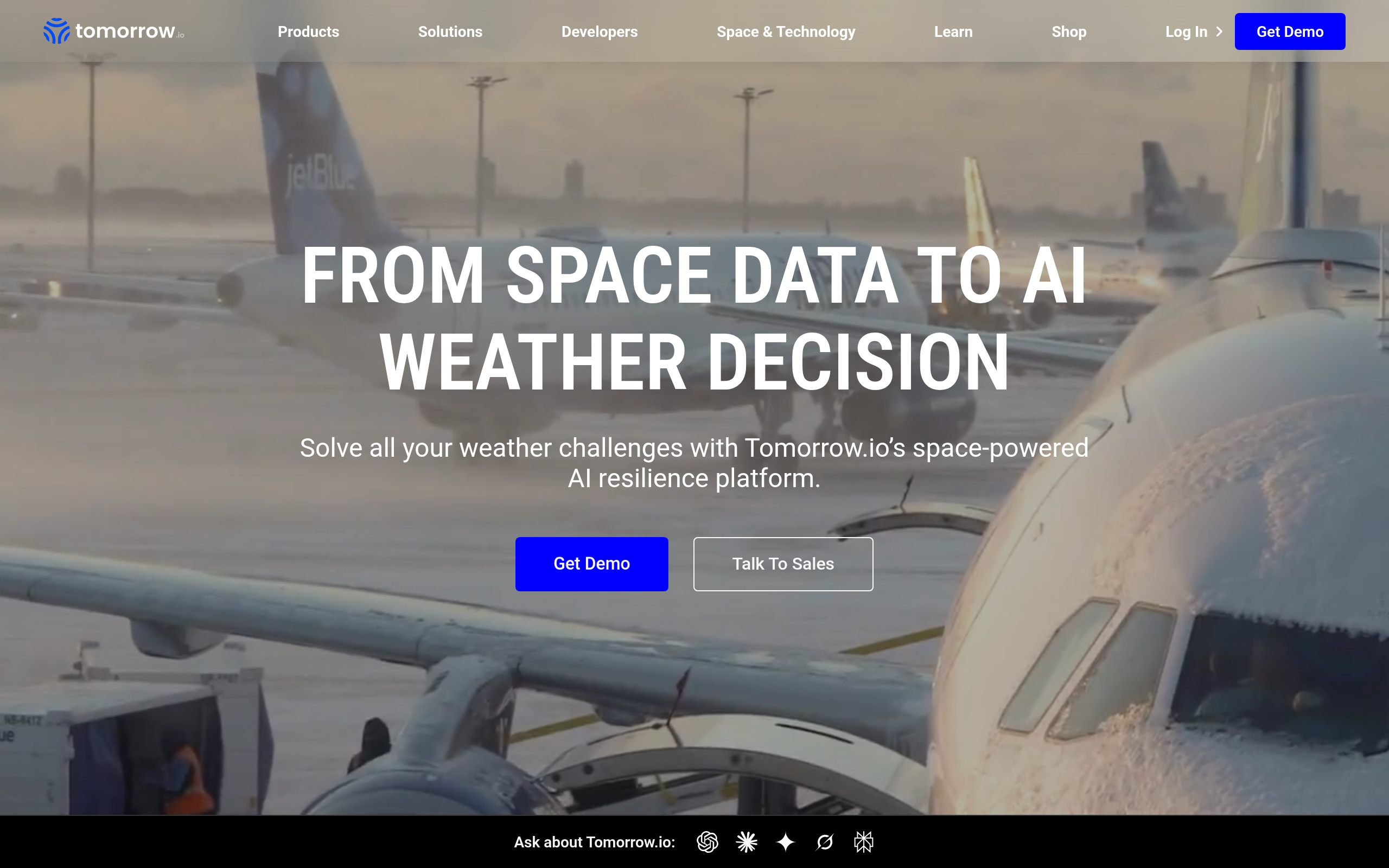
 Tomorrow.io is a US weather-intelligence company operating its own sensing constellation.
Yes, legitimate: a $210 million Series F and NOAA ingesting its sounder data.
This review covers the constellation, data products, pricing and the fit for your team.
Table of Contents
Key Takeaways
- Tomorrow.io is the go-to choice for space-based atmospheric data from a vertically integrated operator with its own constellation
- Its standout edge is a 60-minute global revisit microwave sounder network operationally validated by NOAA
- Tomorrow.io’s satellite data pricing is enterprise-only and not publicly disclosed, requiring direct sales engagement for access
About Tomorrow.io
Tomorrow.io operates a Phase-1 constellation of 13 weather-sensing satellites and layers its own AI weather model (CBAM) and an agentic resilience platform on top of the raw sensor data. This vertical integration, from space hardware through AI models to enterprise workflow tools, sets it apart from weather data resellers that rely entirely on third-party satellite inputs. The key facts below are drawn from Tomorrow.io’s own published pages as of June 2026.
| Name | Tomorrow.io |
|---|---|
| Website | tomorrow.io |
| Legal name | The Tomorrow Companies Inc. |
| Address | 9 Channel Center St, 7th Floor, Boston, MA 02210, USA |
| Founded | 2016 |
| Ownership | Private (Series F, $210M total) |
| Leadership | Shimon Elkabetz (CEO, Co-Founder); Rei Goffer (CSO, Co-Founder); Itai Zlotnik (CCO, Co-Founder); Leigha Kemmett (CFO & COO); Arun Chawla (Chief Weather Officer, ex-NOAA) |
| Products & data | Microwave sounder atmospheric profiles (6U CubeSats, 2200 km swath); Ka-band radar precipitation data (Pathfinder R1/R2); Weather API (80+ data layers); Tomorrow.io Resilience Platform with Gale AI agent; CBAM proprietary AI weather model; Altitude aviation platform; Satellite Data Catalog; DeepSky next-generation constellation (announced 2026) |
| Pricing | Weather API free tier (self-serve); enterprise/satellite data products via quote |
| Languages | English |
Tomorrow.io’s differentiator in the market is that it both manufactures the sensors and sells the downstream intelligence. Named customers include Amazon, BNSF Railway, Lufthansa, Uber, FOX Sports, and the FIA (Formula 1 weather safety). The company reports serving more than 250 enterprise customers, including six of the top ten Fortune 500 companies.
Is Tomorrow.io legit?
A national weather service buying commercial soundings is the strongest signal available in this segment, and it is the one I look for first. It means somebody ran a validation campaign against operational forecasts, which in my view is evidence no marketing page can substitute for.
Tomorrow.io’s legitimacy is well established. The company is a private US corporation founded in 2016 and has reached a Series F funding round totaling $210 million, with NOAA operationally validating its satellite data through the NESDIS Commercial Weather Data Pilot. The more relevant question for a buyer is whether its particular product architecture matches your use case.
Ownership and funding
The Tomorrow Companies Inc. is privately held and venture-backed. The Series F round closed in two tranches: $175 million announced February 3, 2026, led by Stonecourt Capital and HarbourVest Partners, followed by a $35 million extension from Pitango and Harel Insurance in May 2026, bringing the total to $210 million. Earlier investors include Square Peg, Canaan, Activate Capital, ClearVision, and Fontinalis.
The deal was structured with Goldman Sachs as exclusive financial advisor for the Series F, indicating institutional-grade deal structuring. No public valuation figure has been disclosed on the company’s own site.
The three co-founders, Shimon Elkabetz (CEO), Rei Goffer (CSO), and Itai Zlotnik (CCO), have remained in leadership since founding in 2016, providing unusual founder continuity for a company at this stage. The presence of ex-NOAA Chief Weather Officer Arun Chawla in an executive role signals deliberate investment in meteorological credibility.
Track record and customers
Tomorrow.io has operated continuously since 2016 and has moved from pure software into hardware, launching its first Ka-band radar pathfinder satellites in 2023 and completing Phase-1 of its sounder constellation in January 2026. The U.S. Air Force awarded a $19.3 million contract for the radar satellite program, and NOAA’s NESDIS ingests sounder data into its operational AWIPS2 system, confirming government-grade validation of the constellation’s data quality.
Named enterprise customers span aviation (Lufthansa), logistics (Amazon, BNSF Railway, Shipt), motorsport (FIA Formula 1), and agriculture (CHS). The company claims six of the top ten Fortune 500 companies among its 250-plus enterprise customers.
Compliance and data rights
Tomorrow.io’s Weather API is available to developers via a self-serve free tier at app.tomorrow.io. Satellite data products (sounder profiles, radar products) and the enterprise Resilience Platform are sold via direct sales contract, with government use cases, including defense and national security intelligence, handled through dedicated engagement channels. NOAA’s operational ingestion of sounder data into AWIPS2 confirms compliance with US government data-quality standards.
Data and capabilities
Tomorrow.io’s architecture has three distinct layers: the spaceborne sensor constellation that produces raw atmospheric measurements, the CBAM proprietary AI weather model that converts those measurements into forecasts and analytics, and the Resilience Platform (with the Gale AI agent) that delivers actionable impact-based intelligence to enterprise customers. Buyers can access the platform at different depths depending on whether they need raw satellite data, derived weather products, or full workflow automation.
Ka-band radar: precipitation sensing
The two Pathfinder radar satellites, Tomorrow-R1 and Tomorrow-R2, launched in 2023 on SpaceX Falcon 9 (April and June respectively). Each weighs approximately 85 kg (ESPA-class) and carries the ARENA (Adaptive Radar for Earth and Near-space Applications) proprietary Ka-band software-defined radar, operating at 35.5-36 GHz with a Cassegrain reflector antenna. The system delivers 5 km horizontal resolution and 250 m vertical resolution, with sensitivity below 10 dBZ, enabling detection of light precipitation and drizzle.
ARENA’s pulse-to-pulse reconfigurability allows switching between high-bandwidth (over 400 MHz) and low-bandwidth modes on orbit. The Pathfinders demonstrated successful precipitation scans on orbit, confirmed by company press release in 2024. They serve as proof-of-concept for the planned next-generation R3-10 radar satellites, which will add a 400 km cross-track scanning swath and improved 12 dBZ sensitivity at roughly 300 kg ESPA Grande class.
Passive microwave sounders: atmospheric profiling
Eleven passive microwave sounder CubeSats (6U form factor, 12 kg each) form the core of Phase-1 data production. The sounders operate at 91-204 GHz across 12+ channels with a 2200 km cross-track swath (plus or minus 60 degrees), delivering horizontal resolution of 14 by 17 km nadir at 204 GHz and 26 by 28 km at 91 GHz.
The sensor technology was developed in collaboration with MIT Lincoln Laboratory, building on heritage from NASA’s TROPICS mission.
With the Phase-1 constellation complete as of January 12, 2026, the network delivers 60-minute global revisit and provides freshest atmospheric soundings across 45% of Earth’s surface at any given moment, according to the company’s own reporting. Tomorrow.io states it was the first commercial provider to supply operationally validated microwave sounder data to NOAA’s NESDIS.
Weather API and platform
The Weather API exposes 80-plus data layers and includes a free tier accessible via self-serve registration at app.tomorrow.io. Enterprise tiers are quote-based. The Satellite Data Catalog provides access to historical and near-real-time sounder and radar scan products via API, with a Data Discovery interactive map tool for visual exploration of satellite coverage and scan history.
The Resilience Platform adds an AI-native workflow layer, built around the Gale AI agent, and is aimed at enterprise teams running early-warning operations, disaster preparedness, or supply-chain resilience programs. The Altitude platform is a specialized weather-intelligence product for aviation operations, with Lufthansa named as a customer. CBAM, the proprietary physics-plus-AI hybrid weather model, underpins all derived forecast products on the platform.
DeepSky: next-generation constellation
Tomorrow.io announced DeepSky in January 2026 as a proliferated LEO, multi-sensor, AI-native second constellation, with the $175 million Series F financing its deployment. DeepSky is designed to significantly expand both sensor diversity and revisit cadence beyond what Phase-1 achieves.
Launch timelines for DeepSky had not been publicly disclosed as of June 2026, so buyers should treat it as a funded roadmap item rather than a confirmed operational capability.
Pricing
Tomorrow.io publishes a free self-serve entry point for its Weather API but does not publish a price list for satellite data products or the enterprise Resilience Platform. The table below maps the documented pricing tiers from the company’s own product pages as of June 2026. The rates below reflect what is publicly disclosed; enterprise and satellite data pricing requires direct sales engagement with no self-serve route.
| Product | Model | From | Notes |
|---|---|---|---|
| Weather API (free tier) | Freemium | $0 | Self-serve access at app.tomorrow.io. No credit card required for the free tier |
| Weather API (commercial tiers) | Tiered subscription | Quote-based | Commercial and enterprise API plans. Specific rates not published on the pricing page |
| Satellite Data (sounder / radar products) | Enterprise quote | Not published | Delivered via Satellite Data Catalog API. Government use via NOAA AWIPS2 integration. Contact sales for access |
| Resilience Platform (enterprise SaaS) | Enterprise demo / contract | Not published | Full platform including Gale AI agent, early-warning workflows, and industry-specific modules. Request demo to engage |
| Altitude (aviation platform) | Enterprise contract | Not published | Aviation-specific weather operations. Lufthansa named as customer. Direct sales only |
The free Weather API tier makes Tomorrow.io accessible for developers and small teams evaluating the data quality without upfront commitment, which is a meaningful evaluation advantage over satellite data products that require a demo call before any access is granted. For organizations whose primary need is the raw satellite data catalog or the full enterprise platform, a direct sales conversation is the required starting point.
Who it’s for
Tomorrow.io’s architecture maps most naturally onto organizations where weather is a first-order operational risk rather than a secondary background input. The vertical integration from satellite sensors to AI forecast models to enterprise workflow tools creates strongest value for buyers who can absorb and act on impact-based intelligence, not just raw atmospheric data.
Aviation and transportation
For airline operations teams and logistics companies, Tomorrow.io’s combination of real-time microwave sounder atmospheric profiling, Ka-band precipitation radar, and the Altitude aviation-specific platform covers the full weather-intelligence chain from sensing to flight-safety decisions. Lufthansa as a named Altitude customer, and Amazon and BNSF Railway as named supply-chain customers, confirm that the platform holds up under enterprise-scale operational use.
The 60-minute global revisit cadence of the sounder constellation is particularly relevant for aviation and logistics, where forecast latency directly affects routing and scheduling decisions. Buyers in this segment should evaluate whether the API-layer access or a full Resilience Platform contract best fits their operational workflow.
Government, defense, and emergency management
Tomorrow.io has direct government validation: NOAA ingests its sounder data into AWIPS2, and the U.S. Air Force has contracted for the radar satellite program. For civil-government disaster preparedness teams and national security weather intelligence programs, this operational proof of government-grade data quality is a meaningful procurement signal.
State and local emergency management teams, national meteorological and hydrological services, and defense weather programs are explicitly listed as target segments. The early-warning module within the Resilience Platform is designed for government disaster-response workflows rather than commercial analytics use cases.
Energy, insurance, and agriculture
Severe weather risk modeling for insurance catastrophe underwriting, energy and utilities grid management, and agricultural supply chain planning are all documented use cases. The combination of high-cadence microwave soundings and the CBAM model’s physics-plus-AI hybrid approach targets the kind of forecast precision that actuarial and operational risk teams require. CHS (agricultural supply chain) is named as a customer, confirming active agricultural use.
Where it’s less competitive
Tomorrow.io does not offer optical or multispectral imagery, SAR synthetic aperture radar, or hyperspectral data, so buyers whose primary requirement is land-surface monitoring, vegetation mapping, or target characterization will need a separate imagery provider entirely. The satellite data catalog covers atmospheric and precipitation products only, and is not a substitute for an Earth observation imagery platform.
For development teams or startups that need transparent self-serve pricing and instant API access to satellite weather data, Tomorrow.io’s enterprise-only pricing model for satellite products creates a friction point that competitors with published tier pricing do not have. The free Weather API tier partially addresses this, but access to the underlying satellite data still requires sales engagement.
Strengths and limitations
Tomorrow.io’s core structural advantages stem from its vertical integration and the operational validation its constellation has already received. The strengths concentrate in sensor ownership, government credibility, and platform depth:
- Operates the only commercial multi-sensor weather-sensing satellite constellation combining Ka-band spaceborne radar and passive microwave sounders, delivering cloud-penetrating atmospheric observations unavailable from conventional optical or SAR imagery satellites
- Phase-1 constellation (13 satellites as of February 2026) achieves 60-minute global revisit and has been operationally validated by NOAA (NESDIS Commercial Weather Data Pilot, AWIPS2 ingestion), making it the first commercial provider at that milestone
- Vertically integrated stack from space hardware (ARENA software-defined radar, MIT LL-developed sounder CubeSats) through proprietary AI model (CBAM) to enterprise agentic platform (Gale), enabling real-time impact-based decision-making rather than raw data delivery
- U.S. Air Force contract ($19.3 million for the radar satellite program) and NOAA operational ingestion confirm government-grade procurement credibility alongside commercial enterprise use
- Free Weather API tier (80+ data layers, self-serve access) provides a genuine no-commitment evaluation entry point for developers and commercial teams
- DeepSky second constellation ($210 million Series F committed) signals a funded multi-year hardware expansion roadmap with institutional investor backing
The limitations are worth mapping against your specific requirements before committing to an enterprise contract:
- Satellite data products (sounder profiles, radar data) and the enterprise Resilience Platform carry no published pricing. All enterprise and satellite data access requires direct sales engagement with no self-serve route
- The constellation covers atmospheric and precipitation sensing only, with no optical, multispectral, SAR, or hyperspectral imagery, so buyers with land-surface monitoring needs require a completely separate provider
- Phase-1 includes only 2 Ka-band radar pathfinder satellites, which are proof-of-concept instruments rather than a full scanning radar network. Operational global radar coverage depends on the next-generation R3-10 satellites, whose launch date has not been disclosed
- DeepSky, the second proliferated LEO constellation, was announced with $210 million committed but without a published deployment timeline as of June 2026, so buyers planning around its expanded capabilities are working from announced intent
- No public valuation or cumulative pre-Series-F funding history is available on the company’s own site, limiting the financial transparency available to procurement teams without access to third-party databases
The core commercial tension is between Tomorrow.io’s exceptional depth of weather-intelligence integration and the opacity of its enterprise pricing. For organizations where weather risk is a primary operational driver and budget allows for enterprise contracts, the validated constellation and platform depth are genuinely differentiated. For cost-sensitive teams or those needing immediate self-serve access to satellite data, the pricing model creates friction that other weather data API providers do not.
Tomorrow.io alternatives
If Tomorrow.io’s weather-satellite-focused architecture, enterprise pricing model, or atmospheric-only data coverage does not align with your requirement, three providers offer meaningfully different capability profiles. The table below draws on verified specifications from primary sources for each provider.
| Provider | Data type | Revisit / coverage | Pricing model | Key differentiator |
|---|---|---|---|---|
| Tomorrow.io | Microwave sounder profiles + Ka-band radar precipitation | 60-minute global revisit (Phase-1, 13 satellites) | Free Weather API tier, satellite data and enterprise platform via quote | Only commercial operator with both spaceborne radar and microwave sounders, NOAA-validated, vertically integrated to enterprise resilience platform |
| Spire Global | GNSS-RO atmospheric profiles + AIS / ADS-B / NOAA weather model data | ~100+ LEMUR CubeSats, sub-hourly global GNSS-RO | Commercial data license, published API tiers via Spire Data Portal | Largest commercial GNSS-RO constellation, multi-domain data (weather + maritime + aviation) in one platform, transparent self-serve access |
| The Weather Company | Proprietary Global High-Resolution Atmospheric Forecasting (GRAF) model, weather API and feeds | Global, model refreshed hourly | API subscription tiers, enterprise licensing, free developer tier | Decades-long enterprise weather data heritage, deep integration with enterprise supply-chain tools, one of the largest global weather data networks of ground stations and IoT sensors |
| DTN | Agricultural, energy, and transportation weather analytics, proprietary nowcasting and lightning detection | Global, real-time data feeds and historical archive | Sector-specific enterprise SaaS contracts | Deep vertical specialization in agriculture (AgWeather) and energy, long-standing enterprise contracts in utilities and commodities trading, and a broad in-house sensor and data network |
Spire Global is the most direct alternative for buyers who specifically want commercial weather-satellite data at scale. Its GNSS Radio Occultation constellation provides sub-hourly global atmospheric profiles with more transparent self-serve pricing than Tomorrow.io’s satellite data products.
The Weather Company is the benchmark for buyers who need deep historical archives, the broadest global ground-station network, and established enterprise SaaS contracts with published API pricing. DTN is the stronger fit for agriculture and energy verticals where sector-specific forecast products and long-term enterprise support contracts outweigh the need for satellite-native sensing.
Tomorrow.io’s differentiation remains the only commercial spaceborne Ka-band radar plus microwave sounder combination validated by NOAA. The vertical depth of its resilience platform for impact-based enterprise decision-making is something none of the three alternatives replicates at equivalent sensor-to-platform depth.
For how Tomorrow.io fits the wider market, browse our Earth observation provider guides.
Verdict
Legitimacy is not the question with Tomorrow.io: it is a well-funded private company with a Series F totaling $210 million, NOAA-validated satellite data, a U.S. Air Force contract, and more than 250 named enterprise customers. The real question is fit, and that splits along the sensor-versus-platform axis.
For buyers whose core requirement is space-based atmospheric sensing that goes beyond what GNSS-RO data provides, Tomorrow.io’s Ka-band radar and microwave sounder constellation is the only commercially available combination of its kind, backed by the strongest third-party validation in the sector (NOAA AWIPS2). The Resilience Platform with Gale adds genuine enterprise workflow value for organizations that want to translate weather intelligence into operational decisions, not just data feeds.
The caveats are structural. The satellite data catalog and the enterprise platform carry no public pricing, so organizations that require cost transparency before entering a sales process will find Tomorrow.io harder to evaluate than competitors with published tiers. The Ka-band radar capability, while proven on the Pathfinder satellites, remains a two-satellite proof-of-concept until the next-generation R3-10 scanning radar fleet launches. And DeepSky, while well-funded, does not yet have a confirmed deployment timeline.
For enterprise buyers in aviation, logistics, government emergency management, and supply-chain operations where weather is a primary risk driver, Tomorrow.io is a credible and differentiated choice with the deepest sensor-to-platform integration in commercial weather intelligence. Developers and smaller teams can evaluate meaningfully through the free Weather API tier before committing to an enterprise conversation.
The alternatives table above is the practical starting point for buyers who need transparent self-serve pricing or a multi-domain data platform that extends beyond atmospheric sensing.
Frequently asked questions
Below are answers to the questions buyers most commonly ask about Tomorrow.io. Each answer points to the section where the full detail lives.
How does Tomorrow.io work?
Tomorrow.io operates a constellation of 13 weather-sensing satellites (Ka-band radar Pathfinders and passive microwave sounder CubeSats), feeds the data into its proprietary CBAM AI weather model, and delivers derived intelligence through the Weather API, the Satellite Data Catalog, and the enterprise Resilience Platform. Buyers access the Weather API via self-serve registration at app.tomorrow.io, or engage the sales team for satellite data products. Full detail is in “Data and capabilities“.
Is Tomorrow.io a legit company?
Yes. Tomorrow.io is a private company founded in 2016, backed by a $210 million Series F and NOAA operational validation of its satellite data. Its government-validated sounder data, Air Force contract, and 250-plus named enterprise customers are the primary legitimacy markers. See “Is Tomorrow.io legit?“
Who owns Tomorrow.io?
The Tomorrow Companies Inc. is privately held, with no disclosed majority controlling shareholder. The company was co-founded by Shimon Elkabetz (CEO), Rei Goffer (CSO), and Itai Zlotnik (CCO), all of whom remain in executive roles. Series F investors include Stonecourt Capital, HarbourVest Partners, Pitango, and Harel Insurance, with earlier backers including Square Peg, Canaan, and Activate Capital. Ownership details are in “Is Tomorrow.io legit?“
How much does Tomorrow.io cost?
The Weather API has a free tier accessible at app.tomorrow.io via self-serve registration. Commercial Weather API plans, the Satellite Data Catalog, and the enterprise Resilience Platform are all priced via direct sales with no public rate card. Full pricing context is in the “Pricing” section.
Does Tomorrow.io have a free tier?
Yes. The Weather API offers a free tier available at app.tomorrow.io, giving developers and small teams access to 80-plus data layers without a credit card or sales conversation. This free tier covers Weather API data only, not the satellite data catalog or enterprise Resilience Platform. Details are in “Pricing“.
Where is Tomorrow.io based?
Tomorrow.io is headquartered at 9 Channel Center St, 7th Floor, Boston, MA 02210, USA. The company was founded in 2016 and its legal entity, The Tomorrow Companies Inc., is confirmed in the company’s own privacy policy. Background is in “About Tomorrow.io“.
Who are Tomorrow.io’s customers?
Tomorrow.io’s own pages name customers including Amazon, BNSF Railway, Lufthansa, Uber, FOX Sports, Ford Performance/NASCAR, Shipt, CHS, and the FIA (Formula 1). The company reports serving more than 250 enterprise customers including six of the top ten Fortune 500 companies. Full customer context is in “Is Tomorrow.io legit?“
How does Tomorrow.io make money?
Tomorrow.io’s primary revenue comes from enterprise SaaS contracts for the Resilience Platform, Weather API subscription tiers, and direct sales of satellite data products from the Satellite Data Catalog. Government customers, including NOAA and the U.S. Air Force, represent a significant contract revenue channel alongside commercial enterprise licensing. See “Pricing” for the rate structure.
When was Tomorrow.io founded?
Tomorrow.io was founded in 2016 by three co-founders: Shimon Elkabetz, Rei Goffer, and Itai Zlotnik. The company launched its first Ka-band radar satellites in 2023 and completed its Phase-1 constellation on January 12, 2026 when the 60-minute global revisit milestone was reached. Background is in “About Tomorrow.io“.
What are the best alternatives to Tomorrow.io?
The closest matches depend on your primary requirement: Spire Global for commercial weather-satellite data (GNSS-RO) with more transparent self-serve pricing, The Weather Company for the broadest historical archive and published API tiers, and DTN for deep vertical specialization in agriculture and energy forecasting. A full comparison is in “Tomorrow.io alternatives“.
What use cases is Tomorrow.io best suited for?
Tomorrow.io is strongest for aviation weather operations, supply-chain and logistics resilience, government disaster preparedness and early warning, defense weather intelligence, and any enterprise use case where real-time impact-based weather intelligence from a vertically integrated sensor-to-platform stack is the primary driver. It is less competitive for land-surface imagery workflows, transparent self-serve satellite data access, or use cases requiring optical/SAR imagery. Details are in “Who it’s for“.

My passions are Earth Observation and Satellites, and my profession is Data Analysis. I combine both within ObservationData.com to show you the use cases of Earth Observation, to help you find the right provider, and to share your experiences.
