
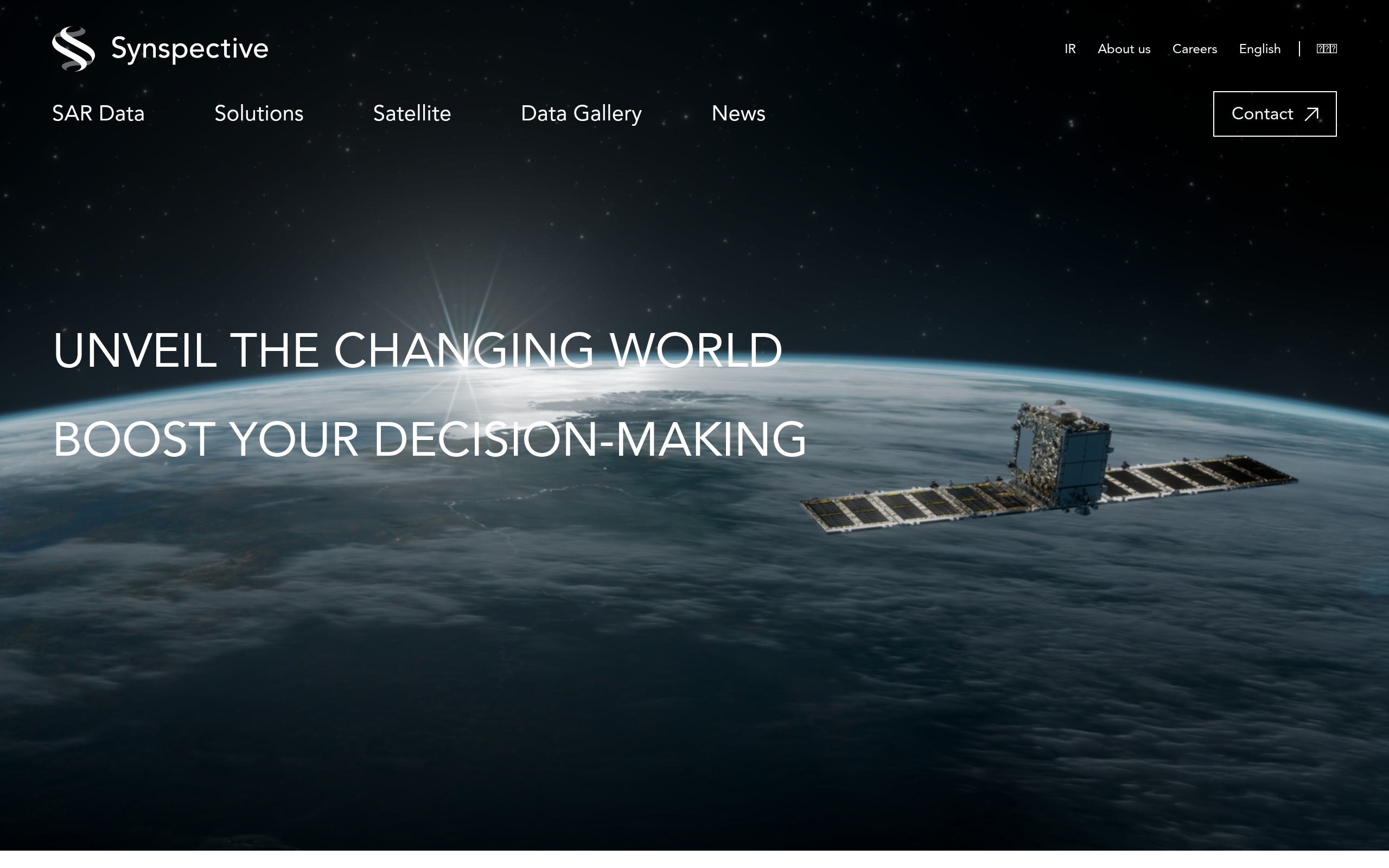
 Synspective is a Japanese SAR operator flying its own StriX X-band constellation.
Yes, legitimate: listed on the Tokyo Stock Exchange Growth Market since December 2024.
This review covers sensors, analytics and whether SAR-first fits you.
Table of Contents
Key Takeaways
- Synspective suits buyers who need Japanese X-band SAR with built-in analytics rather than raw imagery alone
- Its standout edge is a full InSAR suite that delivers millimeter-scale land displacement monitoring without in-house SAR expertise
- The key caveat: all pricing requires a direct sales conversation, with nothing published on the site
About Synspective
Synspective designs, builds, and operates its own SAR microsatellites and wraps the raw data in a set of ready-to-use analytics solutions spanning displacement monitoring, flood assessment, forest inventory, and maritime surveillance. The key facts below are drawn from Synspective’s own published pages as of May 2026.
| Name | Synspective |
|---|---|
| Website | synspective.com |
| Legal name | Synspective Inc. |
| Address | 3-10-3 Miyoshi, Koto-ku, Tokyo, Japan |
| Founded | 2018 |
| Ownership | Public (Tokyo Stock Exchange Growth Market, listed December 2024) |
| Leadership | Dr. Motoyuki Arai (Founder and CEO); Atsushi Shito (CFO and Board Director); Dr. Toshihiro Obata (Distinguished Chief Engineer, satellite development and operations) |
| Products & data | StriX SAR data (X-band; Stripmap, Sliding Spotlight, Staring Spotlight modes to 25 cm azimuth resolution); ALOS-4 L-band SAR data (via JAXA partnership); Synspective Data Platform (archive, tasking, API); Land Displacement Monitoring (LDM); Flood Damage Assessment (FDA); Disaster Damage Assessment (DDA); Offshore Wind and Wave (OWW); Forest Inventory Management (FIM); Object Detection and Classification (ODC) |
| Pricing | Quote-based when buying direct, no public rates; published credit rates for StriX on the UP42 marketplace. Contact via form for SAR data and analytics solutions. |
| Languages | English, Japanese |
Synspective’s technology traces directly to Japan’s government-funded ImPACT Program (2015-2019), co-developed with the University of Tokyo, Tokyo Institute of Technology, and JAXA. The company launched its first demonstration satellite, StriX-alpha, in December 2020 and had nine StriX satellites launched through May 2026, with a target of 30 by the end of the 2020s. Named customers include Fukuoka Expressway, JICA, Japan’s Cabinet Office, and the National Remote Sensing Agency of Vietnam.
Is Synspective legit?
Synspective’s legitimacy is well-established. The company is publicly listed on the Tokyo Stock Exchange Growth Market as of December 2024, was recognized as a member of the World Economic Forum Unicorn Community in 2024, and holds ISO/IEC 27001 certification. The more relevant question for a buyer is whether its SAR-first, analytics-bundled approach fits your requirement.
Ownership and funding
Synspective raised 28.1 billion yen through third-party allotment (as of its Series C in June 2024, with investors including Japan Growth Capital Investment Corporation, JAFCO Group, Mizuho Capital, and Toyota-affiliated entities) plus 8.3 billion yen in loan contracts. Its December 2024 listing on the TSE Growth Market means the company now files financial disclosures subject to Japanese exchange regulation.
Four operating subsidiaries are confirmed on the company’s own pages: Synspective Japan Inc. (Koto-ku, Tokyo), Synspective SG Pte. Ltd. (Singapore), and Synspective USA HD Inc. and Synspective USA Inc. (both established in March 2025), reflecting a deliberate international expansion into defense and geospatial intelligence markets.
Track record and customers
The detail I keep returning to is that every StriX satellite so far has flown as the sole payload on a dedicated rocket. That is expensive, and it buys control over orbit placement that a rideshare cannot offer, which is in my reading the quiet reason a nine-satellite fleet already delivers a usable revisit pattern.
From the first technology demonstration satellite in 2020 to nine launches by May 2026, Synspective has maintained a consistent cadence of commercial deployments, all on Rocket Lab Electron rockets from New Zealand. A 10-launch agreement signed with Rocket Lab in June 2024 and a rideshare contract with Exolaunch/SpaceX in 2025 underpin the path to 30 satellites by the end of the decade.
Named customers on Synspective’s site span Japanese government and civil infrastructure: Fukuoka Expressway (road displacement monitoring), JICA (Japan International Cooperation Agency), Japan’s Cabinet Office and METI under the SBIR program, and Dynamic Map Platform. A partnership with Insight Terra for tailings-dam monitoring and a 2024 MOU with Vietnam’s National Remote Sensing Agency and Fujitsu Vietnam indicate active expansion beyond Japan.
Compliance and data rights
Synspective is ISO/IEC 27001 certified (confirmed since 2021) and holds formal agreements with JAXA as an authorized ALOS-4 data service provider. Distribution partnerships with Airbus (February 2026), e-GEOS (May 2026), and SkyFi (May 2026) suggest that buyers may be able to access StriX data through third-party platforms as well as directly. Licensing terms for SAR data and analytics solutions are not published; all terms are handled through direct agreement with Synspective’s commercial team.
Data and capabilities
Synspective operates a pure SAR constellation. There is no optical sensor in the product line, which means the offer is defined entirely by X-band radar performance, mode variety, and the analytics layer built on top of it.
StriX SAR sensor: modes and resolution
Each StriX satellite carries a 5 m by 0.8 m deployable slot-array X-band antenna operating at 9.65 GHz with VV polarization and right/left look directions. The sensor supports eight imaging modes spanning a dynamic range from broad-area Stripmap to sub-meter Staring Spotlight:
| Mode | Ground range resolution | Azimuth resolution | Scene size |
|---|---|---|---|
| Stripmap | 3.6 m | 2.6 m | 10-30 km x 50-70 km |
| Sliding Spotlight 1 | 0.9 m | 0.9 m | 10 x 10 km |
| Sliding Spotlight 2 | 0.46 m | 0.5 m | 10 x 10 km |
| Staring Spotlight 1 | 0.9 m | 0.5 m | 10 x 3 km |
| Staring Spotlight 2 | 0.9 m | 0.25 m | 10 x 3 km |
| Staring Spotlight 3 | 0.46 m | 0.5 m | 10 x 3 km |
| Staring Spotlight 4 | 0.46 m | 0.25 m | 10 x 3 km |
| Spotlight Enhanced | 0.46 m | 0.5 m (multilooked) | 10 x 3 km |
Staring Spotlight 4 achieves 25 cm azimuth resolution, which Synspective documented as Japan’s highest-resolution commercial SAR imagery in a July 2024 press release. The Spotlight Enhanced mode applies three-look multilooking to reduce speckle, producing GRD-only output suited to interpretation workflows where speckle reduction matters more than finest resolution.
Synspective’s site also notes that Stripmap’s observable area is two to ten times larger than comparable satellites in the class, owing to a high-capacity battery and 1 kW peak RF power amplifier.
InSAR and analytics solutions
The analytics layer is what separates Synspective from operators that sell raw SAR files only. In June 2024, the company demonstrated consecutive-day InSAR pairs using StriX-3 and StriX-1 imagery, and its Land Displacement Monitoring solution quantifies surface change to millimeter precision over infrastructure corridors, construction sites, and at-risk terrain.
The full analytics suite covers six application areas: Land Displacement Monitoring (LDM, InSAR-based subsidence and settlement), Flood Damage Assessment (FDA, rapid extent mapping), Disaster Damage Assessment (DDA, change detection after earthquake or typhoon), Offshore Wind and Wave (OWW, wave height and wind speed), Forest Inventory Management (FIM, biomass and logging detection), and Object Detection and Classification (ODC, AI-based vessel and aircraft detection).
All six products are delivered as cloud-based, ready-to-use outputs rather than raw data, removing the requirement for in-house SAR processing expertise.
ALOS-4 partnership and data platform
In September 2025 Synspective became an authorized ALOS-4 data service provider, adding JAXA’s L-band SAR capabilities to its catalog alongside StriX X-band data. L-band radar penetrates vegetation canopies more effectively than X-band, extending Synspective’s reach into forest monitoring, subsurface feature mapping, and soil moisture applications.
The Synspective Data Platform provides a web interface and API covering archive search, tasking requests, status checking, and data download. All access modes, including the API, are available through direct agreement. The platform’s architecture supports both one-off tasking orders and repeat-pass InSAR monitoring programs requiring scheduled acquisition pairs.
Pricing
Synspective does not publish any pricing on its website. All products, including raw StriX SAR data, ALOS-4 data, and the full analytics solutions suite, are available only through a direct sales engagement via the contact form at synspective.com/contact/.
| Product | Model | Public rate | Access route |
|---|---|---|---|
| StriX SAR Data | Quote-based | Not published | Contact form (subject: StriX SAR data) |
| ALOS-4 SAR Data | Quote-based | Not published | Contact form (subject: ALOS-4 SAR data) |
| Analytics Solutions (LDM, FDA, DDA, OWW, FIM, ODC) | Quote-based | Not published | Contact form (subject: Analytical solutions) |
| Synspective Data Platform (archive, tasking, API) | Quote-based | Not published | Access via agreement following contact |
There is no free tier, no trial, and no self-serve ordering path on Synspective’s own platform as of May 2026. Announced 2026 distribution partnerships with SkyFi and e-GEOS are expected to open third-party access routes, but that integration is still in progress and pricing through those channels is not yet public. Buyers evaluating Synspective at budget-qualification stage should plan for a sales conversation before receiving a formal quote.
Who it’s for
Synspective’s combination of all-weather SAR data and bundled analytics maps onto a set of use cases where optical imagery does not work and in-house SAR processing is either absent or undesirable.
Infrastructure and construction monitoring
For asset owners, engineering firms, and infrastructure agencies that need early warning of ground movement, the LDM product delivers millimeter-scale vertical displacement monitoring over roads, railways, tunnels, dams, ports, and construction sites. The Fukuoka Expressway case study on Synspective’s site is the clearest documented example, and the JICA and Cabinet Office references confirm acceptance by Japanese government infrastructure programs.
Daily InSAR capability from the growing StriX constellation makes this application more practical than earlier two-satellite configurations allowed: the closer the revisit interval, the smaller the atmospheric error and the better the phase coherence over longer displacement time series.
Disaster response and damage assessment
SAR’s ability to image through cloud cover and at night makes it the practical choice for rapid disaster mapping, where optical satellites frequently cannot acquire imagery in the hours immediately following an event. Synspective’s FDA and DDA solutions deliver flood extent maps and change-detection outputs formatted for response and recovery teams rather than data scientists.
The Japan Bosai Platform (2025) partnership is a concrete signal of production use in Japan’s national disaster risk management infrastructure, and the combination of near-daily revisit with ready-to-use outputs reduces the time-to-insight for agencies that cannot process raw SAR data themselves.
Environmental and forest monitoring
Synspective’s Forest Inventory Management solution targets biomass estimation, logging detection, and carbon credit data pipelines. The addition of ALOS-4 L-band SAR in 2025 strengthens this vertical, as L-band penetrates forest canopies more effectively than X-band and is better suited to above-ground biomass retrieval in dense tropical forests.
The Insight Terra tailings-dam partnership extends the environmental monitoring use case into mining, where InSAR-based deformation monitoring is increasingly required for regulatory compliance. This is a smaller but clearly defined buyer segment with strong willingness to pay for operational InSAR.
Where it’s less competitive
Synspective’s X-band constellation does not offer optical imagery, so buyers whose workflows require visual interpretation, color analysis, or vegetation index products will need a separate optical provider alongside Synspective. The absence of published pricing makes Synspective unsuitable for programs with tight budget cycles that require rapid vendor qualification without a sales call.
With nine satellites and a 3 km scene length in the highest-resolution Staring Spotlight mode, per-pass coverage is narrower than the broad-swath SAR constellations approaching operational status at ICEYE and Umbra. Buyers with large-area or high-revisit-frequency requirements at sub-meter resolution should discuss acquisition scheduling in detail during the sales engagement.
Strengths and limitations
Synspective’s strengths concentrate in the depth of its analytics suite and the pedigree of its SAR sensor. The main structural advantages are:
- Japan’s highest-resolution commercial SAR at 25 cm azimuth (Staring Spotlight 4), derived from government ImPACT program research, with eight imaging modes covering Stripmap to sub-half-meter spotlight in a single platform
- End-to-end analytics suite (LDM, FDA, DDA, OWW, FIM, ODC) that converts SAR data into decision-ready outputs for buyers without in-house radar processing expertise
- Millimeter-scale InSAR land displacement monitoring using consecutive-pass pairs from the StriX constellation, confirmed via test observation in June 2024 and operational in the LDM product
- Dual-band SAR access: X-band StriX data combined with ALOS-4 L-band data (via JAXA partnership since 2025) broadens the application range to forest biomass and soil moisture use cases
- TSE-listed (December 2024), ISO/IEC 27001 certified, with active named customers across Japanese government, infrastructure, and international development programs
The limitations are equally worth mapping before committing to a program:
- Synspective publishes no pricing itself: buying direct starts with a sales conversation, though UP42 lists StriX at published credit rates
- SAR-only: no optical imagery, hyperspectral, or non-radar data products from Synspective’s own constellation
- Constellation scale: nine satellites as of May 2026, with the ninth still in commissioning; revisit frequency and tasking capacity will improve as the fleet grows toward 30, but buyers with dense scheduling requirements should verify current availability during sales discussions
- Staring Spotlight scene footprint is 10 by 3 km: fine-resolution X-band coverage of large areas requires multiple passes, which affects both turnaround time and cost at scale
- Distribution infrastructure outside Japan is still maturing: US subsidiary and Singapore office established in early 2025, with Western distribution partnerships only active from early 2026 onward
The core commercial tension for most buyers is between Synspective’s best-in-class Japanese SAR analytics depth and the friction of an entirely quote-based commercial model. For programs with defined infrastructure or disaster-response use cases, the analytics abstraction layer has genuine value. For programs that need transparent self-serve data access or broad-area optical coverage, Synspective is better suited as one element of a multi-provider stack.
Synspective alternatives
If Synspective’s sales-led model or Japan-centric infrastructure does not align with your procurement process, three SAR operators offer verified capability profiles worth comparing. The table below draws on primary sources for each provider.
| Provider | Best resolution | Constellation size | Pricing model | Key differentiator |
|---|---|---|---|---|
| Synspective | 25 cm azimuth (Staring Spotlight 4) | 9 satellites (May 2026, target 30 by end of 2020s) | Quote direct; credit rates on UP42 | Built-in analytics suite (LDM/FDA/DDA/OWW/FIM/ODC), Japan government heritage, InSAR operational |
| ICEYE | 25 cm (Spot Extended Dwell) | 35+ X-band satellites | Quote and subscription | Largest operational X-band SAR constellation, broad archive, established Western distribution |
| Capella Space | 25 cm (Spotlight) | ~10 satellites | Quote and API access | US-based X-band SAR, strong defense and intelligence market, self-serve API |
| Umbra | 16 cm (Spotlight) | ~8 satellites | Published per-scene and subscription rates | Highest published commercial SAR resolution, open-data program, transparent pricing |
ICEYE’s larger constellation gives it superior revisit frequency and a deeper archive for change-detection and insurance programs that require dense time series. Capella Space is the natural comparison for US government and defense buyers for whom supply-chain jurisdiction is a decision factor. Umbra’s published per-scene pricing and open-data program make it the clearest choice for buyers who need cost certainty or a low-friction evaluation path.
Synspective’s differentiation remains the depth of its analytics suite and InSAR capability, which none of the three alternatives packages to the same degree for non-expert buyers.
Synspective is ranked among the field in our guide to the best SAR data providers.
Verdict
Synspective is a legitimate, TSE-listed Japanese SAR operator with a credible path to a 30-satellite constellation, grounded in government research heritage and supported by growing international distribution partnerships. The technical case is strong: eight imaging modes, 25 cm azimuth resolution, demonstrated InSAR capability, and a six-product analytics suite that abstracts the hardest parts of SAR exploitation for buyers without radar processing expertise.
The practical friction is commercial. Synspective publishes no pricing, offers no trial access, and its own channel has no self-serve ordering.
The UP42 marketplace does list StriX at published credit rates (catalog from 43,200 credits per scene, tasking from 103,500), so a number is obtainable without a sales call. Buying from Synspective directly still starts with one, which makes it most suitable for programs with a defined budget cycle and a clear use-case match, such as infrastructure displacement monitoring, disaster response agencies, or forest carbon programs that need InSAR-derived outputs rather than raw imagery.
For buyers whose primary need is large-area SAR monitoring with transparent pricing, ICEYE or Umbra reduce procurement friction. For buyers in the US defense and intelligence space, Capella Space’s domestic supply chain may be the deciding factor.
For programs where the analytics abstraction layer has genuine value, and where a direct vendor relationship in Japan is acceptable or desirable, Synspective is a well-matched and technically credible choice. The alternatives table above is the practical starting point for buyers who need to compare SAR options before committing.
Frequently asked questions
Below are the questions buyers most commonly ask about Synspective. Each answer points to the section where the full detail lives.
How does Synspective work?
Synspective designs, builds, and operates its own X-band SAR satellites (the StriX constellation), then makes that data available through its Data Platform as archive imagery, tasked acquisitions, and API access. Buyers can also subscribe to ready-to-use analytics solutions (LDM, FDA, DDA, and others) that process the raw SAR into decision-ready outputs for specific applications. All access routes require a direct agreement with Synspective. Full detail is in the “Data and capabilities” section.
Is Synspective a legit company?
Yes. Synspective Inc. is publicly listed on the Tokyo Stock Exchange Growth Market (listed December 2024), ISO/IEC 27001 certified, and traces its technology to Japan’s government-funded ImPACT research program. The company has launched nine satellites since 2020 and counts Japanese government agencies among its named customers. See “Is Synspective legit?“
Who owns Synspective?
Synspective Inc. is publicly traded on the Tokyo Stock Exchange Growth Market with no disclosed majority shareholder, having been listed in December 2024 after Series C backing from investors including JAFCO Group, Mizuho Capital, and Toyota group entities. The company was founded by Dr. Motoyuki Arai, who remains CEO. Ownership detail is in “Is Synspective legit?“
How much does Synspective cost?
Synspective does not publish any pricing. All products, including StriX SAR data, ALOS-4 data, and the full analytics suite, are quote-based and accessible only through the contact form at synspective.com/contact/. There is no free tier or trial. Full context is in the “Pricing” section.
Where is Synspective based?
Synspective is headquartered in Koto-ku, Tokyo, Japan, with subsidiaries in Singapore and the United States established in March 2025. Background is in the “About Synspective” section.
When was Synspective founded?
Synspective was founded in February 2018 by Dr. Motoyuki Arai, drawing on research from Japan’s government-led ImPACT Program (2015-2019). The first demonstration satellite, StriX-alpha, launched in December 2020, and the company listed on the TSE Growth Market in December 2024. Background is in the “About Synspective” section.
Who are Synspective’s customers?
Named customers on Synspective’s own pages include Fukuoka Expressway (road displacement monitoring), JICA, Japan’s Cabinet Office and METI under the SBIR program, Dynamic Map Platform, and Japan Bosai Platform. International engagements include a 2024 MOU with Vietnam’s National Remote Sensing Agency and Fujitsu Vietnam. The company is also a World Economic Forum Unicorn Community member (2024). The full customer context is in “Is Synspective legit?“
How does Synspective make money?
Synspective’s revenue comes from three lines: SAR data sales (StriX imagery and ALOS-4 data under its JAXA partnership), cloud-based analytics solutions (LDM, FDA, DDA, OWW, FIM, ODC), and Data Platform access (archive, tasking, and API via direct agreements). All are priced through direct sales conversations, with no self-serve or published rate card. See “Pricing” for the full overview.
What are the best alternatives to Synspective?
The closest matches depend on your requirements: ICEYE for the largest operational X-band SAR fleet with established Western distribution, Capella Space for US-based SAR with a strong defense supply chain, and Umbra for the finest published commercial SAR resolution with transparent pricing. A full comparison is in the “Synspective alternatives” section.
What use cases is Synspective best suited for?
Synspective is strongest for infrastructure displacement and subsidence monitoring (via InSAR LDM), rapid flood and disaster damage assessment, forest inventory and carbon credit pipelines, and maritime surveillance, particularly where buyers need analytics outputs rather than raw SAR data. It is less competitive for large-area optical monitoring or for programs that require self-serve access with published pricing. Details are in the “Who it’s for” section.

My passions are Earth Observation and Satellites, and my profession is Data Analysis. I combine both within ObservationData.com to show you the use cases of Earth Observation, to help you find the right provider, and to share your experiences.
