
Commercial hyperspectral imagery is a small, fast-moving corner of the EO market. Free EnMAP, PRISMA and EMIT data covers research needs, but tasking and fresh revisit cost money.
Seven providers are ranked here, from operational constellations to pre-launch specialists and one multi-sensor platform. Each was picked on hyperspectral capability and weighed against six criteria with no paid placements.
The profiles show spectral bands, resolution, revisit, access model and honest limits. Pixxel earns the top spot for 2026, though the best fit depends on spectral range.
Table of Contents
Key takeaways
- Pixxel’s Firefly gives you 6 satellites at 5 m and 135+ VNIR bands with published per-km² prices
- Wyvern stands out for its free CC BY 4.0 open-data catalog, the lowest barrier to entry on this list
- Rankings weight spectral depth, resolution, and pricing transparency by what a procurement team can act on
How we picked the best hyperspectral imagery providers
Six criteria shaped this ranking. For hyperspectral, spectral band count and range matter most: VNIR-only sensors cover crop stress, mineralogy of iron oxides, and vegetation indices, while VSWIR (including SWIR) adds the diagnostic clay, carbonate, and hydrocarbon absorption features at 1,400–2,500 nm that enable full geological and pipeline monitoring use cases. A provider that hides pricing behind a quote for every order, or has zero satellites on orbit, adds real procurement friction.
- Spectral range and band count: VNIR (400–900 nm) vs. VSWIR (400–2500 nm), and the number of discrete bands available, which determines the chemical discrimination power of the data
- Spatial resolution: the finest ground sample distance available commercially, which sets the minimum target or feature size detectable in spectral analysis
- Revisit and constellation maturity: whether the constellation is operational today, how many satellites are active, and what daily or sub-daily revisit is achievable over a point of interest
- Commercial access model: tasking vs. archive-only, self-serve web platform or API vs. human-assisted workflows, and whether STAC-compliant metadata is provided for downstream integration
- Pricing transparency: whether per-km² or per-scene rates are published without a quote call, and the minimum order size
- Trust signals and delivery: named reference customers or government contracts, processing levels delivered (L1B radiance through L2A surface reflectance or higher), and delivery format
The comparison table below captures the most decision-critical criteria at a glance. Delivery, integration, and trust signals appear in each provider’s full profile in the section below. Providers are ordered from strongest overall hyperspectral capability to most specialized.
Hyperspectral imagery providers compared
The table brings all seven providers side by side on five attributes most relevant to a hyperspectral procurement decision. One fact per cell, giving you an at-a-glance overview before reading the full profiles.
| Provider | Spectral range | Bands / GSD | Constellation status | Self-serve access | Best for |
|---|---|---|---|---|---|
| Pixxel | VNIR 470–900 nm | 135+ bands / 5 m | 6 operational Firefly sats (2025) | Yes (Aurora web UI + API) | Overall commercial hyperspectral with published pricing |
| Wyvern | VNIR 445–870 nm | 31 bands / 5.3 m | 5 operational Dragonette sats | Yes (archive browser + API ordering) | Accessible and open hyperspectral with free data tier |
| Orbital Sidekick | VSWIR 400–2500 nm | 468 bands / 8 m HSI | 5 operational GHOSt sats (as of Apr 2024) | API-driven (SIGMA platform) | Pipeline and energy infrastructure monitoring at VSWIR range |
| Kuva Space | VNIR 475–950 nm | Hundreds of bands / 25 m | 2 operational Hyperfield sats | Kuva Sense platform (Beta) | Subscription-based insights-as-a-service for defined geographies |
| Carbon Mapper | VSWIR 400–2500 nm | 5 nm sampling / 30 m | 1 operational Tanager-1 (2024) | Yes (open data portal + REST/STAC API) | Methane and CO2 emissions monitoring (free, non-commercial) |
| HySpecIQ | VNIR (planned) | 105 bands target / sub-5 m target | Pre-launch (0 sats on orbit) | Not yet available | Defense-grade analytics-first hyperspectral (when operational) |
| Sfera Technologies | VNIR 445–870 nm (Wyvern) | 31 bands / 5.3 m | Access via Wyvern Dragonette constellation | Yes (app.sfera.earth + archive of 2,500+ scenes) | Bundled hyperspectral alongside optical, SAR, thermal, and RF |
Every fact in the profiles below comes from the providers’ own published pages and primary sources. Where data was not publicly available, that gap is noted rather than filled with a guess.
The 7 best hyperspectral imagery providers
Profiles are ranked by overall fit for buyers who need commercial hyperspectral data today. Each “Best for” line reflects the primary strength on the criteria above, not a claim to market leadership.
1. Pixxel
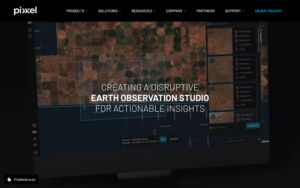 Best for overall commercial hyperspectral with published per-km² pricing. Pixxel Space Technologies, Inc. operates the Firefly constellation, which the company describes as the world’s highest-resolution commercial hyperspectral constellation. Phase 1 is complete with 6 microsatellites in sun-synchronous orbit at 550 km: the first three launched on SpaceX Transporter-12 in January 2025 and the second three on a Falcon 9 NAOS rideshare in August 2025.
Each Firefly captures 135+ VNIR bands across 470–900 nm at 5 m GSD with a 40 km swath and a 24-hour global revisit frequency.
| Type | Satellite operator, imagery provider, analytics provider |
|---|---|
| HQ | Bengaluru, India (US subsidiary in El Segundo, CA) |
| Founded | 2019 |
| Ownership | Private (Series B, $95M total, Google lead investor) |
| Website | pixxel.space |
Pricing is published, which is rare in hyperspectral: archive imagery costs $6/km² and tasking costs $8/km² (with a 15% surcharge for a guaranteed cloud-cover threshold). The Aurora platform provides a free Standard tier for imagery ordering and analytics, with Professional ($150/user/month) and Enterprise ($180/user/month) tiers adding higher token allocations and tutorial access. Distribution partners include UP42, SkyFi, and KSAT for global data downlink.
Named customers span NRO (5-year contract from 2023 plus a second award in 2026), NASA (CSDA program), and India’s IN-SPACe National EO Constellation consortium. The Honeybee next-generation satellites, which will extend coverage into SWIR (470–2500 nm, approximately 250 bands), are planned with a tech demonstrator in 2026, but the commercial constellation timeline is not yet disclosed.
In our analysis of the Firefly platform, the Aurora no-code workspace and the STAC-native delivery represent a meaningful step toward making hyperspectral data accessible to non-specialist teams. Read our in-depth Pixxel review for a full breakdown of pricing tiers, Aurora platform tiers, and the NRO contract details.
The main limitation is spectral range: Firefly Phase 1 covers VNIR only (470–900 nm). Applications requiring clay mineral or carbonate discrimination, which sit in the SWIR range at 1,400–2,500 nm, are not supported by the current constellation and will have to wait for the Honeybee VSWIR generation.
2. Wyvern
 Best for accessible and open hyperspectral data. Wyvern Incorporated operates the Dragonette Gen 1 constellation from Edmonton, Alberta, with 5 operational hyperspectral microsatellites in sun-synchronous orbit at approximately 515–535 km altitude. The Dragonette fleet uses two sensor configurations: Dragonette-1 captures 23 bands across 503–799 nm, while Dragonettes 2, 3, 4, and 5 use an extended VNIR sensor delivering 31 bands across 445–870 nm, all at 5.3 m GSD and a 20 km fixed swath.
Data is delivered as Cloud-Optimized GeoTIFF with STAC JSON metadata, and both L1B (at-sensor radiance) and L2A (surface reflectance) processing levels are available.
| Type | Satellite operator, imagery provider |
|---|---|
| HQ | Edmonton, Alberta, Canada |
| Founded | Not publicly stated (first satellites 2023) |
| Ownership | Private (multiple rounds including $7M in November 2025) |
| Website | wyvern.space |
The open-data program at opendata.wyvern.space offers 100+ hyperspectral images free and with no registration under a Creative Commons Attribution 4.0 license, organized by industry and spectral range, which is the lowest-friction entry point to hyperspectral data on this list. Commercial tasking has three tiers: Standard (best-effort single acquisition), Premium (automatic re-tasking on cloud cover), and Assured Capacity (pre-reserved, guaranteed acquisition window).
Orders are submitted via API or email with an AOI geometry file. Same-day tasking is available. A sixth satellite, Dragonette-6, was listed as planned for 2026. Data quality is validated against ESA EDAP+ Best Practice Guidelines, and band center wavelengths are aligned with PlanetScope, Landsat, and Sentinel band references to simplify cross-sensor workflows. The Gen 2 Rosette constellation, which will add SWIR coverage (110+ bands, VNIR+SWIR, approximately 2028), is in development.
No pricing numbers are published for commercial tasking or archive access. All commercial orders are quote-based, and the budget range fields on the contact form suggest per-scene costs rather than a transparent per-km² model comparable to Pixxel. Buyers who need predictable per-area costs for budget planning will find this a friction point.
3. Orbital Sidekick
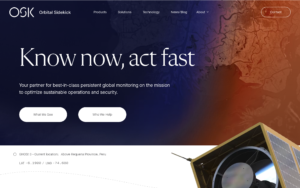 Best for pipeline and energy infrastructure monitoring. Orbital Sidekick, Inc. operates the GHOSt (Global Hyperspectral Observation Satellite) constellation from San Francisco, founded in 2016 by Dan Katz and Tushar Prabhakar. GHOSt satellites use Astro Digital Corvus XL buses (~100 kg) and carry pushbroom VSWIR hyperspectral imagers covering the full 400–2500 nm range at 8 m HSI resolution and 3 m panchromatic GSD.
As of April 2024, 5 satellites are active (GHOSt 1-5 confirmed). GHOSt 4 and 5 deliver 468 spectral bands per the SpaceNews April 2024 first-light report (GHOSt 1-3 deliver 472 bands, the design capacity is 512 bands). A sixth satellite was planned for 2024, but whether it launched is not confirmed as of press time.
| Type | Satellite operator, imagery provider, analytics provider |
|---|---|
| HQ | San Francisco, California, USA |
| Founded | 2016 |
| Ownership | Private (Series A+ with Energy Innovation Capital, In-Q-Tel investor) |
| Website | orbitalsidekick.com |
The VSWIR range is the key differentiator here: unlike the VNIR-only sensors on Pixxel and Wyvern, GHOSt covers the SWIR absorption bands needed for chemical compound identification, methane plume detection, and geological alteration mapping. Onboard AI processing on each satellite enables near-real-time chemical fingerprinting delivered via the SIGMA Monitor dashboard and SIGMA Data API on AWS. Named customers include Williams, ONEOK, Energy Transfer, Colonial Pipeline, PTTEP, Woodside, Newmont, Teck, U.S. Air Force, U.S.
Space Force, and NRO, which gives a cross-section of commercial energy infrastructure and government intelligence program applications. The long-term constellation target is 14–20 satellites for weekly global monitoring coverage, though the current five-satellite fleet supports daily revisit for high-priority locations only.
No pricing is published. All engagements appear to be contracted directly, and the product is positioned toward enterprise energy, government, and defense buyers rather than self-serve commercial teams with smaller per-project budgets.
4. Kuva Space
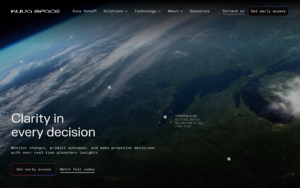 Best for high-revisit subscription-based hyperspectral intelligence. Kuva Space Oy, founded in 2016 and headquartered in Espoo, Finland, operates the Hyperfield constellation: two 6U CubeSat hyperspectral microsatellites (Hyperfield-1A, launched August 2024; Hyperfield-1B, launched June 2025) in 500 km polar sun-synchronous orbit.
The sensor is a patented tunable VNIR hyperspectral imager co-developed with VTT Technical Research Centre of Finland, covering 475–950 nm at 25 m GSD with what the company describes as “hundreds of spectral bands.” The AI analytics pipeline on each satellite delivers decision-ready insights in under 3 minutes from data acquisition.
| Type | Satellite operator, imagery provider, analytics provider |
|---|---|
| HQ | Espoo, Finland |
| Founded | 2016 |
| Ownership | Private (€22.5M total as of Nov 2023, Voima Ventures lead) |
| Website | kuvaspace.com |
The access model is subscription-based insights-as-a-service rather than pay-per-image tasking: customers subscribe to continuous monitoring over a defined geography, receiving AI-generated intelligence rather than raw imagery scenes. Kuva Space is the sole hyperspectral provider under a €5M commercial Copernicus contract (2023) and holds a €1.8M ESA Civil Security from Space award, which gives the constellation meaningful institutional validation for a two-satellite fleet.
The Hyperfield-2 next-generation satellite (70 kg, 15 m GSD, extended range 450–1,650 nm including SWIR, planned H2 2026) adds a VHR RGB camera at 3.6 m and an AIS receiver, with 2 to 6 satellites planned for 2026. The company targets 100 satellites and daily global coverage by 2030.
With only two operational satellites, the current revisit rate for any given location is not published and will be limited. Buyers who need predictable daily or sub-daily coverage at specific latitudes should verify the actual revisit interval for their area of interest before committing to a subscription, as the daily observation target is a 2027 goal, not a current specification.
5. Carbon Mapper
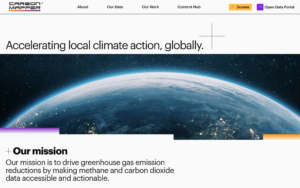 Best for methane and CO2 super-emitter detection. Carbon Mapper, Inc. is a US 501c3 nonprofit headquartered in Pasadena, California, operating the Tanager satellite program in a unique public-private coalition with NASA Jet Propulsion Laboratory, Planet Labs PBC, the California Air Resources Board, and others. Tanager-1 launched August 16, 2024 from Vandenberg Space Force Base.
The satellite carries a 5th-generation JPL-designed imaging spectrometer covering 400–2500 nm at 5 nm spectral sampling with a 30 m spatial resolution and an 18.6 km swath at nadir. The 90% probability of detection for methane is 90–180 kg/hr depending on imaging mode, with a minimum detection limit of approximately 70 kg/hr under moderate conditions.
| Type | Satellite operator (nonprofit), imagery provider, analytics provider |
|---|---|
| HQ | Pasadena, California, USA |
| Founded | Circa 2020 |
| Ownership | 501c3 nonprofit (philanthropic, Bloomberg Philanthropies funder) |
| Website | carbonmapper.org |
All data products (L2A–L5) are freely accessible for non-commercial use at data.carbonmapper.org via a web portal and a REST/STAC API, with a 30-day release latency after acquisition. In Tanager-1’s first year of operation (September 2024 to September 2025), Carbon Mapper published 5,392 methane plumes across 44 countries, 1,234 CO2 plumes, and quantified a total of approximately 141 million kg CO2e per hour. The data portal had 63,089 unique users across 178 countries in year one.
Planet has committed to building and deploying three additional Tanager satellites beyond Tanager-1, backed by a California Satellite Data Purchase Program sub-contract worth $95M awarded in March 2025. In our review of the emissions monitoring sector, Carbon Mapper’s combination of a JPL-grade spectrometer, open STAC API, and zero cost for non-commercial users has no direct equivalent in the market.
Carbon Mapper does not offer user-facing tasking. The observation programming is managed internally. For commercial use cases requiring a service-level agreement, scheduled revisit of specific industrial assets, or commercial data rights, Planet Labs offers L3A quick-look products from Tanager-1 separately, but Carbon Mapper itself is not a commercial data vendor. Buyers who need contracted commercial hyperspectral services should look at Pixxel or Orbital Sidekick instead.
6. HySpecIQ
Best for defense-grade high-resolution hyperspectral analytics (pre-launch). HySpecIQ, LLC is a Washington D.C.-based private company founded in 2013, positioning itself as an analytics-first hyperspectral imaging provider. The company is building the HySpec constellation, targeting up to 12 satellites on York Space Systems LX-Class buses (approximately 400 kg) in sun-synchronous LEO.
The stated sensor target is sub-5-meter spatial resolution across 105 spectral bands (CEO John DeBlasio, SpaceNews February 2022), with Raytheon-built hyperspectral sensor payloads and a NOAA commercial remote sensing license obtained in 2015. Peter Thiel invested $20M or more in September 2021.
| Type | Satellite operator (pre-launch), analytics provider |
|---|---|
| HQ | Washington, D.C., USA |
| Founded | 2013 |
| Ownership | Private (Peter Thiel / Thiel Capital, $20M+ in 2021) |
| Website | hyspeciq.com |
HySpecIQ received the NRO’s first-ever commercial hyperspectral imaging study contract in 2019, before any of the current operational constellations existed, which signals early intelligence-community validation of its approach. The company’s stated mission is to “turn data into powerful insights” alongside the space hardware, building an analytics engine “in parallel” with the constellation rather than treating imagery as the primary deliverable.
For buyers in defense, intelligence, or high-value materials identification use cases, the combination of sub-5-meter resolution and an analytics-first delivery model is the differentiating proposition when the constellation eventually launches.
As of June 2026, zero HySpecIQ satellites are on orbit. The first launch target has slipped from 2023 to 2025 to 2026 and beyond, and the company’s website (hyspeciq.com) was inaccessible at the time of our verification (Wayback Machine last snapshot: March 2026). Buyers with near-term program requirements should treat HySpecIQ as a watch list entry rather than an immediately procurable option.
7. Sfera Technologies
 Best for bundled commercial hyperspectral access alongside other modalities. Sfera Technologies Ltd. is not a hyperspectral operator: it is a Sofia, Bulgaria-based data aggregator founded in 2019 that brokers access to multiple third-party constellations under a single commercial agreement. Hyperspectral data comes from Wyvern’s Dragonette constellation at 5.3 m GSD and 31 VNIR bands, with an archive of 2,500+ images browsable and taskable via app.sfera.earth.
The same contract also covers optical (0.3–3.2 m), SAR (X-band from Capella Space, KOMPSAT-5, and PAZ), thermal (MWIR from SatVu and LWIR from Aistech), and RF/ELINT from Unseenlabs, which means a buyer can combine a hyperspectral campaign with a SAR or thermal pass in a single order.
| Type | Multi-sensor data platform, data aggregator, ground-station-services |
|---|---|
| HQ | Sofia, Bulgaria |
| Founded | 2019 |
| Ownership | Private (Bulgarian Angels Club investment, undisclosed total) |
| Website | sfera.earth |
Optical pricing is published on sfera.earth from $4/km² (1.0 m archive) to $30/km² (0.3 m daily tasking), with minimum orders as low as 15 km². Hyperspectral access is quote-based with no published price per scene, in line with Wyvern’s own pricing model. The platform includes a feasibility tool for SAR tasking and an archive browser for hyperspectral scenes.
Sfera Technologies also operates 12 active ground station sites across Europe, the Middle East, Asia, the Americas, Africa, and Oceania as a standalone B2B service at €3/minute via API, which adds a ground segment capability no other provider on this list offers. Our Sfera Technologies review covers the full modality breakdown, ground station service details, and platform interface.
Hyperspectral access through Sfera Technologies gives you only the Wyvern Dragonette’s VNIR range, not a broader spectral portfolio. Buyers who specifically need VSWIR coverage or a wider band count should go direct to Orbital Sidekick or wait for Pixxel’s Honeybee generation. There are also no named reference customers published, which buyers building mission-critical programs should weigh against the modality breadth advantage.
How to choose a hyperspectral imagery provider
The right answer depends on three questions you should settle before looking at any provider’s spec sheet: what spectral range you actually need, whether the application requires a current operational constellation or can tolerate a pre-launch roadmap, and whether your use case falls inside the free-data envelope that public programs cover.
VNIR vs. VSWIR
VNIR (roughly 400–900 nm) supports vegetation indices, crop stress, water quality, and iron-oxide mineralogy. If you are in agriculture, forestry, algal bloom monitoring, or shallow mineralogy, Pixxel and Wyvern are both effective at 5 m resolution, and Pixxel’s published pricing and larger six-satellite constellation give it a practical edge today. VSWIR (extending to 2,500 nm) adds the clay, carbonate, and hydrocarbon absorption features needed for pipeline monitoring, geological alteration mapping, and methane detection.
For those SWIR-dependent applications, Orbital Sidekick’s GHOSt (400–2500 nm, 468 operational bands) is the only on-orbit commercial option at press time. Carbon Mapper covers the same range but is not a commercial tasking service.
Revisit and constellation size
Single-satellite programs offer limited revisit by definition. Pixxel’s six-satellite Firefly fleet achieves a published 24-hour global revisit. Wyvern’s five-satellite fleet averages 2.1-day revisit at the equator. Orbital Sidekick supports daily revisit for high-priority locations with its five-satellite GHOSt constellation. Kuva Space has two operational satellites and targets daily coverage only by 2027 with additional launches.
For any program requiring reliable sub-3-day revisit today, Pixxel and Orbital Sidekick are the two realistic options among the operators. Sfera Technologies routes to Wyvern for hyperspectral and therefore inherits Wyvern’s revisit profile.
Pricing and access model
Two providers publish per-km² pricing for hyperspectral: Pixxel ($6/km² archive, $8/km² tasking) and Sfera Technologies (quote-based for the Wyvern hyperspectral component, optical pricing published separately). Carbon Mapper is free for non-commercial use. Wyvern and Orbital Sidekick publish no rate cards themselves, though Wyvern’s Dragonette-1 collection carries published credit rates on UP42. Kuva Space operates a subscription model rather than per-image pricing.
For teams running iterative pilots or per-project budgeting, Pixxel’s Aurora platform with its token-based wallet is the most predictable entry point into commercial hyperspectral data at press time.
Operational vs. pre-launch programs
HySpecIQ is the only provider on this list with zero satellites on orbit. Its sub-5-meter resolution target and analytics-first design are compelling for defense and high-value intelligence applications, but buyers with firm delivery requirements in 2026 cannot rely on it. The other six providers are all operational, though Carbon Mapper does not offer commercial tasking and Kuva Space’s constellation is still small.
If your program needs imagery today, filter to Pixxel, Wyvern, Orbital Sidekick, and Sfera Technologies as the four most immediately accessible commercial options.
Hyperspectral procurement is usually driven by a target material rather than by a scene. The guides for mining, oil and gas, forestry and climate each begin with the compound being detected, which determines the bands and the revisit you actually need.
Verdict
Pixxel earns the top spot because it is the only provider on this list that combines a published per-km² price ($6/$8), a self-serve analytics platform with a free entry tier, six operational satellites providing 24-hour global revisit, and two active government contracts with NRO and NASA. That combination of pricing transparency, constellation scale, and institutional validation has no equivalent in commercial hyperspectral at press time.
Wyvern is the strongest pick for teams that want to evaluate hyperspectral data before committing a budget: the free CC BY 4.0 open-data catalog at opendata.wyvern.space, STAC-compliant delivery, and a well-documented data guide lower the barrier to entry further than any other operator here.
Wyvern publishes no rate card of its own, though its Dragonette-1 collection carries published credit rates on UP42, and the open data program makes it the default starting point for hyperspectral pilots.
Orbital Sidekick is the right answer when SWIR coverage matters: GHOSt is the only operational commercial constellation covering the full 400–2500 nm range, and the energy infrastructure customer list (Williams, ONEOK, Colonial Pipeline) confirms its fit for pipeline monitoring, methane detection, and geological use cases where VNIR-only data is insufficient.
Carbon Mapper covers the same spectral range, but it is a nonprofit public-good platform with no user-facing tasking, so it serves a different buyer archetype entirely.
Kuva Space and HySpecIQ are both worth tracking: Kuva’s ESA Copernicus contract validates its data quality, and Hyperfield-2 with SWIR could make it competitive by late 2026. HySpecIQ’s NRO pedigree and analytics-first architecture address a real gap if the constellation ever launches on schedule. Sfera Technologies rounds out the list for buyers who want hyperspectral as one line item in a multi-sensor contract rather than a standalone hyperspectral program.
Frequently asked questions
These answers cover the most common decision points when evaluating a hyperspectral imagery provider for the first time.
What is hyperspectral imagery?
Hyperspectral imagery captures dozens to hundreds of narrow, contiguous spectral bands across a scene, typically from visible through near-infrared or shortwave infrared wavelengths, enabling chemical and material identification by spectral fingerprint rather than color alone. Unlike multispectral sensors (which capture 4–12 broad bands), hyperspectral sensors collect enough spectral resolution to distinguish between crop varieties, mineral types, or hydrocarbon compounds at the pixel level. See the “How we picked” section for the specific criteria we used to evaluate each provider.
What is the difference between VNIR and VSWIR hyperspectral?
VNIR (visible to near-infrared, roughly 400–900 nm) covers vegetation health, iron oxide mineralogy, and water quality applications. VSWIR extends through the shortwave infrared to approximately 2,500 nm, adding the clay, carbonate, and hydrocarbon absorption features needed for geological mapping, pipeline monitoring, and methane detection. Among the operational providers here, only Orbital Sidekick and Carbon Mapper offer the full VSWIR range today. See the “VNIR vs. VSWIR” section for use-case guidance.
Which hyperspectral imagery provider has the best price?
Pixxel is the only commercial hyperspectral operator that publishes per-km² pricing: $6/km² for archive and $8/km² for tasking. Carbon Mapper is free for non-commercial use. Wyvern offers 100+ free images under CC BY 4.0 via its open-data program. Orbital Sidekick, Kuva Space, and HySpecIQ are all quote-only or pre-commercial. See the “Pricing and access model” section for a fuller comparison.
Can I use free public hyperspectral data instead of commercial?
For research, retrospective analysis, or non-time-critical environmental monitoring, free options are viable: NASA EMIT (ISS-mounted, 380–2500 nm, approximately 60 m) and ESA EnMAP (30 m, 420–2450 nm) both provide open archive data, and Carbon Mapper’s data portal is free for non-commercial use. The gap commercial providers fill is on-demand tasking, current-year revisit, and commercial data rights for programmatic or regulatory use cases. See the “How we picked” section for where public data leaves off and commercial data begins.
How many spectral bands do I need?
It depends on the application. Vegetation indices and basic mineral mapping work with 20–30 VNIR bands, which Wyvern’s Dragonette delivers at 5.3 m GSD. Full geological alteration mapping or hydrocarbon compound identification typically requires 100+ bands covering SWIR, which is the domain of Orbital Sidekick’s 468-band GHOSt or Pixxel’s planned Honeybee VSWIR constellation. See the “VNIR vs. VSWIR” section for a fuller breakdown by use case.

My passions are Earth Observation and Satellites, and my profession is Data Analysis. I combine both within ObservationData.com to show you the use cases of Earth Observation, to help you find the right provider, and to share your experiences.
