
Satellite tasking, ordering a new acquisition over a target you define, at a time window you control, is a different procurement decision from buying archive imagery. The satellite has to be there, the sky needs to cooperate, and the provider has to give you a confirmation before you commit budget. A handful of operators and platforms have built genuine tasking pipelines. Many others sell archive and call it tasking.
For this guide I focused on providers that can confirm a tasking request, deliver imagery with a published or verifiable SLA, and offer some form of self-serve or API access. I looked at nine options across two main categories: direct satellite operators with their own tasking schedulers, and multi-operator platforms where a single contract routes to several constellations. Platform specs, delivery times, and pricing notes come from the providers’ own sites and from primary sources. Flags on uncertain or changing data are noted where relevant.
If you already have a long-term relationship with one supplier and a fixed sensor requirement, the full platform comparison may be more than you need, skip to “How to choose” below. For everyone else, Planet remains the strongest pick for optical tasking, with published per-km² prices and near-daily revisit, while Capella leads for dedicated SAR work, and Sfera Technologies is the clearest option if you need optical, SAR, thermal, and RF from a single contract.
Table of Contents
Key takeaways
- SkySat’s published $6–$40/km² tiers put Planet among the few direct operators showing tasking prices upfront
- Capella leads SAR on speed and resolution: sub-20-minute confirmation and 0.25 m Spotlight Ultra azimuth
- The two biggest caveats: Satellogic’s going-concern risk and ICEYE’s undisclosed per-scene pricing
How we picked the best satellite tasking services
Nine providers made the final list. To qualify, a provider had to offer new-acquisition tasking (not archive-only access) with a confirmed scheduling workflow. We evaluated each against the following criteria.
- Revisit and latency: how many collection opportunities per day over a target, and how quickly imagery is delivered after capture.
- Sensor coverage: whether the provider offers optical, SAR, thermal, hyperspectral, or RF under the same contract or API.
- Tasking SLA and lead time: whether a confirmation timeline is published or can be independently verified.
- Minimum order and pricing transparency: published per-km² or per-scene rates vs. quote-only, minimum area or scene size.
- Platform access: self-serve web UI and API availability, STAC-compliance for downstream integration.
- Fleet reliability: active satellite count, constellation maturity, and any noted going-concern or operational flags.
- Buyer type fit: government/defense vs. commercial, ITAR sensitivity for non-US buyers.
The table below distills those criteria into the columns a procurement team scans first, before the full profiles add the trade-offs underneath. The nine services are ordered from the strongest all-round pick to the most specialized.
Satellite tasking services compared
The table below brings all nine providers side by side on the five attributes most relevant to a new-acquisition tasking decision. Full profiles follow in the section below.
| Provider | Type | Sensor(s) | Best resolution | Revisits/day | Delivery SLA | Pricing |
|---|---|---|---|---|---|---|
| Planet | Direct operator | Optical | 50 cm (SkySat), 30 cm (Pelican) | Sub-daily | From 3 h after capture | Published ($6–$40/km²) |
| Capella Space | Direct operator | SAR (X-band) | 0.25 m azimuth (Spotlight Ultra) | 2–15 | Sub-20 min confirmation | Quote/contract |
| Sfera Technologies | Multi-sensor platform | Optical, SAR, Thermal, Hyperspectral, RF | 0.3 m optical (tasked) | Depends on sensor | Sensor-dependent | Optical per-km² published, others on request |
| Vantor | Direct operator | Optical (VHR) | 34 cm Pan (WorldView Legion) | Up to 15 | 15 min (Direct Access), 6 h (Rapid Access) | Credits model, no public per-km² rates |
| Airbus Defence and Space | Direct operator | Optical + SAR (X-band) | 30 cm optical, 25 cm SAR (Staring SpotLight) | Up to daily (Pléiades Neo), <24 h mean (SAR) | PREMIUM NRT avg ±1 h globally (SAR) | Quote direct; credit rates on UP42 |
| ICEYE | Direct operator | SAR (X-band) | 25 cm Dwell Precise (16 cm Gen4) | Daily to sub-daily | 8 h SLA default, avg <4 h | Quote/contract, ITAR-free |
| BlackSky | Direct operator | Optical (VHR) | 35 cm (Gen-3) | Up to 15 (conditional on 16-sat fleet) | Under 90 min from collection | Subscription direct; credit rates on UP42 |
| Satellogic | Direct operator | Optical + Hyperspectral | 50 cm (super-resolution L1 Ortho SR) | Up to 7 | Not published | Transparent per-km² (optical) |
| UP42 | Multi-operator marketplace | Optical, SAR, Thermal, Hyperspectral | Depends on operator | Depends on operator | Operator-dependent | EUR credit system, instant AOI quote, min €100 |
Every fact in the profiles below comes from the providers’ own published pages and our research. Where data was not publicly available, that gap is noted rather than filled with a guess.
The 9 best satellite tasking services
Profiles are ranked by overall fit for buyers who need to task new acquisitions. Each “Best for” line reflects the primary strength on the criteria above, not a claim to market leadership.
1. Planet
 Best for large-scale optical tasking with published prices. Planet Labs PBC operates the SkySat constellation alongside its PlanetScope monitoring network. SkySat tasking has three published price tiers, Flexible at $12/km² and Assured at $40/km² for new acquisitions, with a 3-hour-from-capture delivery commitment on the Assured tier, making Planet one of the few direct operators that put tasking prices on the public site at press time. The Pelican generation (50 cm, commercial ops 2025) is expanding the high-resolution capacity of the fleet.
The Planet Insights Platform API is REST-based and STAC-compliant with a Python SDK. Sentinel Hub is also included for archive access. SkySat minimum order area is 25 km² for archive and applies to tasking orders as well. Named customers include the Rural Payments Agency UK, Bayer, NASA, and Carbon Mapper, which gives a useful cross-section of government, agriculture, and environmental use cases. The Pelican Gen-2 generation at 30 cm is listed as planned for 2026, which would extend Planet’s lead in resolution among optical-only fleet operators.
| Type | Satellite operator |
|---|---|
| HQ | San Francisco, CA, USA |
| Founded | 2010 |
| Ownership | Public (NYSE: PL) |
| Website | planet.com |
The main limitation to flag is sensor type: Planet’s tasking centers on optical, with hyperspectral added through its Tanager line at 30 m. For SAR or thermal alongside it you will still need a second supplier. Read our full Planet review for a complete breakdown of pricing tiers, fleet specs, and API access.
2. Capella Space
 Best for all-weather SAR tasking. Capella Space Corp. operates an X-band SAR constellation with its third-generation Acadia satellites. The sub-20-minute scheduler confirms tasking arrival in under 20 minutes, a SLA that is materially faster than most SAR competitors. The Spotlight Ultra mode delivers 0.25 m azimuth resolution at 600 MHz bandwidth over a 5×5 km scene, and the five collection tiers (Urgent down to Routine) let buyers trade speed for cost.
Taskable InSAR launched commercially in May 2026 at a 3-day repeat cadence, which opens displacement and deformation monitoring to customers who previously had to manage multi-pass scheduling themselves. Capella was acquired by IonQ Inc. (NYSE: IONQ) in July 2025. The Capella Console provides self-serve tasking via a web UI, and the REST API is STAC-compliant with an AWS GovCloud data path for U.S. government customers.
Open data is available on AWS S3. Named customers include NRO (CRL contract), NASA CSDA, NGA, and U.S. Army SMDC, which reflects a heavily defense-oriented customer base. The active satellite count may be outdated, the company’s site lists 20 mission patches, while third-party tracking suggests a smaller active count, so treat any claim about fleet size with some caution until Capella publishes updated constellation status.
| Type | Satellite operator (SAR) |
|---|---|
| HQ | Louisville, CO, USA |
| Founded | 2016 |
| Ownership | Subsidiary of IonQ Inc. (NYSE: IONQ) |
| Website | capellaspace.com |
Capella publishes no rate card of its own, and a direct contract is quote-based. The UP42 marketplace lists catalog scenes from 29,000 credits and tasking from 86,300, so a budget number is obtainable without a sales call. Read our full Capella Space review for sensor specs, use-case fit, and a plain-language explanation of the Spotlight mode hierarchy.
3. Sfera Technologies
 Best for cross-sensor tasking from a single contract. Sfera Technologies Ltd. is not a satellite operator, it brokers access to multiple constellations under a single commercial agreement. Optical (including sub-meter options), SAR from Capella Space, thermal MWIR from SatVu at approximately 3.5 m, hyperspectral from Wyvern’s Dragonette satellites at 5.3 m across 31 VNIR bands, and RF/ELINT from Unseenlabs are all available through the platform.
Optical pricing is published in per-km² tiers starting at $4/km² for 1.0 m archive (minimum 25 km²) and reaching $30/km² for 0.3 m daily tasking (minimum 100 km²). SAR, thermal, hyperspectral, and RF are quote-based. The web UI at app.sfera.earth includes a feasibility tool for SAR tasking.
Sfera Technologies is a private company founded in 2019 and headquartered in Sofia, Bulgaria. Its ground station network runs 12 active sites across Europe, the Middle East, Asia, the Americas, Africa, and Oceania, operating as a standalone B2B service at €3/minute via API.
The multi-sensor breadth is the primary reason it ranks at number three: no other single entry point on this list covers optical, SAR, thermal, hyperspectral, and RF simultaneously. The trade-off is that Sfera Technologies is a small team, and no named reference customers appear publicly, buyers building a mission-critical program should evaluate their service continuity posture accordingly.
| Type | Multi-sensor data platform / aggregator |
|---|---|
| HQ | Sofia, Bulgaria |
| Founded | 2019 |
| Ownership | Private |
| Website | sfera.earth |
Only optical pricing is transparent. SAR, thermal, hyperspectral, and RF all require direct contact for a quote, which adds friction compared to platforms where a single credit wallet covers everything. Read our full Sfera Technologies review for a detailed breakdown of each sensor modality, the ground station service, and the platform interface.
4. Vantor
 Best for 30 cm VHR tasking with fastest delivery. Vantor, formerly Maxar Intelligence, rebranded on October 1, 2025. The company is privately held by Advent International and operates a ten-satellite fleet: six WorldView Legion satellites (34 cm Pan GSD, all six operational since February 2025) plus WorldView-3, WorldView-2, GeoEye-1, and WorldView-1.
WorldView Legion enables up to 15 revisits per day over a given target, and the Direct Access tier delivers imagery in as little as 15 minutes, the fastest confirmed delivery SLA in this comparison. The Rapid Access tier offers 6-hour delivery for less time-sensitive orders.
Tasking is managed through the WorldView 2D service, which offers FastView (guaranteed delivery in under 24 hours) and FlexView (scheduling across a 365-day horizon). The Vantor Hub combines a self-serve web platform and REST API. STAC compliance is supported. Pricing uses a credits model.
No per-km² pricing is published on vantor.com. Third-party reseller figures circulate but cannot be treated as authoritative here. Vantor’s roadmap includes the Vantage satellite at 20 cm class (first launch planned 2029) and the Pulse high-revisit constellation at 40 cm with 40 satellites and a targeted 15-minute revisit cadence (first launch 2027).
| Type | Satellite operator (optical VHR) |
|---|---|
| HQ | Westminster, CO, USA |
| Founded | Not publicly confirmed |
| Ownership | Private (Advent International) |
| Website | vantor.com |
The legal entity name for the rebranded company has not been confirmed in primary sources. The company’s full post-acquisition structure is still settling. No public per-km² pricing is available. Read our full Vantor review for constellation specs, delivery tiers, and what the Advent acquisition changed operationally.
5. Airbus Defence and Space
 Best for combined VHR optical and X-band SAR from a single European vendor. Airbus Defence and Space SAS operates Pléiades Neo (30 cm, two satellites operational after the loss of Neo 5 and 6 in December 2022), Pléiades 1A/1B (50 cm), SPOT 6 (1.5 m), and the Radar Constellation (TerraSAR-X, TanDEM-X, PAZ) at 25 cm Staring SpotLight resolution. All four sensor families are available through a single vendor agreement and the OneAtlas platform.
The PREMIUM NRT SAR delivery option targets an average of ±1 hour globally, which is competitive with ICEYE’s SLA_3H option. A Synspective SAR distribution partnership signed in January 2026 adds up to 25 cm X-band capacity from a separate Japanese constellation.
The One Tasking service covers optical and radar scheduling in the same interface, and the OneAtlas API is STAC-compliant with a separate SAR-API endpoint. Airbus has 29 direct receiving stations and a 40-plus year optical archive stretching back to SPOT 1 in 1986.
Named government customers include the French Ministry of Defence, German Bundeswehr, and NATO AGS Force. Commercial names include Nestlé and Satelytics. The HD15 product, a 15 cm visual product, is AI-enhanced upscaling from native 30 cm, not a native 15 cm capture, which is worth clarifying before specifying it in a contract.
| Type | Satellite operator (optical + SAR) |
|---|---|
| HQ | Toulouse, France |
| Founded | EO operations since SPOT 1 launch, 1986 |
| Ownership | Subsidiary of Airbus SE |
| Website | space-solutions.airbus.com |
TerraSAR-X and TanDEM-X were launched in 2007 and 2010 respectively. Both are aging assets with no published replacement timeline, which creates a service continuity risk for long-duration programs. Airbus publishes no rate card itself, so ordering direct means a quote. Its optical data is resold on UP42 at published credit rates (SPOT archive from 200 credits per km², Pléiades from 1,000). Read our full Airbus Defence and Space review for a complete breakdown of optical and SAR tasking, the Living Library subscription, and OneAtlas platform access.
6. ICEYE
 Best for daily SAR tasking at scale. ICEYE Oy operates what it describes as the world’s largest commercial SAR constellation, with 70 satellites launched since 2018, though that figure may be outdated and the active count may differ.
The fourth-generation satellites (commercial operations September 2025) support 16 cm resolution via Dwell Precise mode with 1,200 MHz bandwidth and a 400 km field of regard. The standard delivery SLA is 8 hours, with an average under 4 hours. The SLA_3H option is available for faster programs. All data is COG-native and STAC-compatible.
ICEYE is ITAR-free, which is a material differentiator for sovereign buyers outside the U.S. and for European programs where ITAR-free sourcing is a compliance requirement.
ICEYE closed a Series F round in June 2026, EUR 1 billion led by General Atlantic, at a reported valuation above EUR 10 billion. Named sovereign customers include the Polish Armed Forces (MikroSAR constellation, under 12 months delivery), the German Armed Forces via a Rheinmetall-ICEYE JV, the Netherlands Royal Air Force, and Portugal under the Atlantic Constellation program.
The imaging mode range, Dwell Precise (25 cm), Spot (50 cm, up to 15×15 km), Strip (3 m, 30×50 km), and Scan Wide (27 m, 200×600 km), covers everything from ultra-fine target monitoring to wide-area surveillance in a single operator contract.
| Type | Satellite operator (SAR) |
|---|---|
| HQ | Espoo, Finland |
| Founded | 2014 (project 2012) |
| Ownership | Private (General Atlantic, Series F June 2026) |
| Website | iceye.com |
ICEYE publishes no rate card of its own, and a direct contract is quote-based. UP42 lists its catalog from 28,571 credits per scene and tasking from 87,500, which is the fastest route to a budget figure. Read our full ICEYE review for a mode-by-mode breakdown, the ITAR-free certification details, and how the Rheinmetall JV affects commercial availability in Europe.
7. BlackSky
 Best for rapid time-diverse optical monitoring tasking. BlackSky Technology Inc. operates a Gen-3 constellation at 35 cm resolution (NIIRS-5+) in a mid-inclination orbit roughly between 42 and 59 degrees, not a sun-synchronous orbit. That orbital design produces time-diverse revisits, with the potential for up to 15 time-stamped images of the same location in a single day, which is valuable for activity monitoring where time-of-day variation matters.
Delivery of collected imagery runs under 90 minutes from capture. Four Gen-3 satellites were operational as of March 2026. The company targets the world’s largest very-high-resolution constellation by end-2026 as additional spacecraft are commissioned.
The BlackSky Spectra platform (powered by OpenWhere) provides API access alongside AI object detection covering 35-plus object types. Two subscription tiers are available: On-Demand for flexible tasking and Assured for guaranteed capacity. Named customers include NGA (Luno contract) and U.S. Air Force AFRL (IDIQ contract at a $99M ceiling), reflecting a primarily defense customer base. Burst imagery (five frames in a single pass) and stereo pairs are available, as is nighttime collection capability.
| Type | Satellite operator (optical VHR) |
|---|---|
| HQ | Herndon, VA, USA |
| Founded | Circa 2014 |
| Ownership | Public (NYSE: BKSY) |
| Website | blacksky.com |
The up-to-15 daily revisit figure is conditional on the full 16-satellite target fleet. With four Gen-3 spacecraft operational in early 2026, the current revisit rate is materially lower. Buyers committing to BlackSky’s time-diverse monitoring proposition should confirm the current constellation size before signing. Read our full BlackSky review for a breakdown of the mid-inclination orbit advantage, Spectra platform capabilities, and how the Assured tier works in practice.
8. Satellogic
 Best for affordable high-cadence multispectral tasking. Satellogic Inc. is one of only two direct operators on this list, alongside Planet, with transparent per-km² optical pricing published on its website. The company launched 57 satellites in total (figure may be outdated), with approximately 17 operational plus two in commissioning as of late 2025 per its 10-K filing.
The native 70 cm optical resolution at 470 km altitude super-resolves to 50 cm in the L1 Ortho SR product. A standout differentiator is that every Satellogic satellite carries a 32-band VNIR hyperspectral camera at 25 m GSD alongside the main optical payload, which gives hyperspectral coverage without a separate tasking contract. Daily revisit of up to seven times over a point of interest is reported. The NextGen platform at 30 cm class is planned with the first satellite in 2027.
The API is STAC-metadata compliant. Delivery format is GeoTIFF with ISO metadata. The ground station network and delivery SLA are not published. Satellogic is a NASDAQ-listed company (SATL). Its 2024 revenue was approximately $12.9 million, and the CFO departed in June 2026. Going-concern risk is noted in its financial filings. These are material uncertainties for multi-year programs.
| Type | Satellite operator (optical + hyperspectral) |
|---|---|
| HQ | Charlotte (Davidson), NC, USA |
| Founded | 2010 |
| Ownership | Public (NASDAQ: SATL) |
| Website | satellogic.com |
The financial going-concern risk is the single biggest caveat for this provider. Buyers should review the most recent 10-K and confirm service continuity commitments before entering a multi-year contract. Read our full Satellogic review for pricing tiers, the hyperspectral camera specs, and an honest assessment of the business risk.
9. UP42
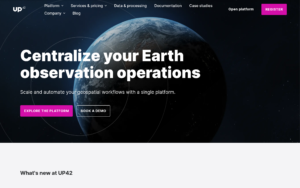 Best for developer teams needing multi-operator tasking via a single API. UP42 GmbH is a Berlin-based marketplace that became a subsidiary of Neo Space Group (NSG, backed by Saudi Arabia’s PIF) in July 2025 following its acquisition from Airbus. The platform provides access to 53 data collections from 28-plus source operators under a single EUR credit wallet: 100 credits equals €1, minimum order €100, credits valid 24 months non-refundable.
Tasking-capable operators available through UP42 include Airbus Pléiades Neo, Planet SkySat, ICEYE, Capella Space, and Umbra. The instant AOI quote function in the console gives price estimates before order commitment, which is a practical advantage for teams managing per-project budgets. Processing algorithms, including custom analytics, are purchasable from the same credit balance.
The REST API is STAC-compliant. A Python SDK is provided. RBAC is available for organizational accounts with multiple teams. Free open data (Sentinel-2, Landsat 8) is available at zero credits. Sensor modalities accessible through UP42 span optical (Airbus, Vantor, Planet, BlackSky, Satellogic, Wyvern), SAR (Capella, ICEYE, TerraSAR-X, Umbra, Synspective), thermal (SatVu MWIR, Constellr TIR), and hyperspectral (Pixxel, Wyvern). No specific customer references appear publicly.
| Type | Multi-operator marketplace / data platform |
|---|---|
| HQ | Berlin, Germany |
| Founded | 2019 |
| Ownership | Subsidiary of Neo Space Group (NSG / PIF) |
| Website | up42.com |
The credit system’s non-refundable 24-month expiry means unused credits are lost. Buyers with irregular or project-based tasking needs should size their credit purchases carefully. Read our full UP42 review for a complete walkthrough of the AOI quoting workflow, the tasking operator list, and how the NSG acquisition affected the platform’s roadmap.
How to choose a satellite tasking service
The right answer depends on three questions you should settle before you look at any provider’s spec sheet: what sensor do you actually need, what turnaround is operationally required, and whether pricing transparency affects your procurement process.
Optical vs. SAR vs. multi-sensor
If your program needs optical only, Planet and Vantor are the two clearest direct-operator choices. Planet and Satellogic are the two with published tasking prices, while Vantor has the fastest single-operator delivery SLA. If SAR is the primary or only requirement and ITAR compliance is a constraint, ICEYE’s ITAR-free status makes it the default starting point for non-U.S. programs.
If the program calls for a combination, optical plus SAR, or optical plus thermal for an industrial monitoring use case, Sfera Technologies and UP42 are both designed to consolidate multi-sensor orders, though their architectures differ: Sfera Technologies uses direct operator partnerships with per-modality pricing, while UP42 uses a credit marketplace across a broader operator catalog.
SLA and delivery speed
Vantor’s Direct Access 15-minute delivery leads the list on raw speed, but it applies to a VHR optical product over covered ground stations, confirm geographic coverage before committing. Capella’s fastest scheduler response on the SAR side is sub-20-minute tasking confirmation, though actual delivery time post-capture is longer. BlackSky’s sub-90-minute from-collection delivery is competitive for optical near-real-time programs, with the caveat on fleet size noted in its profile. Planet’s 3-hour Assured SLA is the most clearly documented end-to-end commitment at a published price point.
Pricing transparency and minimum order
Two direct operators publish tasking prices: Planet and Satellogic. Planet’s SkySat tiers have a 25 km² minimum, with $6/km² archive and $40/km² Assured as the price floor and ceiling. Sfera Technologies’ optical pricing starts at $4/km² for 1.0 m archive with a 25 km² minimum. The 0.3 m daily tasking tier is listed at $30/km² with a 100 km² minimum, and the floor order across all optical tiers is approximately $90. UP42’s credit system offers an instant AOI quote, which is the closest thing to transparent pricing among the multi-operator platforms. Everyone else requires a direct conversation before any numbers appear.
Fleet maturity and business risk
Constellation maturity matters for programs longer than 12 months. Vantor’s WorldView Legion full-fleet deployment (all six satellites operational as of February 2025) and ICEYE’s Series F financing at EUR 1 billion in June 2026 represent the two strongest recent signals of operational and financial stability among operators. Satellogic’s going-concern disclosure and recent CFO departure are material risks for any multi-year program.
BlackSky’s revisit performance is dependent on its constellation reaching 16 Gen-3 satellites. The current operational count should be verified before contracting.
Tasking is bought when the archive cannot answer the question in time. The guides for disaster response, public safety and defense each quantify that pressure differently, and together they show why tasking latency rather than resolution is usually the binding constraint.
Verdict
Planet earns the top spot because it is the only provider on this list that combines a published, self-serve tasking price (from $6/km² archive to $40/km² Assured), a documented 3-hour delivery SLA, API and SDK access in one contract, and a constellation large enough that tasking success rates are not a significant concern. That combination of pricing, delivery speed, and fleet scale does not exist anywhere else on this list at press time.
Capella is the strongest pick for SAR-primary programs: the 20-minute scheduler cycle and taskable InSAR put it ahead of ICEYE and Airbus on scheduling responsiveness, even though ICEYE leads on raw constellation size and ITAR-free status for sovereign non-U.S. buyers.
Sfera Technologies is the right answer if sensor diversity matters more than per-modality depth, its single-contract access to optical, SAR, thermal, hyperspectral, and RF has no direct equivalent on this list, though buyers should factor in the lack of named references and the requirement to contact for non-optical pricing. UP42 serves a similar aggregator role but is better suited to developer teams who want a credit-based API and a broader operator catalog with instant AOI pricing.
Vantor and Airbus Defence and Space are both defensible choices for programs where the vendor relationship, delivery speed, or multi-sensor European sourcing matters more than pricing transparency. Satellogic’s affordable per-km² optical pricing and hyperspectral bonus make it attractive for high-cadence monitoring budgets, but the financial risk flag means it belongs in a competitive evaluation rather than as a sole-source selection for a mission-critical program.
Frequently asked questions
These answers cover the most common decision points when evaluating a satellite tasking provider for the first time.
What is satellite tasking?
Satellite tasking is the process of scheduling a satellite to collect new imagery over a specific area during a defined time window, as opposed to purchasing archive imagery that was collected previously. Tasking requires a scheduler that checks satellite availability, cloud-cover forecasts, and competing demand before confirming an acquisition. See the “How we picked” section for the criteria that distinguish real tasking from archive-only access.
How long does satellite tasking take?
Lead time depends on the provider and the priority tier. Capella Space confirms orders in under 20 minutes and Planet’s Assured SkySat tier delivers within 3 hours, while standard commercial optical tasking typically runs 24 to 72 hours from order to delivery. For per-provider SLAs, see the “Satellite tasking services compared” table.
Which satellite tasking service has the best price?
Two direct operators publish tasking prices: Planet (SkySat Flexible at $12/km², Assured at $40/km²) and Satellogic (per-km² optical on its site). Sfera Technologies publishes optical pricing from $4 to $30 per km² by resolution and priority, while Capella, ICEYE, Vantor, Airbus, and BlackSky publish no rate cards of their own, but all five carry published credit rates on the UP42 marketplace. For a side-by-side summary, revisit the “Satellite tasking services compared” table.
Can I task a satellite for SAR imagery?
Yes, Capella Space, ICEYE, and Airbus (TerraSAR-X) all offer SAR tasking directly, while Sfera Technologies and UP42 route it through their platforms. ICEYE stands out as the only ITAR-free SAR operator here, which matters for non-US sovereign programs. See the “Optical vs. SAR” section for SAR-specific options.
What is the minimum order for satellite tasking?
Minimums vary by provider and sensor. Planet SkySat and Sfera Technologies both start near 25 km² for optical, Sfera Technologies’ 0.3 m daily tier begins at 100 km², and UP42 applies a platform-wide floor of €100. Capella, ICEYE, Vantor, and Airbus quote order minimums on direct request, as summarized in the “Pricing transparency” section.

My passions are Earth Observation and Satellites, and my profession is Data Analysis. I combine both within ObservationData.com to show you the use cases of Earth Observation, to help you find the right provider, and to share your experiences.
