
Free public thermal data from Landsat TIRS at roughly 100 m resolution and NASA ECOSTRESS or MODIS can cover low-resolution, low-cadence needs at zero cost, but the moment you need to resolve a heat signature inside a building, detect a small fire before it spreads, or monitor an industrial facility more than once a week, you are in commercial territory. The specification gap between free and commercial thermal is wider than in any other EO modality.
This guide covers six providers selected on thermal capability, access model, and honest buyer fit. The list deliberately mixes dedicated thermal satellite operators with a bundled-access platform that resells thermal alongside other sensor types, because for many buyers a single contract covering thermal plus optical or SAR is more practical than a standalone thermal deal. Each was evaluated against a consistent set of criteria with no paid placements.
The profiles below show each provider’s sensor band, best resolution, revisit, access model, and one honest limitation so you can match the pick to your use case. SatVu takes the top spot overall, though the best fit depends on whether you need ultra-high resolution or broad-area coverage and rapid alerts.
Table of Contents
Key takeaways
- SatVu leads on world-highest-resolution commercial thermal at 3.5 m MWIR, backed by ESA and NATO contracts
- OroraTech is the strongest pick for wildfire monitoring with on-orbit AI and sub-3-minute alert delivery
- Rankings weight resolution, revisit, access model, and trust signals by what a commercial procurement team can act on
How we picked the best thermal satellite imagery providers
Six criteria shaped this ranking. For thermal imagery, sensor band and ground resolution matter most: MWIR (mid-wave infrared, roughly 3–5 µm) delivers finer spatial detail at the cost of a more complex, cooled detector, while LWIR (long-wave infrared, 8–14 µm) is better suited to low-temperature targets such as soil moisture proxies, land surface temperature, and sub-canopy heat. A provider that cannot state its resolution, has no confirmed satellite in orbit, or hides all pricing adds real procurement friction regardless of band.
- Thermal resolution and band: the finest GSD available and the infrared band, because band choice drives the applications for which the data is suited (MWIR for high-temperature industrial and defense targets, LWIR for agriculture, environmental, and wide-area monitoring)
- Constellation status and revisit: confirmed operational satellites and a credible path to the revisit cadence the provider advertises, not a target constellation spec from a roadmap slide
- Coverage and access model: whether the provider offers self-serve tasking and catalog access, or requires direct contact for every order, and whether an API or STAC-compliant delivery pipeline is in place
- Pricing transparency: whether any price information is published, or all orders are quote-only, because pricing opacity is a material friction for budget-constrained programs
- Trust signals and named customers: government contracts, institutional partnerships (ESA, NATO, NRO), and named commercial customers that a buyer can verify independently
- Delivery and integration: COG/STAC-native delivery, API and SDK availability, and whether the data is analysis-ready or requires significant preprocessing before use
The comparison table below captures the most decision-critical criteria at a glance. Full profiles in the section that follows add the trust signals, limitations, and delivery details a procurement team needs before shortlisting.
Thermal satellite imagery providers compared
The table brings all six providers side by side on the five attributes most relevant to a thermal imagery procurement decision. One fact per cell, giving you an at-a-glance overview before the full profiles add context and trade-offs.
| Provider | Band | Best thermal resolution | Revisit target | Access model | Best for |
|---|---|---|---|---|---|
| SatVu | MWIR (4.5–5 µm day / 3.7–5 µm night) | 3.5 m at nadir | 10–20/day (full 8-sat constellation) | Self-serve web app + REST API | High-resolution MWIR for defense, energy, and industrial monitoring |
| OroraTech | LWIR | 4 m × 4 m minimum detectable hotspot | ~30 min (growing constellation) | Subscription platform (Wildfire Solution) | Wildfire detection and national early-warning systems |
| Sfera | MWIR (SatVu) + LWIR (Aistech) | 3.5 m (via SatVu source) | Depends on underlying operator | Self-serve web app + API | Thermal access without a direct operator contract |
| constellr | LWIR (4 thermal bands) | 30 m native / 10 m sharpened (LSTzoom) | 1.5-day average (2-satellite pair) | API + UP42 marketplace | Absolute land surface temperature for agriculture, defense, and climate |
| Hydrosat | LWIR (10.6–12.51 µm) | 70 m native / 30 m LST (co-registered) | Daily (VZ-1 + VZ-2, two overpasses) | STAC API + Data Discovery Portal | Daily field-scale thermal for water stress and irrigation |
| Aistech Space | LWIR (8–14 µm) | 26–39 m | Not published (48-sat target by 2030) | ALEX platform (subscription + on-demand) | Thermal plus VIS/NIR and ADS-B/IoT from a single payload |
Every fact in the profiles below comes from the providers’ own published pages and primary-source verification. Where data was not publicly available, that gap is noted rather than filled with a guess.
The 6 best thermal satellite imagery providers
Profiles are ranked by overall fit for buyers who need commercial thermal imagery. Each “Best for” line reflects the primary strength on the criteria above, not a claim to market leadership.
1. SatVu
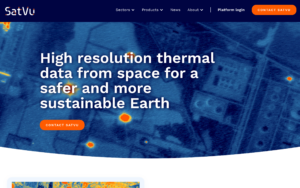 Best for commercial high-resolution MWIR thermal imagery. Global Satellite Vu Limited, trading as SatVu, is a UK thermal-infrared satellite operator founded in 2016 and headquartered in London. The HotSat constellation uses a MWIR sensor covering 4.5–5 µm by day and 3.7–5 µm by night, delivering up to 3.5 m GSD at nadir, the finest commercially available thermal resolution from space. Scene size is approximately 3.5 × 4.5 km (16 km²). Thermal sensitivity is confirmed as less than 2 °C per the WMO OSCAR instrument record. Both still imagery and up to 60-second thermal video are available, a capability SatVu describes as unique at this resolution. Data is delivered as Cloud Optimized GeoTIFF with STAC-format JSON metadata and a usable-data mask (UDM).
| Type | Satellite operator (thermal MWIR) |
|---|---|
| HQ | London, United Kingdom |
| Founded | 2016 |
| Ownership | Private (£60M total equity, investors include NATO Innovation Fund, Lockheed Martin, In-Q-Tel) |
| Website | satellitevu.com |
HotSat-2 launched on SpaceX Transporter-16 in March 2026 and is commercially active. HotSat-3 through HotSat-6 are under contract, with the full eight-satellite constellation targeting 10–20 revisits per day globally. The platform at app.satellitevu.com offers self-serve Standard Tasking (date-range) and Assured Tasking (specific date, highest priority), a catalog of historical imagery, and a price estimation step before order commitment. A RESTful API and Python SDK are available at docs.satellitevu.com. Named institutional customers include ESA (Copernicus Contributing Mission Category 1 contract worth up to €3M over three years, announced June 2025), NATO APSS, and the NGA LUNO A/B programme, which places SatVu in a small group of commercial thermal operators with active government intelligence contracts at press time. Cyber Essentials Plus certification is noted on the about page.
The main limitation is pricing opacity: no price numbers are published on the public site. Both tasking and catalog imagery show a price at the order step, but no indicative range is stated in advance, which makes budget-modelling harder than with providers who publish per-km² figures.
2. OroraTech
 Best for wildfire detection and thermal monitoring at scale. OroraTech GmbH is a German wildfire-intelligence company founded in 2018 and headquartered in Munich. The company operates a purpose-built LWIR CubeSat constellation, combining fully owned satellites (FOREST series, OTC-P1 batch, Hellenic Fire System units) with hosted payloads on Spire Global and Kepler Communications satellites, totalling approximately 18 thermal payloads in orbit as of mid-2026. On-board AI processing detects fire coordinates and relays them via inter-satellite link within approximately 3 minutes of satellite overpass, without requiring a ground-station pass.
| Type | Satellite operator + analytics provider (wildfire intelligence) |
|---|---|
| HQ | Munich, Germany |
| Founded | 2018 |
| Ownership | Private (Series B €37M, led by BNP Paribas Solar Impulse Venture Fund and Rabo Ventures) |
| Website | ororatech.com |
OroraTech’s Wildfire Solution platform integrates proprietary satellite data with 30-plus public sources (NOAA, GOES, Meteosat) for a stated approximately 30-minute revisit target as the constellation grows, along with fire spread simulation, burnt area analytics, land surface temperature products, and hazard risk mapping. The minimum detectable hotspot size is 4 × 4 m, which the company describes as enabling detection of a single burning tree. Customers include ARAUCO (2 million hectares of forestry in four South American countries), the Greek Ministry of Digital Governance (€20M Hellenic Fire System contract for four dedicated satellites plus a ground station, delivered May 2026). OroraTech also holds a DLR data licensing contract and an EU multi-million contract confirming institutional data validation. The SAFIRE Gen4 payloads hosted on Kepler Communications satellites enable what OroraTech describes as the world’s first thermal livestream from orbit, activated in 2026.
The main limitation is product focus: OroraTech is a wildfire and thermal-anomaly intelligence platform. Buyers who need absolute land surface temperature at specified wavelengths, or raw LWIR imagery for general-purpose analysis outside the wildfire and environmental domain, will find the platform less well suited than constellr or Hydrosat.
3. Sfera
 Best for commercial thermal access without a direct operator contract. Sfera Technologies Ltd. is a Bulgaria-based data aggregator and ground-station-services provider founded in 2019. Sfera does not operate its own satellites. Instead it brokers thermal imagery from two source operators under a single commercial agreement: SatVu’s HotSat MWIR data at approximately 3.5 m GSD, and Aistech Space’s LWIR data at 26–39 m GSD from the Hydra constellation. Both thermal modalities are available through the app.sfera.earth web interface and API alongside optical, SAR, hyperspectral, and RF data, which makes Sfera one of very few access points where thermal does not require a standalone operator contract.
| Type | Multi-sensor data platform / aggregator |
|---|---|
| HQ | Sofia, Bulgaria |
| Founded | 2019 |
| Ownership | Private (Bulgarian Angels Club investor confirmed) |
| Website | sfera.earth |
Optical pricing is published in per-km² tiers on sfera.earth/pricing, starting at $4/km² for 1.0 m archive. Thermal imagery, SAR, hyperspectral, and RF are all quote-based, requiring contact at [email protected]. A feasibility tool for SAR tasking is available in the web app. Sfera’s proprietary ground station network includes 12 active sites across Europe, the Middle East, Asia, the Americas, Africa, and Oceania, and is sold as a standalone B2B service at €3/minute via API. The platform’s GS infrastructure advisory team has backgrounds at Thales Alenia Space, DLR, and EUMETSAT. Read our Sfera review for a detailed breakdown of each sensor modality, the ground station service, and platform access.
The key limitation is that Sfera is a small team with no named commercial reference customers published as of press time. Buyers building a mission-critical programme should evaluate service continuity carefully, and the requirement to contact for a thermal quote adds a step that SatVu’s self-serve platform avoids.
4. constellr
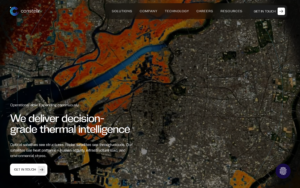 Best for land surface temperature and agriculture or defense-grade thermal intelligence. constellr GmbH is a German thermal-infrared satellite operator headquartered in Munich. The company’s HiVE constellation uses cryocooled LWIR sensors, a first-of-its-kind deployment on a microsatellite platform per the Tokyo first-light press release of March 2025. Two satellites are operational: SkyBee-1 (launched January 2025) and SkyBee-2 (launched June 24, 2025, with upgraded sensors). Native thermal GSD is 30 m (27.3 m at 510 km SSO altitude), sharpened to 10 m in the LSTzoom product. Thermal accuracy is 1.0–1.5 K absolute, with a thermal sensitivity (NETD) of 0.05–0.15 K, which constellr describes as enabling detection of subtle temperature variations invisible to less precise sensors. The sensor suite covers 4 thermal bands plus 10 VNIR bands for atmospheric correction and geolocation.
| Type | Satellite operator + analytics provider (thermal LWIR) |
|---|---|
| HQ | Munich, Germany |
| Founded | Not publicly confirmed (ISS demonstrator launched 2022, founded in Freiburg, Germany) |
| Ownership | Private (Series A €37M, Alpine Space Ventures and Lakestar co-lead, €75M total equity) |
| Website | constellr.com |
Three data products are available: LSTprecision (high-precision absolute LST at 30 m, frequently updated), LSTzoom (sharpened 10 m spatial detail layer), and LSTfusion (cloud-free modelled daily LST at 30 m, combining constellr measurements with other sources). Commercial access runs through direct contact at constellr.com, the UP42 marketplace (from February 27, 2026), and SKY Perfect JSAT for Japan (from February 2, 2026). Non-commercial research access is available via the ESA Third Party Mission (TPM) programme since January 2026. Named institutional partners include ESA (Copernicus Contributing Mission since 2023, multi-year European Commission contract), DLR, and Fraunhofer Gesellschaft. Roadmap: approximately 30 satellites targeted by 2030, with next-generation resolution below 5 m per the February 2026 Series A announcement. The current 1.5-day average revisit is not yet daily, though the roadmap targets daily revisit for priority regions at full constellation capability.
The main limitation is access maturity: there is no self-serve web console at press time, and the ESA TPM article from January 2026 noted that self-service archive is not yet available. Buyers need to engage a customer success manager or go through UP42 for commercial orders, which adds lead time compared to providers with fully self-serve platforms.
5. Hydrosat
Best for water-stress and agricultural thermal monitoring at daily cadence. Hydrosat, Inc. is a US thermal-infrared satellite operator and analytics company headquartered in Washington, DC. The VanZyl constellation, named in honor of co-founder and former NASA JPL Associate Director Dr. Jakob van Zyl, comprises two pathfinder satellites: VZ-1 (launched August 2024 on SpaceX Transporter-11) and VZ-2 (launched June 24, 2025 on SpaceX Transporter-14), which delivers four times the collection capacity of VZ-1. Each satellite carries two collocated instruments: LIRI (Longwave InfraRed Imager) at approximately 70 m native GSD, and VIRI (Visible and near-InfraRed Imager) with 7 spectral bands across 458–900 nm at 30 m GSD. The Level-2 product delivers land surface temperature at 30 m via thermal sharpening from the 70 m LWIR using collocated VNIR data, all as Cloud Optimized GeoTIFF via a STAC-compliant API (stac.hydrosat.com). Imagery is acquired at two local times per day, VZ-1 at approximately 10:30 am and VZ-2 at approximately 1:30 pm, giving diurnal temperature variation data that single-overpass missions cannot provide.
| Type | Satellite operator + analytics provider (thermal LWIR + VNIR) |
|---|---|
| HQ | Washington, DC, USA |
| Founded | Not publicly confirmed (Seed round November 2021) |
| Ownership | Private (Series B $60M led by Hartree Partners, Subutai Capital, Space 4 Earth) |
| Website | hydrosat.com |
Hydrosat acquired IrriWatch in June 2023, a field-scale irrigation management platform founded by Dr. Wim Bastiaanssen and serving more than 4 million acres across more than 40 countries. Named government customers include NOAA (multiple SBIR grants), NRO (Stage II contract, 2025), and the US Air Force ($1.9M contract, October 2024). Named commercial customers include Bayer and SupPlant. A Data Discovery Portal (discover.hydrosat.com) is available for catalog browsing, and an Open Data Program provides sample access without an account. Full catalog access requires ordering through a sales contact. The next-generation constellation is in development following the January 2026 Series B of $60M. The planned next-gen satellites target 25 m LWIR native GSD with 10 m VNIR, enabling a 10 m LST product, though satellite count and timeline are not published on the site.
The current limitation is spatial resolution: 70 m native LWIR (30 m thermally sharpened LST) is well suited to field-scale and catchment-scale analysis but does not resolve individual structures or sub-field thermal features the way SatVu’s 3.5 m sensor does. Buyers with sub-50 m industrial or defense requirements will need a different provider.
6. Aistech Space
 Best for thermal combined with VIS/NIR and IoT data from a single payload. Aistech Space S.L. is a Spanish NewSpace company founded in 2015 and headquartered in Castelldefels, Barcelona. The Hydra LEO constellation carries the proprietary Multispectral Thermal Telescope (MST), which captures three spectral channels simultaneously: VIS, NIR, and LWIR (8–14 µm atmospheric window). LWIR ground sample distance is 26 m at 8 µm and 39 m at 12 µm per the company’s own 2019 EPIC/ESA technical specification, with a 7 km swath and 35 km² scene size per the live technology page. Two operational satellites are confirmed as of May 2026: Hydra 2 (launched January 11, 2026) and Hydra 3 (launched May 3, 2026). Six total launches are planned for 2026, with a target of 48 satellites by 2030. The ALEX cloud platform provides real-time tasking, data access, and AI analytics through subscription tiers (Basic, Standard, Premium) and on-demand pay-as-you-go options. ESA selected the Hydra constellation as a Copernicus Contributing Mission in 2023, and Spain’s CDTI declared Aistech a strategic technology company with a committed co-investment of up to €22.5M in the Series B round.
| Type | Satellite operator + imagery provider (thermal LWIR + multispectral) |
|---|---|
| HQ | Castelldefels (Barcelona), Spain |
| Founded | 2015 |
| Ownership | Private (Series B, €8.5M first close, GPI lead, CDTI committed up to €22.5M co-investment) |
| Website | aistechspace.com |
The Hydra platform also retains legacy ADS-B aircraft tracking and IoT/M2M payload capability from the company’s earlier satellite generations, which makes it the only provider on this list able to combine thermal infrared with aircraft position data in a single contract. Aistech is an EU-based company, and while ITAR status is not stated on the site, the European supply chain and Spanish/ESA institutional backing are relevant for EU-sovereignty-sensitive programmes.
The main limitation is revisit transparency: neither per-satellite revisit frequency nor the full-constellation revisit target is published on the site as of press time. With only two confirmed operational Hydra satellites, buyers should contact Aistech directly to understand current coverage cadence before committing to any time-sensitive monitoring requirement.
How to choose a thermal satellite imagery provider
The right choice depends on three questions you should answer before you look at any spec sheet: what spatial resolution do you actually need, what temperature target are you monitoring (high-heat industrial vs. low-differential land surface), and whether you need tasking on demand or a continuous subscription service covering a defined area.
MWIR vs. LWIR: band selection
MWIR (3–5 µm) is optimal for high-temperature targets, industrial heat sources, and scenarios where you need to resolve detail inside a structure or over a small scene. SatVu’s 3.5 m MWIR sensor is the only commercially available option at that resolution, and the HotSat data can detect heat signatures from naval vessel engines, refinery stacks, power plant cooling systems, and data centres with enough spatial precision to distinguish individual emitters. If your use case is national-security ISR, energy-facility monitoring, or maritime activity detection, MWIR at 3.5 m is the only sensor that does it from orbit today.
LWIR (8–14 µm) is better for lower-temperature targets: soil and vegetation surface temperature, land surface temperature for evapotranspiration modelling, and broad-area wildfire detection where the hotspot threshold (rather than precise spatial resolution) matters most. constellr, Hydrosat, OroraTech, and Aistech Space all work in LWIR. The choice among them comes down to resolution, revisit, and the analytics layer: Hydrosat for daily field-scale agricultural thermal, constellr for absolute calibrated LST with defence-grade accuracy, OroraTech for wildfire-specific intelligence with sub-3-minute alerts.
Direct operator vs. access platform
Four providers on this list operate their own thermal satellites (SatVu, OroraTech, constellr, Hydrosat, Aistech Space). Sfera is the exception: it resells SatVu and Aistech thermal imagery alongside optical, SAR, hyperspectral, and RF data under a single contract. For buyers who need thermal as one modality among several, Sfera’s single access point reduces procurement overhead. For buyers whose programme is thermal-primary and requires direct SLAs, delivery guarantees, and the full product specification, going directly to the operator avoids an intermediary layer. In my analysis, the access-platform model earns its place on a mixed-modality programme, but a thermal-only programme with a significant data volume is better served by a direct operator relationship.
Revisit and tasking vs. continuous monitoring
SatVu and Aistech Space offer on-demand tasking (you define a target, the satellite collects). constellr offers tasking via direct engagement or UP42. OroraTech and Hydrosat operate continuous push-broom collection: their satellites image everything in the swath on every pass, and you query the resulting archive. For persistent monitoring of a defined geography, the continuous model is often more efficient. For selective collection over a specific target you want imaged at a specific time, tasking is the right model. The table in the previous section captures the access model column for a quick reference. For buyers comparing pricing in more detail, see the “How we picked” section for the pricing transparency criteria.
Verdict
SatVu earns the top spot because no other commercially available thermal satellite delivers 3.5 m MWIR GSD with self-serve tasking, a RESTful API with Python SDK, and confirmed contracts with ESA, NATO APSS, and the NGA LUNO programme. That combination of resolution, access model, and institutional validation is the strongest proposition in commercial thermal imagery at press time. The constellation is still small (HotSat-2 confirmed active, HotSat-3 through HotSat-6 under contract), so current revisit over any single point is not yet daily, but the scale path is clearly funded following the February 2026 £30M NATO Innovation Fund round.
OroraTech is the strongest pick for wildfire and thermal-anomaly monitoring: the on-orbit AI edge processing, approximately 18 thermal payloads, and the Hellenic Fire System contract prove that the platform works at national scale. The minimum-detectable hotspot size of 4 × 4 m and the sub-3-minute alert architecture have no equivalent on this list for time-critical fire response.
Sfera is the right choice if you need thermal as part of a multi-sensor programme and want to avoid negotiating a separate contract with a thermal operator. The platform gives access to SatVu’s MWIR data alongside SAR, optical, hyperspectral, and RF under a single commercial relationship, though thermal pricing is quote-based and the buyer should factor in the small team risk. constellr leads among LWIR operators on absolute accuracy (1.0–1.5 K) and institutional credentials (ESA CCM, Fraunhofer, DLR), and its scale roadmap to sub-5-metre resolution by 2030 is credible given the Series A. Hydrosat is the clearest choice for daily agricultural and water-resource thermal: the two-satellite diurnal pair, STAC API, and IrriWatch analytics make it a vertically integrated option for irrigation and evapotranspiration programmes. Aistech Space rounds out the list as the most cost-accessible entry point in the LWIR category and the only provider combining thermal with ADS-B and IoT payloads, though buyers should verify current revisit capability before contracting.
Frequently asked questions
These answers cover the most common questions when evaluating a thermal satellite imagery provider for the first time.
What is thermal satellite imagery?
Thermal satellite imagery captures the infrared radiation emitted by objects on Earth’s surface as heat rather than reflected sunlight, allowing temperature measurement day and night regardless of visible-light conditions. MWIR sensors (3–5 µm) excel at high-temperature industrial targets, while LWIR sensors (8–14 µm) are better suited for land surface temperature, agriculture, and environmental monitoring. See the “How we picked” section for the band-by-band criteria used in this ranking.
What is the best resolution available for commercial thermal satellite imagery?
SatVu’s HotSat constellation delivers 3.5 m MWIR GSD at nadir, the finest commercially available thermal resolution from space as of 2026. For LWIR, constellr reaches 30 m native with a sharpened 10 m product, and Hydrosat delivers 70 m native with a 30 m thermally sharpened LST. For a full side-by-side comparison, see the “Thermal satellite imagery providers compared” table.
Is free thermal satellite data good enough?
For regional-scale environmental research, coarse land surface temperature mapping, or archival studies where revisit is not critical, free sources such as Landsat TIRS (~100 m, 16-day revisit), NASA ECOSTRESS, or MODIS may cover the need at zero cost. Commercial thermal is the right choice when you need sub-50 m resolution, more frequent revisit, or near-real-time delivery. The “How we picked” section explains the resolution and revisit thresholds that drive buyers toward commercial options.
Which thermal satellite imagery provider publishes pricing?
None of the six providers on this list publishes a full public price list for thermal imagery. Sfera’s thermal access is quote-based (contact [email protected]), and SatVu’s platform shows a price estimate at the order step but no public range. OroraTech, constellr, Hydrosat, and Aistech Space all require direct contact for commercial pricing. For a comparison of access models by provider, see the “Thermal satellite imagery providers compared” table.
Can thermal satellites detect wildfires?
Yes. OroraTech’s dedicated wildfire constellation detects hotspots as small as 4 × 4 m and delivers fire coordinates within approximately 3 minutes of satellite overpass via on-orbit AI processing. SatVu’s MWIR sensor can also see through smoke. For buyers focused specifically on fire monitoring, the “The 6 best thermal satellite imagery providers” section profiles OroraTech’s architecture and named government contracts in detail.

My passions are Earth Observation and Satellites, and my profession is Data Analysis. I combine both within ObservationData.com to show you the use cases of Earth Observation, to help you find the right provider, and to share your experiences.
