
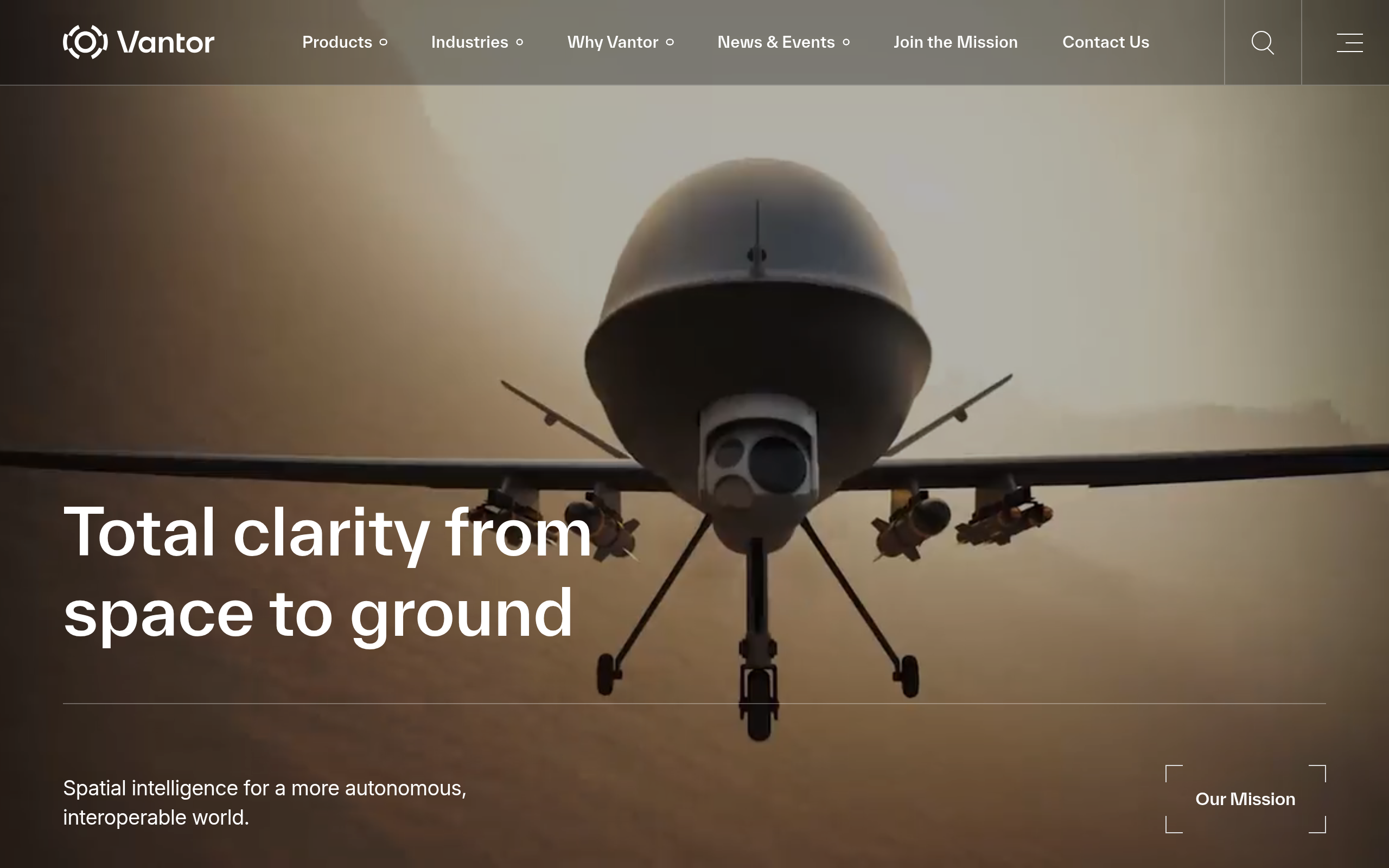
 Maxar (now operating as Vantor) is a US very-high-resolution optical satellite operator running the most accurate and highest-capacity commercial VHR imaging constellation in the world, built around its 10-satellite WorldView fleet.
It is a thoroughly established operator, with a 30-plus-year heritage rooted in DigitalGlobe, the company that built the commercial VHR imagery market, and a continuous record of supplying foundational geospatial intelligence to the US government and commercial enterprise.
This review covers the rebrand, the constellation specs, the pricing opacity, and where the operator fits, so you can judge whether it is the right choice for your requirements.
Table of Contents
Key Takeaways
- Maxar delivers the sharpest commercial optical pixels on orbit for buyers who require 30 cm-class VHR with up to 15x daily revisit
- Its standout edge is the Tensorglobe AI platform, automating tasking-to-fusion and deployable in classified sovereign environments
- We weighed all the strengths and limitations: the real caveat is fully quote-driven pricing, with no rates published publicly
About Maxar
The name “Maxar” remains the dominant search term, but the company rebranded to Vantor on October 1, 2025, simultaneously unveiling the Tensorglobe AI-powered spatial intelligence platform. Maxar.com now redirects to vantor.com. The imagery intelligence unit and the satellite manufacturing arm (which rebranded to Lanteris) had already been operating as separate entities since the Advent International acquisition in 2023. The facts below are drawn from Vantor’s own published pages as of May 2026.
| Name | Vantor (formerly Maxar Intelligence) |
|---|---|
| Website | vantor.com |
| HQ | Westminster, Colorado, USA |
| Ownership | Private (acquired by Advent International, formerly NYSE: MAXR) |
| Leadership | Dan Smoot (CEO); Peter Wilczynski (Chief Product Officer); Arvind Srinivasan (CTO) |
| Employees | ~2,000+ globally (per vantor.com/company/about/) |
| Products & data | WorldView 2D (30 cm-class VHR optical tasking); Vivid Mosaic basemaps (15 cm HD and 30 cm global); Vivid Terrain 3D models; Tensorglobe AI platform; WorldView Radar (SAR via Umbra); Vantor Hub self-serve portal; Sentry persistent monitoring; Raptor GPS-resilience software |
| Pricing | No public pricing; credits-based Hub model with quote-based enterprise programs |
| Languages | English |
The scale of Vantor’s collection capacity is notable: 10 imaging satellites on orbit as of May 2026, generating roughly 7 million square kilometers of imagery per day, including 3.5+ million square kilometers at 30 cm-class resolution. The WorldView constellation has been the backbone of US government foundational GEOINT since the DigitalGlobe era, powering the GEGD program that distributes geospatial intelligence to over 1 million users.
Is Maxar legit?
Vantor (Maxar) is unambiguously a real, operational company with a decades-long track record in both commercial and defense geospatial markets. The more useful question for a buyer is whether the product line and access model match your specific acquisition needs and budget.
Ownership and funding
Maxar Technologies went private in 2023 following an acquisition by Advent International, a private equity firm, having been previously listed on the NYSE as MAXR. As part of that acquisition, the company was split into two separate entities: the imagery intelligence business (Maxar Intelligence) and the satellite manufacturing arm (Maxar Space Systems).
The October 2025 rebrand simply renamed those already-separate entities to Vantor and Lanteris respectively. Vantor’s current corporate structure is not detailed on the company’s website, and the full legal entity name has not been publicly stated.
The trademark footer confirms “Vantor Holdings, Inc.” as the trademark holder, but the complete legal and parent-entity structure requires verification from third-party corporate records.
What is clear from the site is that the business is actively funded and operational: new products launched at rebrand, a constellation expansion was announced in April 2026, and government contracts continue to be disclosed on the company’s blog.
Track record and customers
The heritage here is deep. DigitalGlobe, the direct predecessor, successfully launched QuickBird in 2001 and built the commercial VHR imagery market over the following decade. The WorldView constellation has been operational under successive brands for over 15 years, and the company has supplied imagery for applications ranging from disaster response and humanitarian mapping to US Army One World Terrain mission rehearsal and space domain awareness.
Named customers on Vantor’s own site include HERE Technologies, TomTom, and Mapbox (all using Vivid Mosaic basemaps), Google (Tensorglobe AI integration), Anduril, Lockheed Martin, BAE Systems, and Saab in defense. Zonda monitors 60,000-plus US housing construction projects using the platform. The Netherlands Ministry of Defence signed a multi-year Vantor Hub contract in 2025 valued at approximately $14 million, one of the few contract values the company has disclosed publicly.
Compliance and data rights
Vantor’s licensing structure is worth examining before signing any contract. The active end-user licenses (Internal Use License and Subscription Services License) both contain explicit restrictions on using licensed imagery to train machine learning models or improve any algorithm. This is a genuine constraint for organizations building AI/ML pipelines on top of VHR optical data.
The ARD (Analysis-Ready Data) tile product was deprecated as of January 2026. Current delivery runs via COG format with STAC-compliant catalog access through the Hub API. Redistribution of processed imagery requires a sublicense add-on, and the license architecture includes several distinct tiers depending on use case.

Data and capabilities
Vantor’s core product is VHR optical imagery from 10 imaging satellites, spanning the resolution range from 30 cm-class WorldView Legion and WorldView-3 down to the 50 cm WorldView-1. The constellation also incorporates third-party SAR and high-revisit optical sensors via Vantor’s virtual constellation framework.
Optical sensors and constellation
The six WorldView Legion (WVL) satellites completed their constellation over three launches: the first pair in May 2024, the second pair in August 2024, and the fifth and sixth satellites in February 2025. Each WVL satellite carries a panchromatic sensor with a native ground sample distance of 34 cm, which Vantor markets as “30 cm-class imagery” in product literature.
The older WorldView-3 has a slightly sharper native Pan GSD of 31 cm and adds 8-band VNIR and 8-band SWIR sensing plus a CAVIS atmospheric correction layer, making it the most spectral satellite in the fleet. WorldView-2, GeoEye-1, and WorldView-1 round out the legacy satellites with Pan GSDs of 46, 41, and 50 cm respectively.
The “15 cm HD” product marketed under the Vivid Mosaic brand is not a native sensor resolution. Vantor’s own site states explicitly that “our HD processing upscales 30 cm imagery to 15 cm clarity,” meaning it is a machine-learning super-resolution product. For visualization and basemap use cases the upscaling is well-regarded. For precision measurement tasks, however, the 34 cm or 31 cm native GSD is the operative figure.
The full constellation delivers up to 15 imaging opportunities per day at priority locations and a daily collection capacity of roughly 7 million square kilometers in total. Accuracy is rated at better than 5 m CE90 across the constellation, with Block Bundle Adjustment sharpening mosaic products to the same threshold globally.
SAR and third-party sensors
Through the WorldView Radar product, Vantor distributes ultra-high-resolution SAR imagery from Umbra’s X-band constellation under a virtual constellation partnership. The product was in beta via Vantor Hub as of March 2026 and is not yet available in the standard self-serve portal. Satellogic’s high-revisit optical imagery is also accessible via the virtual constellation for combined tasking. The exact resolution specs for both third-party sensors come from those operators’ own publications, not from Vantor’s site directly.
Platform and archive access
Vantor Hub is the primary access point: a cloud-based self-serve portal with a credits-based ordering model, a STAC-compliant imagery catalog, satellite tasking, archive browsing, basemap streaming, and the Sentry monitoring API. The archive spans 20-plus years and holds more than 6 billion square kilometers of imagery at 30 cm resolution.
Two tasking tiers are available via WorldView 2D: FastView (guaranteed within 24 hours, highest priority) and FlexView (365-day scheduling window, less than 15% cloud cover guaranteed). For large enterprise and government accounts, the Direct Access program enables data delivery as fast as 15 minutes after collection, and Rapid Access guarantees six-hour delivery. Both priority programs require a direct-contract sales engagement rather than self-serve Hub ordering.
The Tensorglobe platform wraps the constellation into an AI-driven spatial intelligence pipeline with three modules: Cortex for constellation orchestration, Forge for sensor fusion and analytics, and Nexus for secure cloud or on-premises deployment. Sovereigns and classified environments can run Tensorglobe on-prem, enabling in-country intelligence production entirely within customer infrastructure.
Pricing
Vantor publishes no pricing for any of its imagery or platform products on vantor.com. The Vantor Hub uses a credits-based model that the site describes as having “transparent pricing,” but credit prices and per-area rates are not shown publicly. Third-party reseller sources have cited figures of $29 to $45 per square kilometer for 30 cm imagery (archive and tasking variants), but these come from reseller PDFs, not from Vantor directly.
Government and enterprise bulk programs are negotiated directly and differ materially from spot rates. The pricing table below summarizes the access model for each major product line.

| Product | Model | Published Price | Notes |
|---|---|---|---|
| WorldView 2D tasking (30 cm-class) | Credits / quote | Not published | Reseller estimates: ~$29-45/km² (third-party, unverified from Vantor directly) |
| Vivid Mosaic basemaps (15 cm and 30 cm) | Subscription | Not published | Streaming via Hub or direct enterprise delivery with custom quote |
| Vivid Terrain 3D models | Subscription / quote | Not published | 50 cm resolution, 3 m accuracy, 100M+ sq km coverage, enterprise pricing |
| WorldView Direct Access | Enterprise contract | Not published | 15-minute delivery SLA, requires direct sales engagement |
| WorldView Rapid Access | Enterprise contract | Not published | 6-hour guaranteed delivery, requires direct sales engagement |
| Tensorglobe platform | Quote / sovereign deployment | Not published | On-prem or cloud deployment, classified environment support, custom programs |
The Open Data Program provides free imagery for qualifying disaster response and humanitarian mapping use cases, which is one of the few truly no-cost access paths. Beyond that, any meaningful evaluation requires a conversation with a Vantor sales representative, including for the Vantor Hub credits model.
Who it’s for
The WorldView constellation is oriented toward buyers with demanding resolution requirements and the procurement infrastructure to negotiate enterprise contracts. Defense agencies, intelligence communities, and large government geospatial programs are the primary customer segment, as evidenced by the GEGD program, One World Terrain, and sovereign intelligence deployments. But commercial enterprise is substantial: digital mapping companies (HERE, TomTom, Mapbox), construction monitoring, property analytics, and 5G network planning all have confirmed use cases on Vantor’s own site.
Defense and government
The government application stack is the strongest fit. The GEGD program, which Vantor has operated since 2011, distributes foundational GEOINT to over a million users across US government. Sovereign intelligence packages, the Direct and Rapid Access programs, and Tensorglobe’s ability to run in classified on-prem environments are capabilities that have no real equivalent in the commercial VHR market.
Space domain awareness via WorldView Space (orbital imagery at better than 10 cm resolution) is another niche that few competitors in the commercial market touch.
Commercial enterprise and mapping
For commercial buyers, the most practical entry points are Vivid Mosaic basemaps (available via Hub subscription) and WorldView 2D tasking through the Hub credits model. The 20-plus-year archive is uniquely deep for change detection and longitudinal analysis, and the STAC-compliant API supports modern geospatial workflows. Teams running construction monitoring, infrastructure surveys, or digital-twin mapping will find the combination of 30 cm resolution and 15x daily revisit compelling for high-temporal-resolution monitoring of known sites.
Where it is less competitive
Buyers looking for frequent-revisit moderate-resolution monitoring at low cost per square kilometer will find Planet Labs a better fit. Organizations that need synthetic aperture radar as a primary sensor should evaluate dedicated SAR operators before relying on Vantor’s beta WorldView Radar product. Small teams or startups without the procurement bandwidth for enterprise negotiations will find the sales-led access model a genuine barrier.
Strengths and limitations
In my analysis of the WorldView constellation and the Vantor platform, the split between clear strengths and genuine friction points is worth stating plainly before reaching a verdict.
The five core strengths are:
- The highest-capacity VHR optical constellation in the commercial market: 10 satellites, 30 cm-class imagery, up to 15 imaging opportunities per day at priority locations
- Only commercial provider with a global 30 cm basemap product (Vivid Mosaic, 135 million sq km coverage) at better than 5 m CE90 accuracy
- Deep archive: 20-plus years and over 6 billion square kilometers at 30 cm resolution, unmatched for longitudinal analysis
- Tensorglobe can be deployed on-prem in classified or sovereign environments, a capability competitors have not matched
- Announced Vantage (20 cm-class) and Pulse (40-satellite high-revisit fleet, every-15-minute revisit) expansions for 2027-2029
The four key limitations are:
- No public pricing for any product; credits-based Hub model is described as “transparent” but prices are not shown on site
- ML training prohibition in active license terms (Subscription Services License and Internal Use License) constrains AI/ML pipeline development
- SAR product (WorldView Radar via Umbra) remained in beta as of March 2026 and was not yet in the self-serve Hub portal
- Full corporate structure post-rebrand and post-Advent acquisition is not disclosed on the company website
The combination of pricing opacity and a licensing structure that restricts ML training are the two factors I would flag most clearly for any buyer running a competitive evaluation.
Maxar alternatives
Buyers comparing Vantor (Maxar) to the broader VHR optical market have several well-documented options, each with a distinct sensor profile and pricing model.
| Provider | Type | Best-fit resolution | Key differentiator |
|---|---|---|---|
| Airbus Defence and Space | Satellite operator | 30 cm (Pléiades Neo) | European VHR operator with native SAR constellation (TerraSAR-X/TanDEM-X/PAZ) and combined optical + SAR tasking via OneAtlas |
| Planet Labs | Satellite operator | 3 m (monitoring) / 50 cm (tasking) | Near-daily global coverage at lower cost per sq km, better fit for frequent-revisit monitoring than single-pass VHR collection |
| BlackSky | Satellite operator | 35 cm (Gen-3) | Real-time optical tasking with sub-90-minute delivery, SPECTRA AI analytics platform, publicly traded (NYSE: BKSY) |
| Satellogic | Satellite operator | 70-100 cm (multispectral) | High-revisit sub-meter optical with native hyperspectral per satellite and a lower cost structure for frequent coverage |
| Sfera | Multi-sensor data aggregator | Depends on sensor selected | Brokers optical, SAR, thermal, hyperspectral, and RF data across multiple operators with unified tasking and global ground stations, useful for buyers who want sensor flexibility rather than committing to one VHR optical provider |
The decision ultimately comes down to three variables: resolution floor, delivery speed requirements, and procurement model. If your workflow demands the sharpest pixels in the commercial market with the deepest archive and sovereign-grade platform integration, Vantor has no direct peer. If you need sensor-type flexibility or want to compare prices across operators before committing, evaluating a multi-sensor aggregator alongside single-operator quotes makes practical sense.
Verdict
Vantor (Maxar) is a legitimate, established operator: the question is fit, not credibility. Thirty-plus years of VHR imagery operations, 10 satellites on orbit, and a customer base that includes the US government’s foundational GEOINT program place it in a category where legitimacy is genuinely not the concern. The real question is whether your procurement timeline and budget can accommodate an entirely quote-driven pricing model.
For defense agencies, sovereign governments, and large commercial enterprises with dedicated geospatial procurement teams, Vantor is the natural benchmark. The 30 cm-class resolution, 15x daily revisit capacity, and Tensorglobe’s classified-environment deployment capability have no direct equivalent in the current commercial market. The Vantage and Pulse constellation expansions, announced for 2027 and 2029, suggest the resolution and revisit ceiling will continue to rise.
The ML training restriction in licensing is worth flagging for organizations with AI-heavy workloads, and the SAR product (WorldView Radar via Umbra) was still in beta as of early 2026. For smaller teams or buyers who need pricing transparency before initiating a procurement process, the access model is a genuine barrier. Those buyers may find that starting with a multi-sensor aggregator or a competitor with published tariffs reaches a decision faster.
Frequently asked questions
Below are answers to the most common buyer questions about Maxar and the Vantor rebrand.
What happened to Maxar?
Maxar Intelligence rebranded to Vantor on October 1, 2025, simultaneously launching the Tensorglobe AI platform. Maxar Space Systems (the satellite manufacturing division) rebranded to Lanteris at the same time. maxar.com now fully redirects to vantor.com. For more context on the company, see the section “About Maxar.”
Is Maxar (Vantor) a legitimate company?
Yes. Vantor has a 30-plus-year operational history, supplies foundational imagery to the US government, and counts named enterprise customers including Google, HERE Technologies, and NATO-member defense ministries. That question is covered in depth in the “Is Maxar legit?” section, including the full ownership and compliance picture.
How much does Maxar imagery cost?
Vantor publishes no pricing on its website. The Hub uses a credits model, but credit prices are not shown publicly. Third-party reseller sources have cited indicative rates in the range of $29 to $45 per square kilometer for archive and tasking, but these are unverified estimates. Pricing details are in the “Pricing” section.
What resolution is Maxar imagery?
The WorldView constellation delivers 30 cm-class imagery commercially. The native panchromatic GSD is 34 cm for WorldView Legion and 31 cm for WorldView-3. The “15 cm HD” product is an ML-upscaled version of 30 cm native imagery, not a native 15 cm sensor. Full specs are in the “Data and capabilities” section.
Who owns Maxar (Vantor)?
Maxar Technologies was taken private by private equity firm Advent International in 2023 (previously NYSE: MAXR). Post-rebrand, the imagery business operates as Vantor. The full corporate structure under Advent is not disclosed on the company website. More detail is in the “Is Maxar legit?” section.
Does Maxar have a free tier?
There is no general free tier. The Open Data Program provides imagery at no cost for qualifying disaster response and humanitarian mapping use cases. Standard commercial access requires a Hub account and credits purchase or a direct enterprise contract. Pricing details are in the “Pricing” section.

My passions are Earth Observation and Satellites, and my profession is Data Analysis. I combine both within ObservationData.com to show you the use cases of Earth Observation, to help you find the right provider, and to share your experiences.
