
 The Group for Earth Observation (GEO) is an independent organisation that has connected weather satellite and Earth observation enthusiasts worldwide since 2003. Building on the foundations laid by earlier hobbyist groups, GEO created a vibrant international community that bridged the gap between amateur satellite reception and the professional Earth observation industry.
The historic domain name geo-web.org.uk has been acquired by ObservationData.com following GEO’s website going offline in 2024, ensuring that the legacy of this enthusiast community continues through modern Earth observation resources and industry insights. This acquisition represents a commitment to preserving the heritage of amateur satellite reception while guiding users toward today’s professional platforms.
GEO’s mission to enable amateur reception of weather and earth imaging satellites inspired hundreds of members across the globe. Satellite imagery providers like Sfera Technologies, SkyFi and SkyWatch represent the commercial evolution of GEO’s original vision: making satellite data accessible to everyone.
Table of Contents
The Independent Organisation for Weather Satellite Enthusiasts
The Group for Earth Observation emerged during a pivotal moment in Earth observation history when new satellite generations like MSG (Meteosat Second Generation) were transforming what amateur enthusiasts could receive and process at home. This community became an essential bridge between hobbyists and organisations like EUMETSAT.
| Name | Group for Earth Observation (GEO) |
|---|---|
| Website | geo-web.org.uk |
| Founded | 2003 |
| Chairman | Francis Bell (passed away 2021) |
| Active Period | 2003–2024 |
| GEO Quarterly | 72 issues published (2004–2020) |
| Management Team | David Anderson, Nigel Evans, Clive Finnis, Peter Green, Les Hamilton, David Simmons, David Taylor, John Tellick |
| Online Community | GEO-Subscribers (groups.io) – 673 members, 7,190+ topics |
| Website Offline | Between July and November 2024 |
Foundation (2003): A New Generation of Satellite Enthusiasts
GEO was formed in 2003 to enable amateur reception of the new generation of weather and Earth imaging satellites.
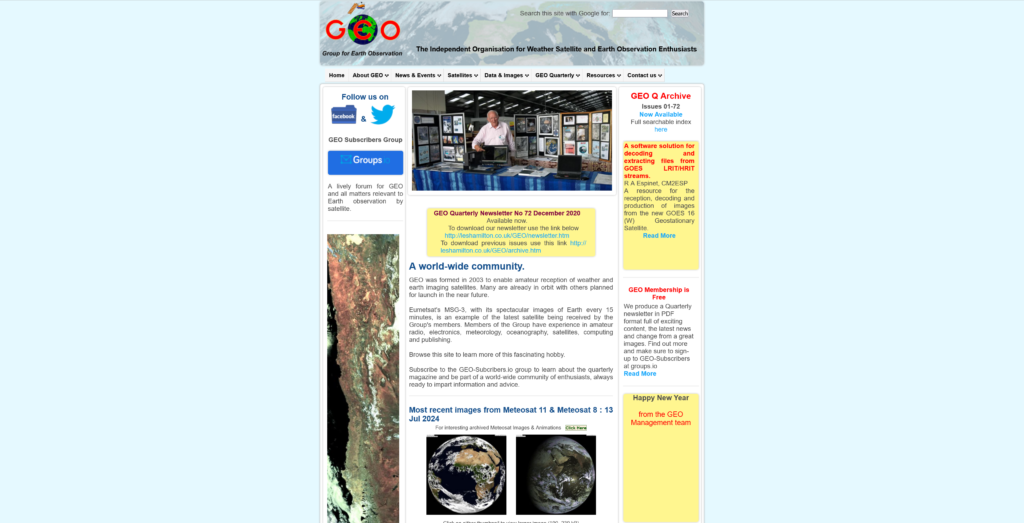
Members brought experience from amateur radio, electronics, meteorology, oceanography, satellites, computing and publishing – sharing their skills freely with other amateurs. The arrival of EUMETSAT’s MSG satellites, delivering spectacular images of Earth every 15 minutes, created an exciting new frontier for home reception.
Growth and Community Building (2004–2014): Symposia and International Reach
GEO held its first symposium in May 2004 at the National Space Centre in Leicester, attracting 58 delegates from 5 countries. The event featured live demonstrations of Meteosat-8 reception, expert lectures and workshops for beginners and advanced users alike. Annual symposia followed, with the most recent held in May 2014, covering topics like the transition to DVB-S2 for EUMETCast.
The group also organised landmark visits to EUMETSAT’s headquarters in Darmstadt, Germany, in 2007, 2011 and 2015. These included tours of satellite control rooms, the T-Systems ground station at Usingen and ESA’s ESOC facilities – offering members unique behind-the-scenes access to professional satellite operations.
The GEO Quarterly Magazine (2004–2020)
One of GEO’s most significant contributions was its quarterly magazine, the GEO Quarterly. Over the years, 72 issues were published, packed with colour satellite images, technical tutorials, equipment reviews, and commentary on the latest Earth imaging satellites. The magazine was edited by Les Hamilton and featured contributions from members worldwide.
Publication ceased with issue 72 in December 2020. Following the end of the paid subscription model in late 2017, all back issues were made freely available in the GEO Q Archive. The full archive remains a valuable resource documenting over 15 years of amateur satellite reception knowledge.
Transition and Legacy (2017–2024): From Active Organisation to Archive
After the GEO Quarterly ceased publication in 2020, GEO continued as a community through its GEO-Subscribers group, which had migrated from Yahoo Groups to groups.io. The website was last modified on 25 January 2022 and continued to display live Meteosat imagery until mid-2024. The geo-web.org.uk website went offline between July and November 2024.
Sadly, Francis Bell, GEO’s Chairman, passed away in 2021. The recognition GEO holds within the weather satellite community is a testimony to his leadership and contribution. The GEO-Subscribers group on groups.io remains active with 673 members and over 7,190 archived topics, continuing the community spirit that defined GEO from its earliest days.
From EUMETCast to Cloud Platforms: Technology Evolution
GEO’s active years coincided with a revolutionary period in satellite data distribution technology, as the industry moved from direct radio reception to internet-based delivery systems.
GEO Era Technology (2003–2024)
GEO members were at the forefront of adopting new reception methods:
- EUMETCast reception via DVB satellite dishes and dedicated PC setups
- MSG data processing with David Taylor’s MSG DataManager and GeoSatSignal software
- APT reception from NOAA polar-orbiting satellites on 137 MHz
- HRPT direct reception for high-resolution polar satellite imagery
- GOES LRIT/HRIT geostationary satellite data decoding
Key Software and Tools
The GEO community relied on and contributed to specialised software:
- David Taylor’s software suite – MSG DataManager, GeoSatSignal, HRPT Reader and more
- CM2ESP by R A Espinet – decoding and extracting GOES LRIT/HRIT data streams
- Rob Alblas’ xrit2pic – free software for EUMETCast product display
- tq-TELLICAST – EUMETSAT’s client software for handling EUMETCast data streams
AI-Powered Systems (2010s–Present)
Today’s platforms leverage advanced computing that builds upon the foundations laid by communities like GEO:
- Machine learning for automated image analysis and pattern recognition
- Autonomous constellations managed via cloud infrastructure
- Scalable on-demand processing replacing dedicated home PC setups
- Daily global coverage across multiple spectral bands
GEO’s Management and Key Contributors
GEO was run entirely by dedicated volunteers who gave their time freely to support the community. The organisation operated independently of any single equipment manufacturer.
Management Team
- Francis Bell – Chairman (passed away 2021)
- John Tellick – General enquiries and coordination
- Les Hamilton – GEO Quarterly Editor
- David Anderson – Membership and Subscriptions
- David Taylor – Software development and technical expertise
- David Simmons – Technical Consultant (hardware)
- Clive Finnis – GEO Shop Manager
- Peter Green – International Liaison
- Nigel Evans – Management team member
Additional Contributors
- Ray Godden – Webmaster
- Alan Banks – Website support (many years)
- Peter Wakelin – Meteorological Consultant
- David Painter – Education Coordinator
The GEO Community Network
GEO fostered an international network of enthusiasts connected through multiple channels.
Online Presence
- GEO-Subscribers (groups.io) – The primary community forum, started 22 January 2004, with 673 members and 7,190+ topics as of 2026
- Facebook – Group for Earth Observation page (438 followers)
- Twitter/X – @GEOWEBUK (5 followers)
- Website – geo-web.org.uk (2003–2024)
International Connections
GEO maintained close ties with sister organisations across Europe and beyond:
- Werkgroep Kunstmanen – Dutch weather satellite working group
- EUMETSAT – As registered amateur users, GEO members participated in EUMETCast trials and provided valuable operational feedback
- AMSAT-UK – Regular coverage of GEO activities and newsletter announcements
- SSTL (Surrey Satellite Technology Ltd) – Guided tours organised for GEO members
Today’s Earth Observation Leaders
Modern companies fall into three categories, each extending the legacy of amateur communities like GEO.
AI-Powered Analytics Platforms
Extract actionable insights from imagery:
- EOS Data Analytics – AI-driven agricultural monitoring
- Granular.ai – geospatial ML for crop and disaster analysis
- LiveEO – satellite-AI for infrastructure monitoring
Data Access and Marketplaces
Democratize satellite imagery delivery:
- SkyFi – “Netflix for Satellites” consumer access
- SkyWatch – enterprise API marketplace
- CloudEO – vendor-independent geoinfo platform
Infrastructure and Satellite Data Providers
Power the industry’s backbone:
- Sfera Technologies – Bulgarian imagery provider for streamlined data delivery
- EarthDaily Analytics – daily global coverage constellation
- Tilebox – distributed computing for space data
ObservationData.com: Continuing GEO’s Educational Mission
At ObservationData.com, I focus on Earth Observation and satellite technology to deepen your understanding and help you find the perfect service provider.
Earth Observation offers limitless possibilities for every industry, from environmental monitoring to urban planning, and I showcase diverse use cases to highlight its importance.
On ObservationData.com, you’ll find independent tests and reviews of service providers, examining strengths and weaknesses to guide your decisions.
Your experience matters: you can share insights on Earth Observation services to help others in the community select the best providers.
I update regularly with new articles on trends, technologies, and the latest developments in Earth Observation.
The DNA Link: How GEO’s Spirit Lives On
Core principles persist even as technology evolves, from amateur EUMETCast reception to cloud-based AI analytics platforms.
Shared Principles
- Democratizing Space Data: Amateur EUMETCast reception to professional API access
- Community Building: Yahoo Groups and mailing lists to global developer networks
- Technical Innovation: Home PC setups to cloud-scale processing
- Real-time Monitoring: Live Meteosat reception to daily multispectral insights
Evolution Patterns
- Scale: Individual → Community → Commercial → Enterprise
- Technology: DVB dishes → Software-defined radios → APIs → Cloud
- Data: Weather images → Multi-spectral → Hyperspectral → AI-processed insights
- Access: EUMETCast stations → Free downloads → APIs → On-demand platforms
Timeline: From Foundation to Legacy
The timeline from GEO’s founding to its website going offline illustrates two decades of passionate community engagement with Earth observation technology.
- 2003: GEO founded to enable amateur reception of new satellite generations
- 2004: First GEO symposium at National Space Centre, Leicester; GEO-Subscribers mailing list launched (January); GEO Quarterly issue 1 published
- 2004–2014: Annual symposia with workshops, lectures and live demonstrations
- 2007: First GEO visit to EUMETSAT headquarters, Darmstadt
- 2011: Second EUMETSAT visit
- 2014: Last GEO symposium – covering DVB-S2 transition for EUMETCast
- 2015: Third EUMETSAT visit
- 2017: Paid subscription model ends; GEO Quarterly becomes free PDF download
- 2019: Sfera Technologies founded
- 2020: GEO Quarterly issue 72 (December) – final issue published
- 2021: Francis Bell, GEO Chairman, passes away
- 2022: Website last modified (25 January)
- 2024: Website goes offline (between July and November); domain acquired by ObservationData.com
- Present: GEO-Subscribers community remains active; EO market projected $35.1 B by 2033
The Enduring Influence
GEO’s legacy continues to shape modern providers and platforms, each advancing the mission to democratize satellite data.
- Sfera Technologies – infrastructure for efficient imagery delivery
- SkyFi – consumer-friendly imagery access
- SkyWatch – enterprise API marketplace
From EUMETCast Dishes to Global Intelligence
The journey from home satellite reception stations to AI-powered constellations demonstrates the power of community-driven innovation in transforming how we observe Earth.
GEO proved that passionate amateurs, working together voluntarily and sharing their skills freely, could build a community recognised and valued by professional organisations like EUMETSAT itself. That spirit of open knowledge sharing and technical curiosity continues to drive the Earth observation industry forward.
I’m thrilled to guide you through satellites and data analysis – discover how Earth Observation can enrich our world.

My passions are Earth Observation and Satellites, and my profession is Data Analysis. I combine both within ObservationData.com to show you the use cases of Earth Observation, to help you find the right provider, and to share your experiences.
